Singapore MRT Map 2026: Lines, Tickets & Prices
Last updated: 19 July 2026

Last updated: 19 July 2026
Singapore MRT service updates
Until 5 September 2026, Downtown Line services end at 23:30 on Fridays and begin at 08:30 on Saturdays because of expansion works. Replacement buses S41, S42 and S43 run on Saturday mornings. Check the latest operating announcements before travel.
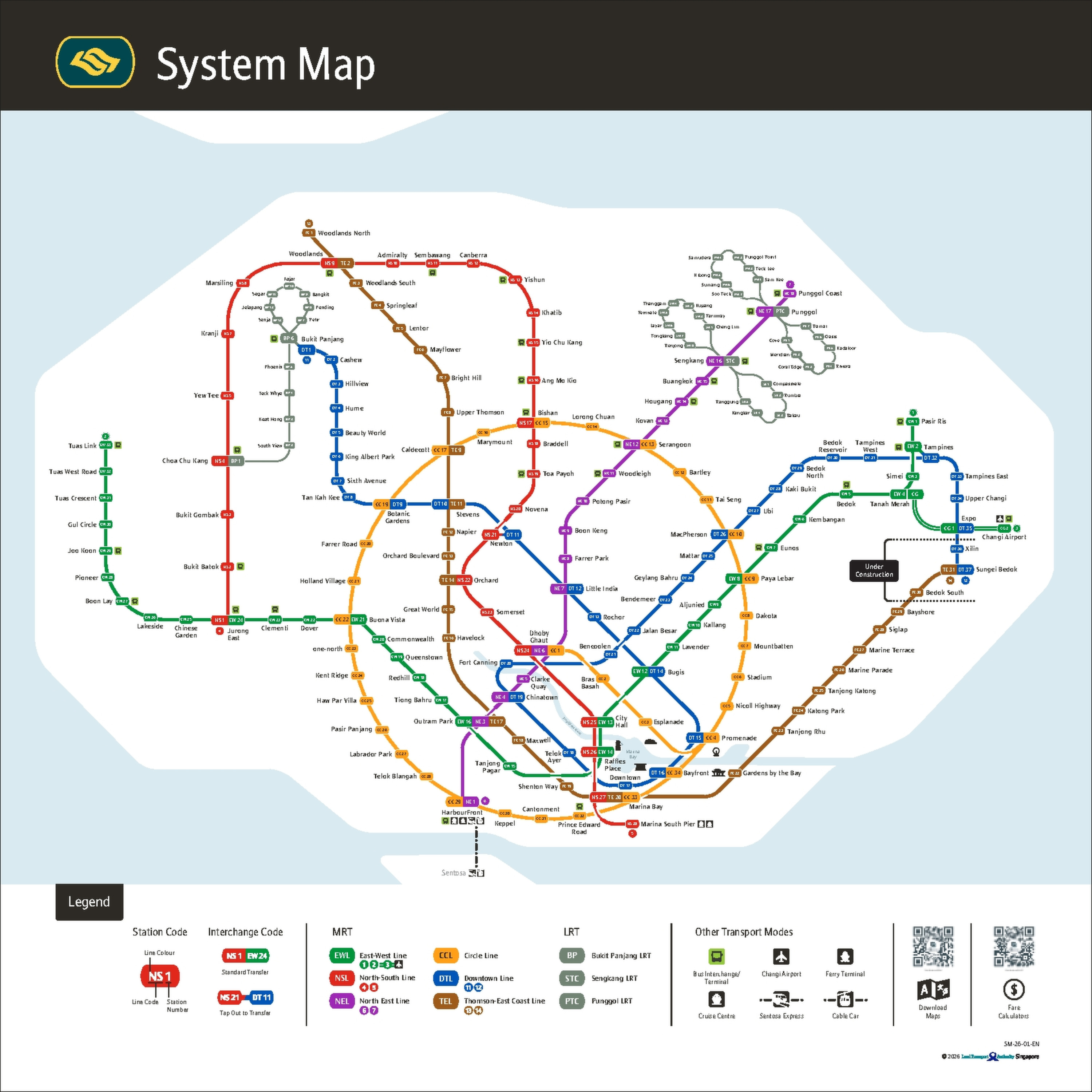
The Singapore MRT map above shows the six-line Mass Rapid Transit network, the Changi Airport branch and the open Circle Line ring. This guide explains the line colours and directions, visitor routes, current fares, operating hours and projects that are still under construction.
Contents
Circle Line 6 completed the ring on 12 July 2026, adding three stations and 4 km of track. The current Singapore MRT map shows the completed ring and the three new stations.
The Mass Rapid Transit system is Singapore’s principal metro network. It opened for passenger service on 7 November 1987 between Toa Payoh and Yio Chu Kang, initially with five stations.
Today the Singapore MRT has more than 170 stations on six lines and covers about 240 km. The MRT carried an average of 3.5 million passenger journeys per day in 2025.
The Land Transport Authority plans, builds and regulates the network and owns its operating assets. SMRT Trains operates four MRT lines, while SBS Transit operates two.
Start with the line colour and two-letter line code, then find the station code beside the name. Interchange symbols show where lines connect, while the terminus identifies the correct direction of travel.
The legend also distinguishes standard transfers from connections that require tapping out. Circle Line journeys may require a change at Promenade, so check the direction and branch before boarding.
For a departure-specific route, use LTA’s journey planning information after reading the printable diagram.
The MRT is the six-line main network. Bukit Panjang LRT, Sengkang LRT and Punggol LRT are separate feeder systems connecting local neighbourhoods with MRT stations and must not be counted as MRT lines.
In Singapore, “metro” generally refers to the MRT; the LRT feeders and Sentosa Express are separate systems.
Bukit Panjang LRT feeds the North-South and Downtown lines. The Sengkang and Punggol systems each serve 14 stations on two loops and connect with their respective North East Line stations.
The Singapore MRT reaches the main visitor districts and Changi Airport, but the practical route depends on the correct line, station and transfer. Use the Singapore MRT map to confirm the line colour, station code and interchange before setting out.
Central interchanges make many attractions reachable with one train change or none. The table lists lines, stations and practical notes for nine destinations.
| Attraction or destination | MRT line | Station | Practical note |
|---|---|---|---|
| Marina Bay Sands | Circle, Downtown | Bayfront CC34/DT16 | Exits C and D serve the complex. The Shoppes are about 1 minute away, while SkyPark and the ArtScience Museum are up to 10 minutes away on foot. |
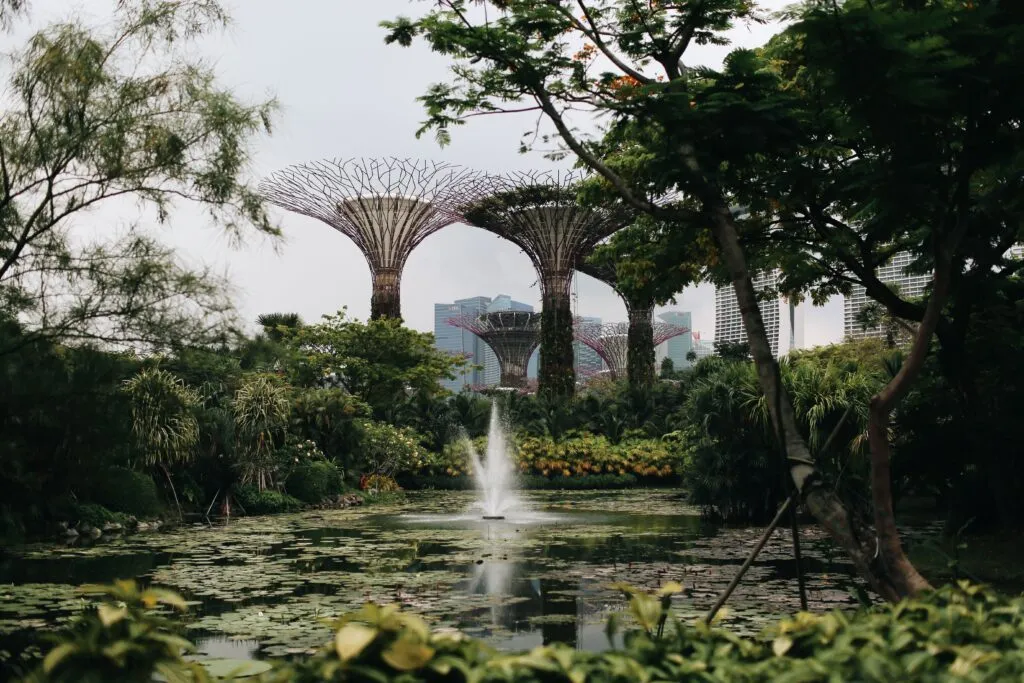
| Gardens by the Bay | Thomson-East Coast | Gardens by the Bay TE22 | Exit 1 is beside Satay by the Bay and leads into the gardens. |
| Merlion and Fullerton precinct | North-South, East-West | Raffles Place NS26/EW14 | Use Raffles Place for the Fullerton and Merlion precinct. |
| Chinatown | North East, Downtown | Chinatown NE4/DT19 | The central precinct attractions are within walking distance. |
| Little India | North East, Downtown | Little India NE7/DT12 | Both lines serve the neighbourhood from the same interchange. |
| ION Orchard | North-South, Thomson-East Coast | Orchard NS22/TE14 | ION Orchard stands directly beside the station. |
| Singapore Sports Hub and National Stadium | Circle | Stadium CC6 | For National Stadium, use Exit A for Gates 1-5 and 18-23, or Exit B for Gates 6-17; follow the venue signage for your gate. |
| Sentosa connection | North East, Circle | HarbourFront NE1/CC29 | Continue through VivoCity Level 3 to the separate Sentosa Express. |
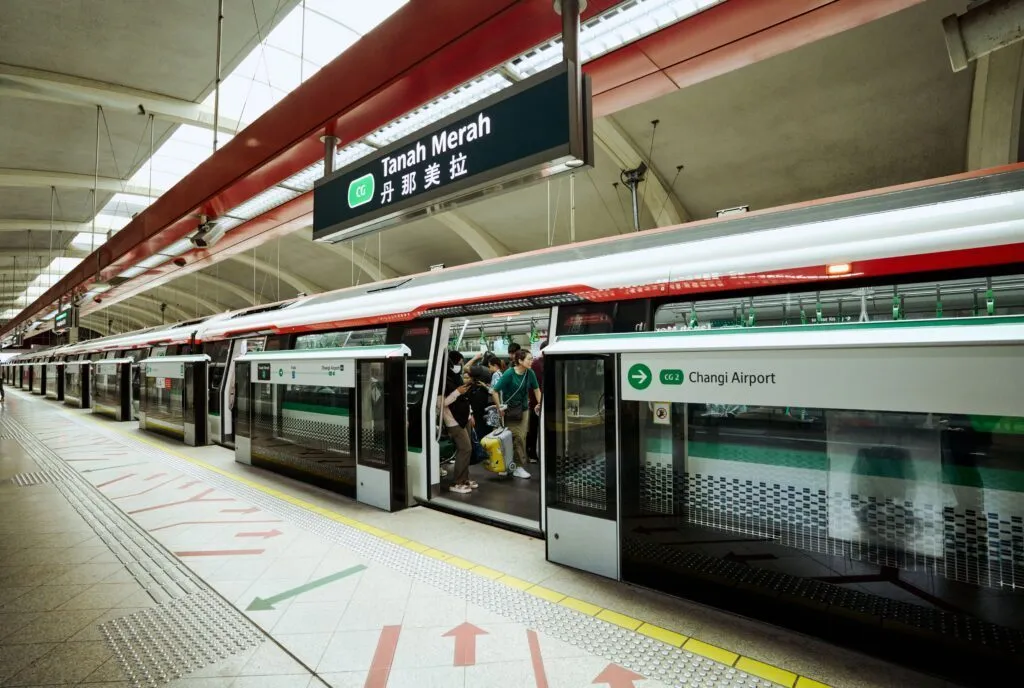
| Changi Airport | East-West | Changi Airport CG2 | Change at Tanah Merah for city trains; the station directly connects with Terminals 2 and 3. |
Take the East-West Line airport branch from Changi Airport CG2 through Expo to Tanah Merah EW4/CG. Change there to an East-West Line train towards Tuas Link for City Hall or Raffles Place.
Allow about 40 minutes for the Changi Airport-to-city MRT journey. The adult card fare is S$2.24 (≈US$1.73) to City Hall over 18.3 km, or S$2.27 (≈US$1.76) to Raffles Place over 19.3 km.
Changi Airport station lies in the basement area linking Terminals 2 and 3. From Terminal 1, take the free Skytrain to T2 or T3. From Terminal 4, use the free T4 to T2/MRT shuttle.
At Tanah Merah, follow the signs for the westbound East-West Line train towards Tuas Link. The concourse transfer applies between the Changi branch and Platform A towards Pasir Ris, not to the westbound city transfer.
The airport branch remains part of the East-West Line in 2026, despite future plans to convert it into a Thomson-East Coast Line extension.
All public trains are wheelchair-accessible, and every MRT and LRT station has a barrier-free route. SMRT stations provide at least one barrier-free entrance, lifts and wider fare gates.
Keep luggage clear of aisles and doors. Children below 0.9 m travel free with an accompanying fare-paying passenger. Taller children below seven who have not entered primary school need a Child Concession Card for free travel.
MRT and LRT adult card fares are distance-based. The Public Transport Council’s current fare table sets the 2026 range at S$1.28 to S$2.57 (≈US$0.99 to US$1.99), with transfers governed by the official distance-fare rules.
Visitors can tap an eligible contactless bank card or mobile wallet, buy an EZ-Link card, or choose a Singapore Tourist Pass.
A contactless card is usually the simplest choice for a short stay. An EZ-Link card offers prepaid travel value, while the Singapore Tourist Pass covers unlimited MRT, LRT and basic bus rides for consecutive calendar days, excluding specified premium services.
| Ticket | Price | Ticket purchase |
|---|---|---|
| Contactless bank card or mobile wallet | Distance fare S$1.28 to S$2.57 (≈US$0.99 to US$1.99); S$0.60 (≈US$0.46) per day of public-transport use with a foreign Mastercard or Visa card | No purchase or registration required; use an eligible card or wallet at the fare gate. |
| Adult EZ-Link card | S$10.00 (≈US$7.74), comprising a S$5.00 (≈US$3.87) card cost and S$5.00 (≈US$3.87) travel value | See official travel-card information |
| Singapore Tourist Pass (1 day) | S$17.00 (≈US$13.17) | Find official sales locations |
| Singapore Tourist Pass (2 days) | S$24.00 (≈US$18.59) | Find official sales locations |
| Singapore Tourist Pass (3 days) | S$29.00 (≈US$22.46) | Find official sales locations |
| Singapore Tourist Pass (4 days) | S$37.00 (≈US$28.66) | Find official sales locations |
| Singapore Tourist Pass (5 days) | S$45.00 (≈US$34.85) | Find official sales locations |
USD equivalents use the ECB reference rate dated 17 July 2026: S$1 ≈US$0.7745.
For most visitors, contactless payment is the simplest choice: use the same supported card or the same wallet device to enter and exit.
A S$0.60 (≈US$0.46) fee applies for each day a foreign Mastercard or Visa card is used for public transport, before any issuer fees.
Choose EZ-Link when a bank card is unsupported, prepaid spending is preferable, or repeated foreign-card daily fees would accumulate during a longer stay. Tap in and out for each rail journey; normal adult distance fares apply.
SimplyGo accepts contactless American Express, Mastercard, NETS and Visa, plus Apple Pay, Google Pay, Samsung Pay, Fitbit Pay and Garmin Pay. A SimplyGo account is not required for bank-card travel.
Do not tap in with a physical card and tap out with a phone wallet linked to it. The system treats them as different media. Bank-card fares may appear later in the SimplyGo app or at kiosks rather than immediately at the gate.
Choose the Singapore Tourist Pass for intensive travel or a fixed daily budget. The current pass is non-returnable and non-refundable, comes with no stored value and becomes a normal EZ-Link card after expiry. The former refundable-deposit model is outdated.
At the maximum adult fare, a S$17.00 one-day pass costs the same as 6.61 journeys, so it becomes cheaper on the seventh such journey.
The regular network operates roughly from 05:30 to midnight. Trains run every 2 to 3 minutes during the 07:00 to 09:00 morning peak and about every 5 to 7 minutes off-peak.
First and last trains vary by station, direction and day. At City Hall, the last listed train towards Changi Airport is 23:26, while Tanah Merah lists its last airport-bound train at 23:50.
Sunday starts can be later. City Hall’s first train towards Pasir Ris is 06:29 on Sunday compared with 06:01 from Monday to Saturday. Check the station-specific first and last trains before a time-critical trip.
The former SMRT NightRider and SBS Transit Nite Owl routes were discontinued in 2022. After rail service ends, regulated taxis and private-hire cars are the standard point-to-point alternatives.
The 2026 Singapore MRT map distinguishes open lines from projects still under construction. The dates below are current targets, not guaranteed opening days.
Fun Fact: Singapore’s East Coast Integrated Depot is the world’s first four-in-one depot, combining three train depots and one bus depot. It can accommodate around 220 trains and about 760 buses, saves 44 hectares of land and became operational in December 2025.
You might also be interested in these metro maps – for comparison or for your next trip:
Find the destination station, note the line colour and code, and use the terminus to choose direction. Tap the same card or wallet at entry and exit, and check service announcements before departure.
Use the PDF Download button directly below the viewer. The button opens LTA’s English System Map 2026, version dated 13 July 2026.
LTA provides the current MRT system map in English, Chinese, Bahasa Melayu and Tamil.
Adult card fares range from S$1.28 to S$2.57 (≈US$0.99 to US$1.99) by distance. Changi Airport to City Hall costs S$2.24 (≈US$1.73), with no separate airport surcharge.
No. Adults pay distance-based fares. Children below 0.9 m travel free with a fare-paying passenger, while eligible taller children need a Child Concession Card for free travel.
Yes. SimplyGo accepts eligible contactless American Express, Mastercard, NETS and Visa cards. Use the same card or wallet device for both taps. A S$0.60 (≈US$0.46) fee applies for each day a foreign Mastercard or Visa card is used for public transport.
Yes. MRT stands for Mass Rapid Transit and is Singapore’s metro system. LRT lines are separate neighbourhood feeders and are not included in the six-line MRT count.
Singapore MRT has more than 170 stations across six lines and covers about 240 km.
Changi Airport CG2 connects directly with Terminals 2 and 3.
Take the East-West Line branch via Expo to Tanah Merah, then change towards Tuas Link for central Singapore. Allow about 40 minutes. City Hall costs S$2.24 (≈US$1.73), while Raffles Place costs S$2.27 (≈US$1.76). From T1, use the free Skytrain; from T4, use the free T4 to T2/MRT shuttle. Load the map, check the route and confirm the station-specific last train before a late journey.