Bangkok Metro Map 2026 (BTS & MRT): Lines & Tickets
Last updated: July 23, 2026

Last updated: July 23, 2026
Current Bangkok rail service updates
The proposed network-wide THB 20 fare (≈ USD 0.59) was canceled before launch in June 2026. The current limited measure is the qualifying Purple and Red Line daily cap described above. Read the fare policy notice.
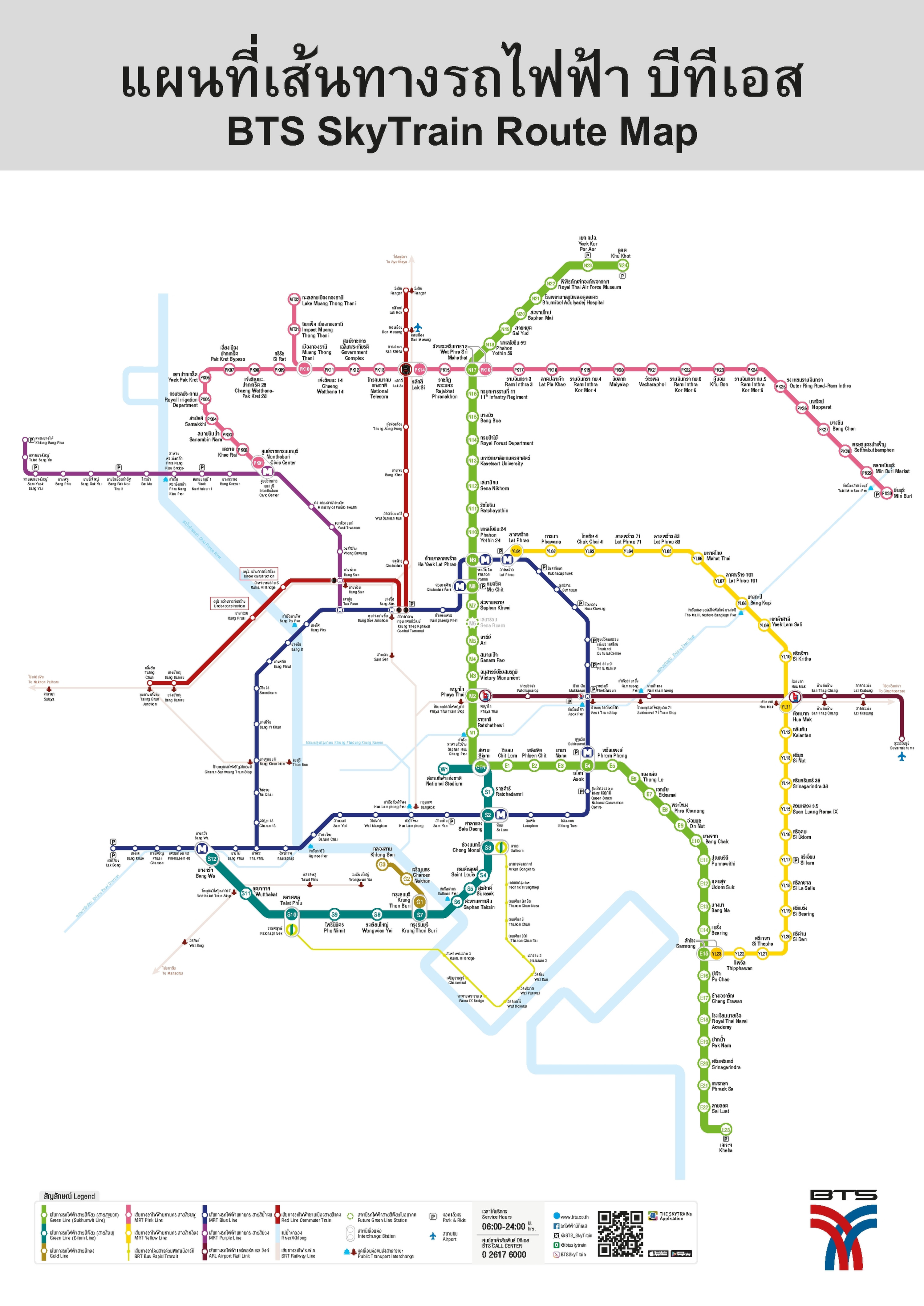
Bangkok Metro Map is a useful umbrella label, not one unified operator. BTS refers to Bangkok Mass Transit System, while MRT stands for Mass Rapid Transit. A Bangkok BTS map covers the Skytrain network, while a Bangkok MRT map covers four MRT lines. Airport and commuter services remain separate.
Contents
Two separate rapid transit systems form one rail backbone: Bangkok’s elevated BTS Skytrain and the MRT network. Airport Rail Link and the State Railway of Thailand Red Lines add airport and commuter connections without becoming BTS or MRT services.
Bangkok Mass Transit System Public Company Limited (BTSC) operates the BTS core, which opened on 5 December 1999. BTSC reports that its two principal lines cover about 68.5 km and serve 60 fully operating stations.
MRT includes heavy rail and monorail. The Mass Rapid Transit Authority of Thailand (MRTA) is the authority. Bangkok Expressway and Metro Public Company Limited (BEM) operates the Blue and Purple lines.
The Bangkok BTS map needs both green core lines and the Gold feeder. Gold is not a third Skytrain trunk line and has its own fare.
The Bangkok MRT map must distinguish the four MRT lines. Blue and Purple use BEM operations, while Yellow and Pink are driverless monorails with separate concession structures.
Airport Rail Link, abbreviated ARL, connects Suvarnabhumi Airport with Phaya Thai through eight stations over 28.6 km. State Railway of Thailand owns it and Asia Era One operates it.
The State Railway of Thailand (SRT) Red Lines are commuter rail. Dark Red links Krung Thep Aphiwat, Don Mueang Airport and Rangsit. Light Red runs to Taling Chan. An SRT operating subsidiary manages both.
| System | Lines | Operator | Ticket and payment |
|---|---|---|---|
| BTS Skytrain | Sukhumvit, Silom | BTSC | BTS Single Journey Card, BTS One-Day Pass or Rabbit Card |
| Gold Line | Gold | BTSC operations and maintenance | Rabbit and Gold Line ticket media |
| MRT Heavy Rail | Blue, Purple | BEM under MRTA | Token, MRT EMV Card or eligible contactless EMV |
| MRT Monorails | Yellow, Pink | Yellow and Pink concessionaires, with BTSC operations and maintenance | Rabbit, eligible contactless EMV and limited BTS-group through-ticket rules |
| Airport Rail Link | ARL City Line | Asia Era One under SRT | Token, Smart Pass or contactless bank card |
| SRT Red Lines | Dark Red, Light Red | SRT operating subsidiary under SRT | SRT ticket media or qualifying EMV; Purple and Red daily-cap rules may apply |
The viewer uses BTSC’s one-page bilingual PDF. Unlike a Bangkok BTS map or Bangkok MRT map alone, it includes all operational lines in those groups, ARL, SRT Red and the open Pink branch to Impact and Lake Muang Thong Thani.
Orange Line does not appear because its eastern and western sections remain projects. The PDF also uses symbols for some future or construction context, so the legend must be checked before assuming that every depicted element is open.
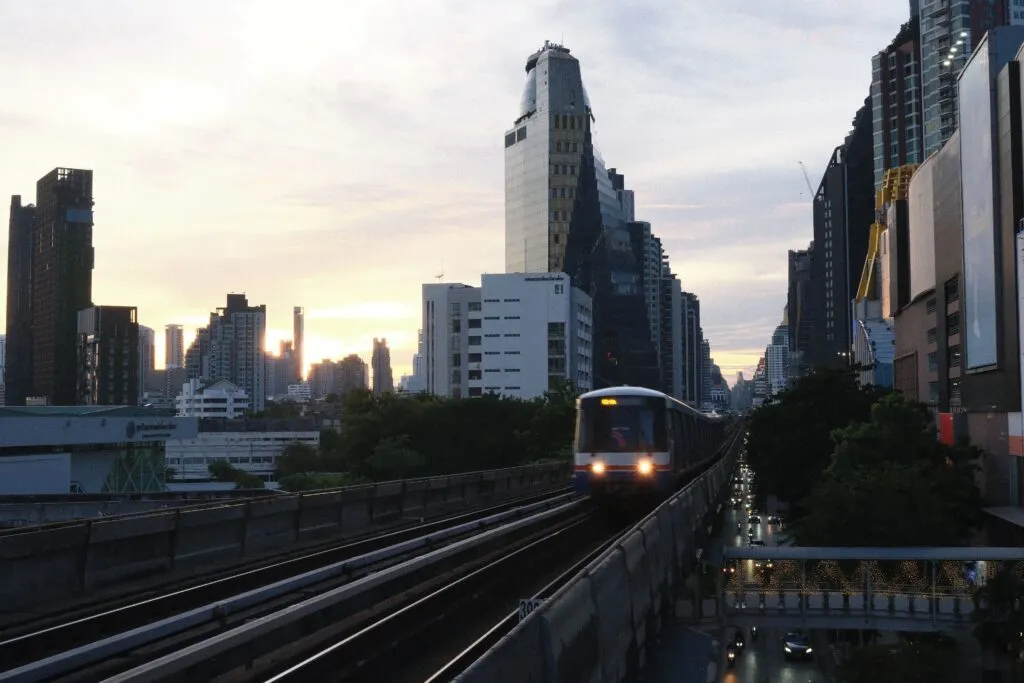
Match the destination to a station, then confirm the line, interchange and ticket. A Bangkok BTS map helps with Siam and Sukhumvit, while a Bangkok MRT map clarifies routes to the Old Town and Chinatown.
Thailand’s Ministry of Tourism and Sports recorded 43,043,755 tourists in Bangkok in 2025. Rail reaches historic districts, shopping areas, markets, convention facilities and Chao Phraya River boats, although several destinations still require walking or a separate boat ticket.
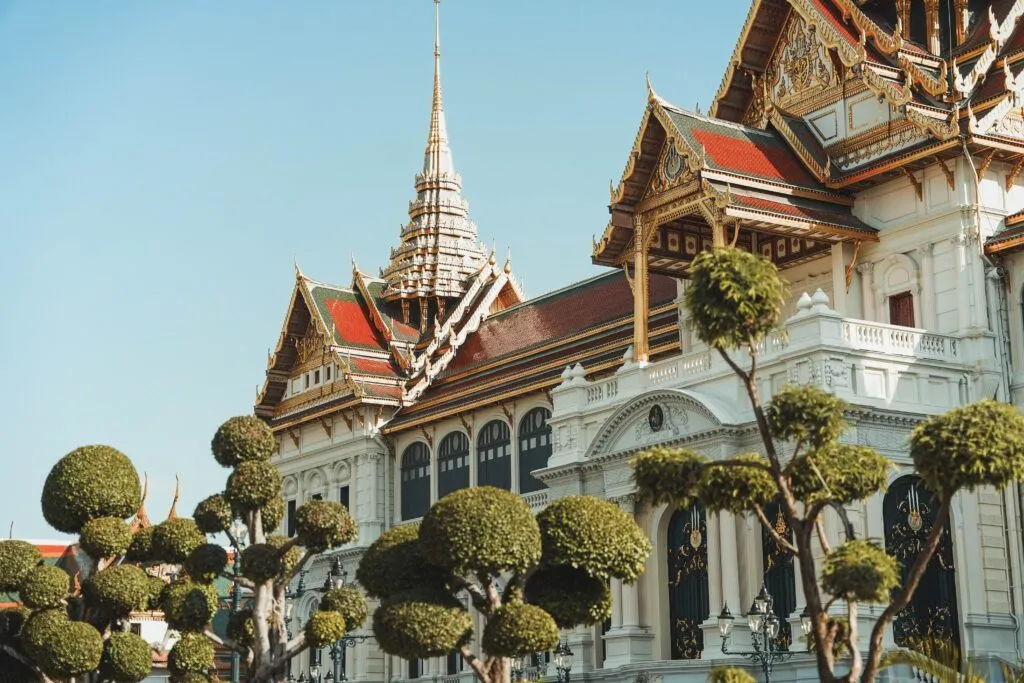
For travelers asking which MRT station is especially striking, Sanam Chai is a strong candidate rather than an objective winner. MRTA describes the station as a showcase of distinctive Thai architectural design.
| Attraction or destination | Line | Station | Practical tip |
|---|---|---|---|
| Grand Palace and Wat Pho | MRT Blue Line | Sanam Chai BL31 | Exit 1 serves Wat Pho; the Grand Palace requires an outdoor walk. |
| Chatuchak Weekend Market | MRT Blue Line | Kamphaeng Phet BL12 | Exits 1 and 2 provide the most direct market access. |
| Chatuchak Weekend Market | BTS Sukhumvit Line | Mo Chit N8 | Use Exit 1 and continue along Chatuchak Park. |
| Siam shopping district | BTS Sukhumvit and Silom Lines | Siam CEN | Both BTS core lines meet here; exits serve Siam Paragon, Siam Center and Siam Discovery. |
| MBK Center | BTS Silom Line | National Stadium W1 | Exit 4 connects to a covered skywalk. |
| Chinatown and Yaowarat | MRT Blue Line | Wat Mangkon BL29 | Exit 1 serves Yaowarat and the Old Market. |
| Sukhumvit and Asok | BTS Sukhumvit and MRT Blue Lines | Asok E4 / Sukhumvit BL22 | MRT Exit 3 connects to BTS Asok and Terminal 21; a separate ticket or payment method is required. |
| Chao Phraya River boats | BTS Silom Line | Saphan Taksin S6 | Connect to Sathorn Pier; boat tickets are separate. |
| ICONSIAM | Gold Line | Charoen Nakhon G2 | Transfer from BTS at Krung Thon Buri and use Exit 3. |
| Queen Sirikit National Convention Center | MRT Blue Line | QSNCC BL23 | Exit 3 serves the venue directly. |
| Lumphini Park | MRT Blue Line | Si Lom BL26 or Lumphini BL25 | Choose the station according to the park entrance required. |
ARL leaves Suvarnabhumi Airport from Level B1 and reaches Phaya Thai in no more than 30 minutes. Phaya Thai connects with BTS Sukhumvit; Makkasan connects with MRT Blue at the differently named Phetchaburi station.
Don Mueang Airport uses Dark Red to Krung Thep Aphiwat. An internal connection near Ticket Office 2 leads to MRT Blue at Bang Sue. There is no direct BTS platform.
DMK international arrivals use Terminal 1, while the rail connection is toward the Terminal 2 side. No official walking time is verified, so a fixed estimate would be misleading.
| Airport | Rail route | Central interchange | Typical time | Fare | Transfer reality |
|---|---|---|---|---|---|
| BKK Suvarnabhumi | ARL City Line to Phaya Thai | BTS Sukhumvit at Phaya Thai | No more than 30 minutes | THB 45 (≈ USD 1.33) | One system change; ARL starts on terminal Level B1. |
| BKK Suvarnabhumi | ARL City Line to Makkasan | MRT Blue at Phetchaburi BL21 | Shorter than the full route; no verified station-pair time | THB 35 (≈ USD 1.04) | Makkasan and Phetchaburi have different names; follow signs to MRT Exit 1. |
| DMK Don Mueang | SRT Dark Red to Krung Thep Aphiwat | MRT Blue at Bang Sue BL11 | No verified station-pair time | THB 33 (≈ USD 0.98) | Internal connection to MRT; no direct BTS platform. |
BTS and MRT have no universal ticket in July 2026. BTS uses single-journey cards, the BTS One-Day Pass and Rabbit. The pass allows unlimited trips on its activation date and is sold at BTS ticket offices.
MRT accepts a token, MRT EMV Card or eligible contactless card. International Visa and Mastercard credit cards are documented for direct gate payment. The same physical card must be tapped at entry and exit.
Since 1 June 2026, one eligible EMV card can work across MRT Blue, Purple, Yellow and Pink. It still is not a universal BTS and MRT ticket.
| Ticket | Price | Buy ticket |
|---|---|---|
| BTS adult Rabbit journey | THB 17 to 65 (≈ USD 0.50 to 1.92), depending on the journey | Available at the station |
| New Adult Rabbit Card | THB 200 (≈ USD 5.92), including THB 100 issuance fee (≈ USD 2.96) and THB 100 initial value (≈ USD 2.96) | Available at the station |
| Gold Line journey | THB 15 (≈ USD 0.44) flat fare | Available at the station |
| MRT Blue or Purple single journey | The fare depends on distance; the current amount is calculated for the selected stations | Check current fare |
| MRT Pink or Yellow journey | THB 15 to 45 (≈ USD 0.44 to 1.33), depending on distance | Available at the station |
| MRT EMV Visa prepaid card | THB 250 (≈ USD 7.40), including THB 150 fee (≈ USD 4.44) and THB 100 value (≈ USD 2.96) | Available at the station |
| Airport Rail Link journey | THB 15 to 45 (≈ USD 0.44 to 1.33), depending on station | Available at the station |
| SRT Red Line adult journey | THB 12 to 42 (≈ USD 0.36 to 1.24), depending on station | Available at the station |
| Purple and Red adult daily cap | Maximum THB 40 per day (≈ USD 1.18) with the same qualifying card, through 30 November 2026 | Applied through qualifying payment media |
BTS machines sell single journeys for coins, banknotes or QR payment. QR payment is made at the machine, not directly at Green Line gates. Ticket offices issue tickets and top up Rabbit from 06:00 to 24:00.
A foreign visitor can register Rabbit with an original passport and contact details. It has no deposit, accepts up to THB 4,000 (≈ USD 118.40) and keeps value valid for two years after the last transaction.
The MRT EMV Visa prepaid card needs passport activation, same-day app identity verification and a Thai mobile number for top-up and use on Yellow, Pink and Red.
Bangkok has no network-wide THB 20 fare (≈ USD 0.59) in 2026. The Royal Thai Government’s 23 June 2026 notice confirms that the wider second phase was canceled before launch.
The earlier Purple and Red pilot ran from October 2023 through 30 November 2025. From 1 December 2025 through 30 November 2026, Purple and both Red branches instead use an adult daily cap of THB 40 (≈ USD 1.18).
The same qualifying MANGMOOM EMV, MRT EMV or contactless EMV card must be used throughout the day. A future integrated-fare principle remains policy work, not a current retail fare.
Bangkok rail is not a 24-hour network. First and last trains depend on station and direction.
No verified system provides regular overnight service. The exact station and direction determine the final departure.
MRTA records that Pink’s Muang Thong branch has operated since 17 June 2025. Yellow’s proposed 2.6 km extension from Ratchada-Lat Phrao to Ratchayothin remains under negotiation without a verified opening date.
Orange Line is not open. MRTA’s April 2026 update put its 22.5 km eastern section at 48.7 percent complete, with January 2028 as the target. The 13.4 km western section was 26.7 percent complete at the end of March, targeting July 2030.
Purple South toward Rat Burana and Khru Nai is under construction. MRTA’s June 2026 progress report put civil work at 75.9 percent, with November 2030 as the target.
The Royal Thai Government reported that SRT signed Red Line extension contracts in May 2026, but no actual construction start was verified. The Red Line extensions are contracted, not operational.
Fun Fact: Bangkok’s Blue Line stations were not designed as interchangeable boxes. MRTA says the architecture should reflect each district’s identity, highlighting Sanam Chai, Wat Mangkon, Sam Yot and Itsaraphap as four distinctive stations from the 2019 extension.
Taken together, BTS fits Siam and Sukhumvit, MRT Blue serves the Old Town and Chinatown, ARL links BKK, and SRT Dark Red plus MRT handles DMK. Travelers should plan for separate ticket logic at system changes.
You might also be interested in these metro maps – for comparison or for your next trip:
Neither is universally better. BTS is direct for Siam, Sukhumvit and Saphan Taksin; MRT Blue serves Chinatown, Sanam Chai and Chatuchak. The destination and required transfers determine the better option.
The Bangkok BTS map has Sukhumvit and Silom plus Gold. The Bangkok MRT map has Blue and Purple heavy rail plus Yellow and Pink monorails. Operators and fare media differ.
Passengers can use a single-journey token, MRT EMV Card or eligible contactless card. International Visa and Mastercard credit cards are documented. The same physical contactless card must be tapped at both entry and exit.
Ordinary direct bank-card tapping is not documented at BTS Green Line gates. Current BTS media are the Single Journey Card, BTS One-Day Pass and Rabbit Card. QR payment is available for buying a single journey at current machines.
There is no single citywide fare. BTS Rabbit journeys cost THB 17 to 65 (≈ USD 0.50 to 1.92); Pink, Yellow and ARL cost THB 15 to 45 (≈ USD 0.44 to 1.33).
Adult Rabbit fares across the BTS core and extensions range from THB 17 to 65 (≈ USD 0.50 to 1.92), depending on the journey. Gold Line has a separate THB 15 fare (≈ USD 0.44).
No. Verified line windows start around 05:00 or 06:00 and end around midnight or 01:00. Exact last trains depend on the line, station and direction.
Neither system is always cheaper because fares depend on route, distance and current payment rules. A station-pair comparison is more accurate than a system-wide claim.
Take ARL from terminal Level B1. Phaya Thai connects with BTS Sukhumvit and costs THB 45 (≈ USD 1.33), with a full journey of no more than 30 minutes. Makkasan connects with MRT Phetchaburi and costs THB 35 (≈ USD 1.04).
Take SRT Dark Red from Don Mueang to Krung Thep Aphiwat for THB 33 (≈ USD 0.98). Continue internally to MRT Blue at Bang Sue. There is no direct BTS platform, and no verified station-pair travel time is stated.