Montreal Metro Map 2026: Lines, Tickets and Prices
Last updated: 17 July 2026

Last updated: 17 July 2026
Current service updates
Check STM’s current service and live elevator status before traveling. At Berri-UQAM, elevators serve the Orange and Green lines, but there is no accessible elevator connection to the Yellow Line.
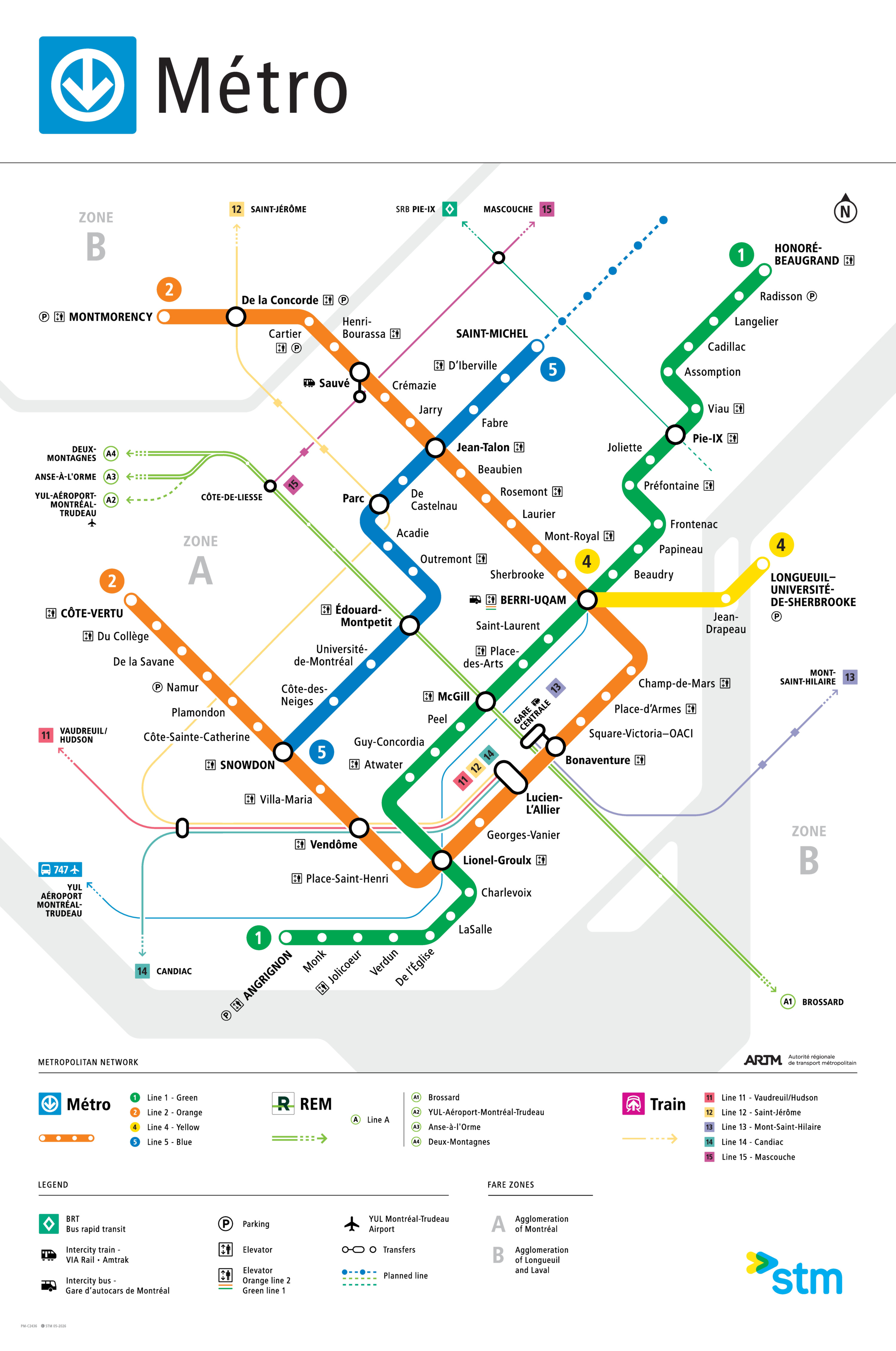
The Montreal Metro map is available above as an official English STM PDF for zooming, printing or offline use. It shows the four STM Metro lines, while REM, trains and BRT use separate symbols in the metropolitan legend.
Montreal’s Metro was designed as the opposite of a standardized subway: multiple architects were commissioned to make its stations different from one another. Behind that visual variety the embedded STM map stays easy to read, because it shows exactly four numbered, color-coded STM Metro lines and codes the REM, trains and BRT as separate legend systems, so the REM reads as its own network rather than a fifth Metro line.
The Société de transport de Montréal, usually shortened to STM, operates the rubber-tired Metro. The system opened on 14 October 1966 with 20 stations, and its current STM network profile lists four lines, 68 stations, 71 km and 30 accessible stations.
STM reports 293.9 million trips for its entire regular network, not for the Metro alone, so that figure should not be presented as Metro-only ridership.
Anyone looking for a Montreal subway map should follow the numbered, color-coded Metro lines for underground journeys, and treat the separately coded REM, train and BRT symbols as connecting networks rather than Metro routes.
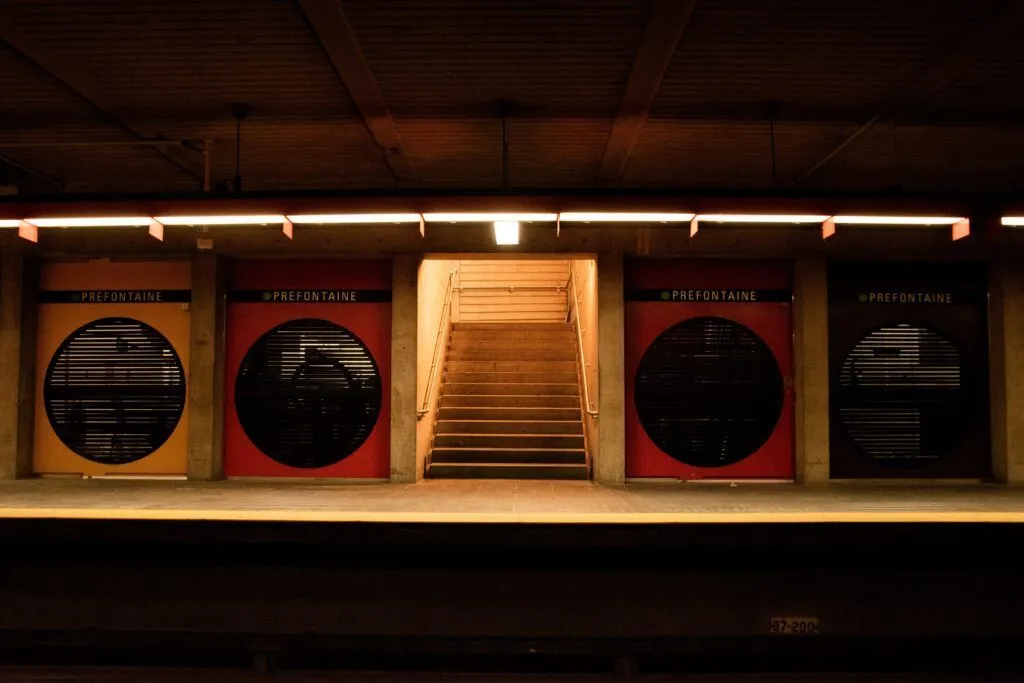
The map displays exactly four STM lines. Each line keeps the same number, color and termini throughout the official network information.
The line totals overlap at interchange stations, so adding the four line-level station counts does not produce the network total of 68 unique stations. This is why the network profile and the line lists answer different questions.
The Metro is the best way to get around central Montreal: its four lines link most visitor districts, and buses, the 747 airport route or a short walk cover the final stretch. Start with the Montreal Metro map, identify the destination station, check the required ARTM zone, then follow the line number and terminus shown on station signs.
For first-time visitors, the historic core of Old Montreal, home to the Old Port and Notre-Dame Basilica, sits a short walk from Champ-de-Mars or Place-d’Armes on the Orange Line, and the destination table below maps ten more attractions to their access station. For an uncomplicated trip, choose the station before entering the paid area and confirm whether the route remains in Zone A. Keep the physical fare medium ready for validation, and check STM service information if elevators are important for the journey.
REM is a separate regional light-metro system, not another name for the Metro. The official map can show a connection between the two networks without treating them as one operation.
Tourisme Montréal counted 11.9 million overnight tourists in 2025, excluding day visitors, but the practical issue for each traveler is the station and connecting mode for a particular destination rather than the citywide total.
| Destination | Line | Station | Practical note |
|---|---|---|---|
| Notre-Dame Basilica | Line 2, Orange | Place-d'Armes | Place-d'Armes is the basilica's listed Orange Line station. |
| Old Port of Montreal | Line 2, Orange | Champ-de-Mars | Official estimate: an 8-minute walk from Champ-de-Mars. |
| Montreal Museum of Fine Arts | Line 1, Green | Guy-Concordia | Also reachable from Peel; Guy-Concordia is the closest. |
| Jean-Talon Market | Lines 2, Orange and 5, Blue | Jean-Talon | Orange-Blue interchange; De Castelnau also serves the market. |
| Montreal Biodôme | Line 1, Green | Viau | Official venue access station. |
| Montreal Botanical Garden | Line 1, Green | Pie-IX | Official venue access station. |
| Olympic Stadium | Line 1, Green | Pie-IX | Olympic Park also lists Viau; Pie-IX is the inner-corridor station. |
| Biosphère | Line 4, Yellow | Jean-Drapeau | Official estimate: a 3-minute walk from Jean-Drapeau. |
| Saint Joseph's Oratory | Line 5, Blue | Côte-des-Neiges | Continue on bus 165 or 435, or a 10-minute walk. |
| Mount Royal Park | Line 2, Orange | Mont-Royal | Continue on bus 11, which STM says runs year-round, seven days a week. |
YUL Montréal-Trudeau has no operating Metro or REM station at the terminal as of 17 July 2026. The 747 bus runs 24/7 and links the airport with STM at Lionel-Groulx or Berri-UQAM.
Route 747-2 reaches Lionel-Groulx in about 30 to 35 minutes. Route 747-1 serves downtown and Berri-UQAM in about 45 to 70 minutes depending on traffic, with 11 stops including Lionel-Groulx. STM gives a general headway of 10 to 20 minutes.
At YUL, board at door 28. Lionel-Groulx connects with the Green and Orange lines. Since 26 January 2026, the temporary downtown stop is 52905 at René-Lévesque and Berri, with Berri-UQAM Exit B on Rue Sainte-Catherine Est specified by STM.
Fares depend on the ARTM zones covered and the duration of the product. The prices below follow the English ARTM fare schedule updated on 30 June 2026 and effective from 1 July 2026.
Montreal is Zone A. Longueuil-Université-de-Sherbrooke, Cartier, De la Concorde and Montmorency are in Zone B, so travel from Montreal to any of those stations requires All Modes AB. All Modes can cover bus, Metro, REM and commuter train in the named zones without merging their operations.
An OPUS card costs CA$6.00, is valid for four years, is non-refundable and can hold up to four different fares. Short-term cross-zone fares require a designated OPUS card or an occasional card rather than any standard OPUS configuration.
| Ticket | Price | Ticket purchase |
|---|---|---|
| 1-trip, All Modes A | CA$3.75 (≈ US$2.67) | Metro vending machine or station agent; authorized retailer; exact coins on an STM bus; Chrono reload to OPUS. |
| 2-trip, All Modes A | CA$7.00 (≈ US$4.99) | Metro vending machine or station agent; authorized retailer; Chrono reload to OPUS. |
| 10-trip, All Modes A | CA$35.00 (≈ US$24.93) | Load onto OPUS at the Metro, an authorized retailer or with Chrono. |
| 24-hour, All Modes A | CA$11.25 (≈ US$8.01) | Metro vending machine or station agent; authorized retailer; YUL vending machine; Chrono reload to OPUS. |
| 3-day, All Modes A | CA$21.75 (≈ US$15.49) | Metro vending machine or station agent; point of sale; YUL vending machine; Chrono reload to OPUS. |
| Weekly, All Modes A | CA$33.25 (≈ US$23.69) | Load onto OPUS at the Metro, an authorized retailer or with Chrono. |
| Unlimited Evening, zones A to D | CA$6.75 (≈ US$4.81) | Metro vending machine or station agent; authorized retailer; Chrono reload to OPUS. |
| Unlimited Weekend, zones A to D | CA$17.00 (≈ US$12.11) | Metro vending machine or station agent; authorized retailer; YUL vending machine; Chrono reload to OPUS. |
| 1-trip, All Modes AB | CA$5.00 (≈ US$3.56) | Buy on an occasional card or load a compatible designated OPUS card. |
CAD is the sale currency. The approximate USD values use the Bank of Canada rate from 16 July 2026, when US$1 equaled CA$1.4038.
Buy or load fares at Metro vending machines, station agents and authorized retailers as specified for each product. On an STM bus, the 1-trip Zone A fare can be paid with exact coins. Validate the physical card when traveling.
Chrono is the official ARTM app for reloading a physical OPUS card by NFC. For Metro gate access the physical OPUS card, not the phone, stays the fare medium you validate. The verified official listings are available for iOS and Android.
The CA$11.25 24-hour Zone A fare also covers the 747 airport bus.
Operating times and frequencies differ by line, direction, day and period. STM publishes terminal-specific first and last departures, so there is no single opening and closing time for the whole network.
STM defines weekday peak periods as 07:00 to 09:00 and 16:00 to 18:00. It groups morning, day and evening under non-peak service and does not publish a separate late-night Metro frequency band.
After the last trains, STM directs passengers to a separate network of 23 night routes running every night. Intervals across that network range from 4 to 45 minutes, while route 358 is specifically listed every 15 minutes.
The Blue Line extension and the separate REM are different projects. The Blue Line remains part of STM, while REM is an electric, fully automated light-metro system with different project and operating organizations.
STM is extending the Blue Line east from Saint-Michel to Anjou. The project adds five accessible future stations named Vertières, Mary-Two-Axe-Earley, Cesira-Parisotto, Madeleine-Parent and Anjou, with a tunnel of approximately 6 km.
In May 2026, STM said tunnel boring machine Lisette was ready to begin its 4.6 km drive between Vertières and Anjou. The current completion target is 2031. No later distance estimate should be inferred from that construction update.
REM has 23 stations and 64 km in service as of July 2026. Brossard to Gare Centrale opened in July 2023, Gare Centrale to Deux-Montagnes in November 2025 and Bois-Franc to Anse-à-l’Orme in May 2026.
The REM airport branch remains under construction, integration and testing. A train movement in January 2026 was a validation run, not passenger service. Commissioning is scheduled for 2027 and remains conditional on project milestones, with no verified opening month or day.
The official future downtown to YUL estimate is about 20 minutes, but it is not a current airport option. Travelers should use the 747 connection described above until passenger service is officially operating.
No. REM is not part of the STM network and is not a fifth Metro line. It is a separate, electric, fully automated light-metro system, even though integrated fares and interchange stations connect it with STM services.
CDPQ Infra is the REM developer and principal contractor, NouvLR builds the system, and Pulsar operates and maintains it. Transfers with STM are available where the REM’s Gare Centrale connects to the Orange Line at Bonaventure, at McGill on the Green Line, and at Édouard-Montpetit on the Blue Line.
The official STM map uses separate coding for Metro and REM. A traveler may transfer between them, but the systems have different maps, responsibilities and operating structures.
Fun Fact: The Montreal Metro now contains 100 works of art. STM marked the milestone after Francis Montillaud’s Point de mire was installed at Pie-IX station, continuing a tradition in which artists and station designers shape each station’s identity together.
You might also be interested in these metro maps – for comparison or for your next trip:
Pay with a valid physical fare medium for the required ARTM zone and validate it for travel. A 1-trip All Modes A fare costs CA$3.75 (≈ US$2.67), while cross-zone journeys to specified Zone B stations require All Modes AB.
Metro vending machines, station agents and authorized retailers sell or load the relevant products. Exact coins are accepted for the 1-trip Zone A fare on an STM bus. Chrono can reload physical OPUS by NFC but does not turn the phone into a ticket.
Buy tickets from a Metro vending machine, a station agent or an authorized retailer. Selected products can also be reloaded to a compatible physical OPUS card through the official Chrono app.
The ticket table above identifies the purchase channels verified for each fare. A designated OPUS card or occasional card is needed for short-term cross-zone fares, so the standard card does not cover every product configuration.
Tourists can use the official map to match a destination with a line and station, confirm the correct zone, then follow signs toward the line’s terminus. The destination matrix gives ten verified examples.
Some journeys continue by bus or on foot. The Montreal subway map can also show separate REM, train and BRT symbols, so check the legend instead of assuming every colored connection is an STM Metro line.
The 24-hour All Modes A fare costs CA$11.25 (≈ US$8.01), effective 1 July 2026. It covers Zone A travel and the 747 airport bus within the product conditions.
The USD value is an approximation calculated with the Bank of Canada rate from 16 July 2026. For a cross-zone journey, check whether an All Modes AB or other product is required rather than relying on the Zone A day fare.
YUL has no operating Metro or REM station at the terminal as of 17 July 2026. Take the 747 airport bus: route 747-2 to Lionel-Groulx in about 30 to 35 minutes, or 747-1 toward downtown and Berri-UQAM in about 45 to 70 minutes depending on traffic.
Both connections provide access to STM. The REM airport branch is scheduled for conditional commissioning in 2027, but it is still under construction, integration and testing and is not a current passenger option.
No. REM is a separate electric, fully automated light-metro system, not an STM Metro line. Interchanges and integrated fares connect the systems without merging their operators, maps or responsibilities.
The official map distinguishes the systems in its legend. Use STM information for the four Metro lines and REM information for journeys that continue on the separate regional network.
The official STM map gives the clearest starting point for choosing one of the four Metro lines and locating the right station, and the printable English PDF also works as an offline reference when mobile service is unavailable.
For a complete trip, combine the map above with the dated fare table, destination matrix and current service information on this page. Check the ARTM zone before buying a fare, and keep REM and YUL’s present 747 connection separate from the STM network.