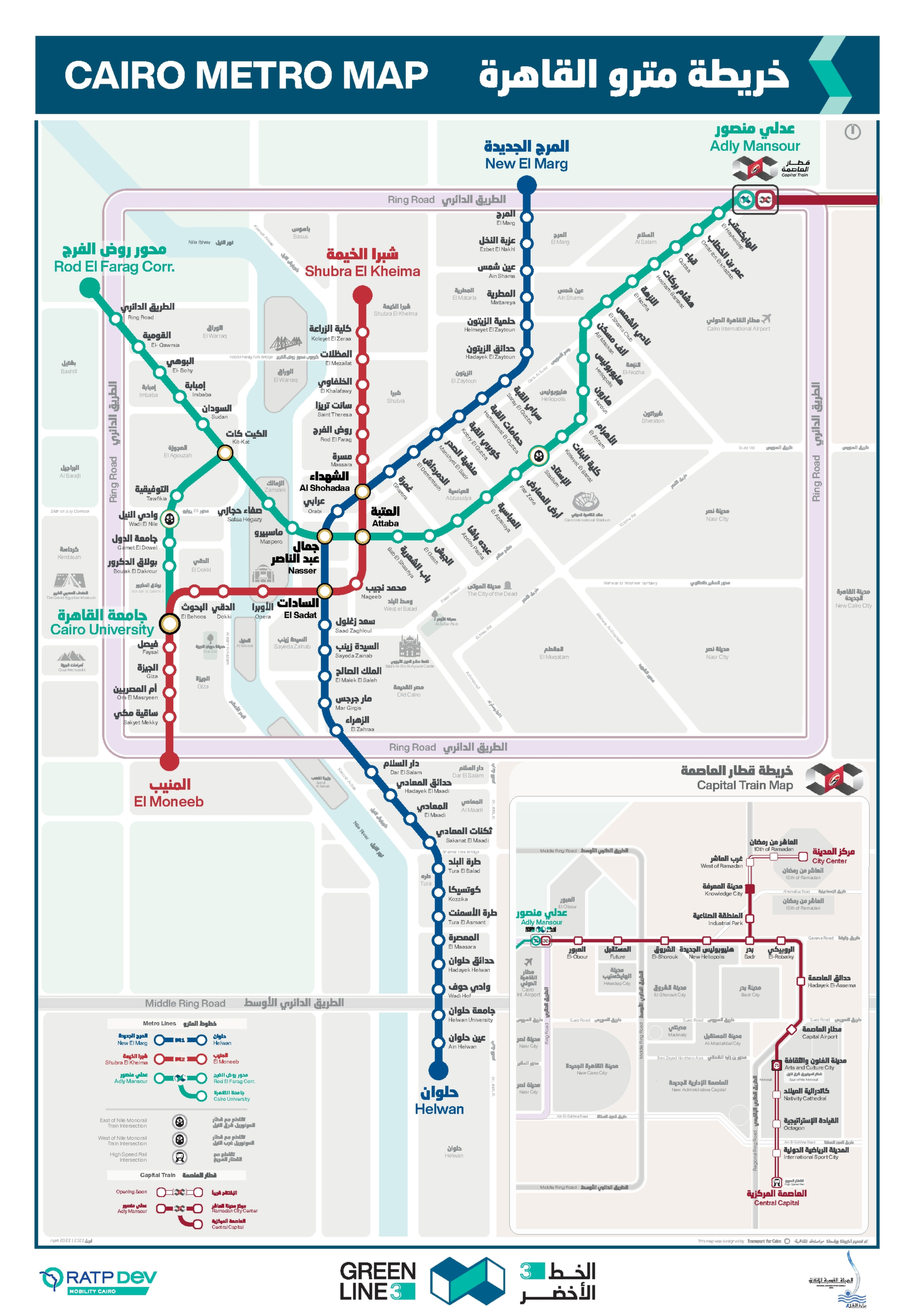
Cairo Metro Map 2026: Lines, Tickets & Prices
Last updated: August 20, 2026

Last updated: August 20, 2026
Cairo Metro Service Updates
Green Line 3 posts operational notices on its service updates page. Check current notices before starting a trip.
The Cairo Metro map PDF shows the three operating Metro lines, not every rail project in Greater Cairo. This guide covers current fares, operating hours and practical transfers for major visitor destinations.
Cairo built Africa’s first full metro system in the late 1980s. The first phase of Line 1 was completed on October 1, 1987, establishing the core of a rapid-transit network that now crosses Cairo and Giza.
The operating Metro has three lines totaling 106.7 km and 89 line stops: 44 km and 35 stations on Line 1, 21.5 km and 20 stations on Line 2, and 41.2 km and 34 stations on Line 3.
Counting the five shared interchange stations only once produces a calculated total of 84 physical stations.
The Egyptian Company for Metro Management and Operation operates Lines 1 and 2. RATP Dev Mobility Cairo operates Green Line 3, while the National Authority for Tunnels is part of Egypt’s Ministry of Transport and owns the Metro network.
According to the State Information Service, more than 4.5 million passengers used the Metro daily in December 2025. Green Line 3 alone carries more than 500,000 passengers daily, with peaks up to 650,000.
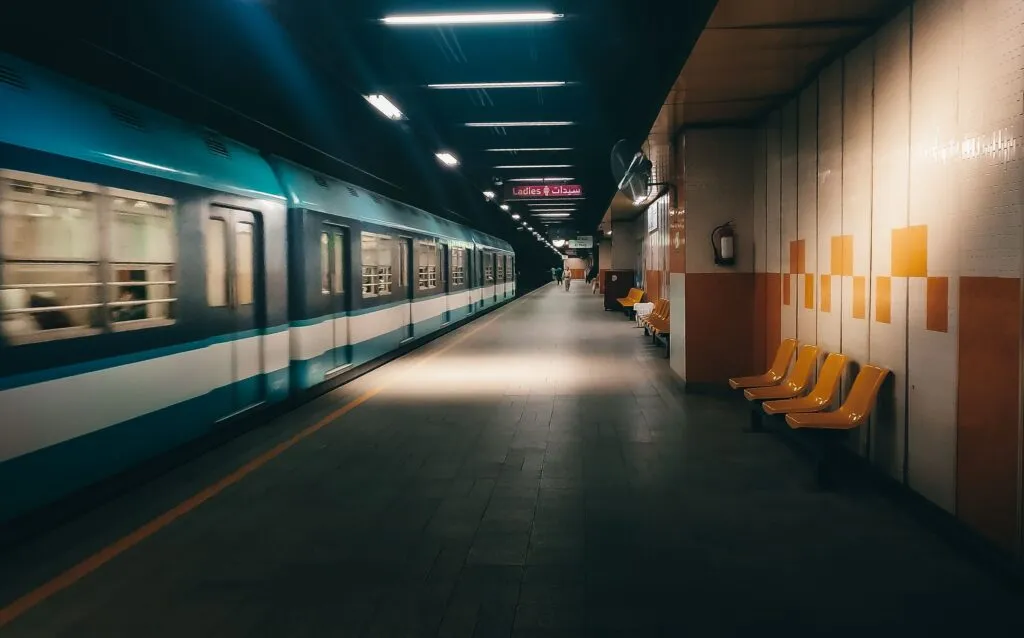
English-speaking travelers sometimes call the Cairo Metro a subway. Capital Train or LRT, the East and West Nile monorails, and Ring Road BRT are separate systems and excluded from Metro line, station and distance totals.
Line 3 runs west from Adly Mansour and divides at Kit Kat. One branch continues to Rod El Farag Corridor, while the other reaches Cairo University; both western branches have been fully operating since 2024.
At Cairo University, passengers can change to Line 2. Attaba also links Lines 2 and 3, Gamal Abdel Nasser links Lines 1 and 3, and Adly Mansour connects the Metro to the separate Capital Train or LRT.
The operating Line 3 route diagram does not extend into Cairo International Airport. An airport connection was discussed in 2020, but the 2026 operating station list ends without a station at any airport terminal.
Cairo rail systems in 2026
The Metro works especially well for central Cairo, Coptic Cairo and several Nile-side districts. Walking and road transfers are still needed for Islamic Cairo, the Citadel, the Pyramids and the Grand Egyptian Museum.
For Tahrir Square, use Sadat on Lines 1 and 2. The walk from Sadat to the Egyptian Museum is about 1.0 km and takes approximately 15 minutes.
Mar Girgis on Line 1 opens directly into Coptic Cairo. The walk to the Hanging Church is about 80 meters and takes approximately one minute.
For Al-Azhar and Khan el-Khalili, Bab El-Shaaria on Line 3 is the closer station. The walk to Khan el-Khalili is about 1.3 km and 16 minutes, while Al-Azhar is about 1.8 km and 22 minutes away.
Attaba is a longer alternative at about 1.9 km and 24 to 25 minutes.
Al-Shohadaa on Lines 1 and 2 is the Metro connection for Ramses Railway Station, around a six-minute walk away. Egyptian National Railways services are intercity trains and remain separate from the Cairo rapid-transit network.
Opera on Line 2 serves the Cairo Opera House and is the nearest Metro station to the Zamalek area. The walk to the Opera House is about 1.0 km and 13 minutes.
The Citadel has no direct station. A road transfer from El-Malek El-Saleh on Line 1 covers about 4.9 km and takes roughly eight minutes without traffic, so actual travel time depends on road conditions.
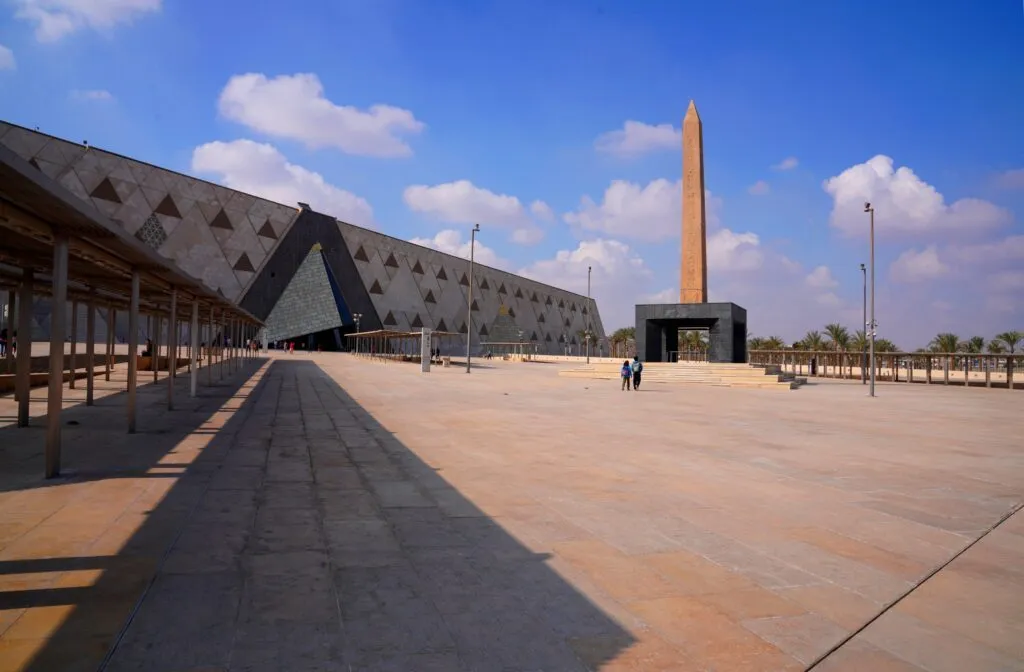
The Giza Pyramids and Grand Egyptian Museum have no Metro stations. From Sadat, Line 2 reaches Giza in 17 minutes; separate road trips from Giza cover about 13.8 km to the Pyramids and 14.7 km to the museum.
Women may use any carriage. Lines 1 and 2 also have two designated women’s cars, one of which becomes mixed after 9:00 p.m. Line 3 has two designated middle cars for women.
All 34 Line 3 stations provide step-free access. Lines 1 and 2 offer passenger assistance, so travelers who need step-free access should confirm their stations. Large objects, bicycles, animals and hazardous materials are not permitted on Line 3.
Security checks at station entrances may include bags and personal belongings.
Green Line 3 weekday peaks are 7:00-11:00 a.m. and 2:00-7:00 p.m. Travel outside these periods when practical, and spread out along the platform for easier boarding.
Illuminated M entrance totems, multilingual signs, maps and real-time screens support Line 3 wayfinding.
| Attraction or destination | Line | Station | Practical note |
|---|---|---|---|
| Egyptian Museum and Tahrir Square | Lines 1 and 2 | Sadat | The museum is about 1.0 km (15 minutes) away on foot. |
| Coptic Cairo and Hanging Church | Line 1 | Mar Girgis | The Hanging Church is about 80 meters (one minute) away on foot. |
| Khan el-Khalili and Al-Azhar | Line 3 | Bab El-Shaaria | Khan el-Khalili is about 1.3 km (16 minutes) away; Al-Azhar is about 1.8 km (22 minutes) away. |
| Cairo Citadel | Line 1 | El-Malek El-Saleh | Continue by road for about 4.9 km; the traffic-free routing estimate is roughly eight minutes. |
| Ramses Railway Station | Lines 1 and 2 | Al-Shohadaa | Walk about 0.5 km (six minutes) to the intercity railway complex. |
| Cairo Opera House and Zamalek area | Line 2 | Opera | The Opera House is about 1.0 km (13 minutes) away on foot; Zamalek lies beyond the Nile-side station area. |
| Giza Pyramids | Line 2 | Giza | There is no Pyramids Metro station; continue about 13.8 km by road, roughly 16 minutes without traffic. |
| Grand Egyptian Museum | Line 2 | Giza | There is no museum Metro station; continue about 14.7 km by road, roughly 16 minutes without traffic. |
No. Terminals 1, 2 and 3 have no operating Metro station as of August 14, 2026. The airport’s internal people mover only links the terminals, Air Mall and parking lot; it does not connect to the city network.
A practical route is a taxi or official limousine from any terminal to Heliopolis on Line 3. Ride west to Gamal Abdel Nasser, change once to Line 1 toward Helwan, and travel one more station to Sadat at Tahrir Square.
The trip from Heliopolis to Sadat takes 29 minutes across 13 stations with one transfer. That Metro leg costs 12 EGP (≈ USD 0.24); the amount does not include the road transfer from the terminal.
Plan the road transfer separately because the 29-minute journey time and 12 EGP (≈ USD 0.24) fare apply only from Heliopolis. The free people mover links T1, T2 and T3 within five minutes but does not reach a Metro station.
Regular single tickets use a station-count fare. The four bands cover journeys of up to 9, 10 to 16, 17 to 23, and 24 to 39 stations; travelers pay for the band covering their full Metro trip.
The network also offers a non-personalized, rechargeable smart-wallet card. It has no expiry date and costs 80 EGP (≈ USD 1.59). Subscription products exist separately, with their own zone and validity rules.
| Ticket | Price | Where to buy |
|---|---|---|
| Single ride, up to 9 stations | 10 EGP (≈ USD 0.20) | Available at station ticket counters |
| Single ride, 10 to 16 stations | 12 EGP (≈ USD 0.24) | Available at station ticket counters |
| Single ride, 17 to 23 stations | 15 EGP (≈ USD 0.30) | Available at station ticket counters |
| Single ride, 24 to 39 stations | 20 EGP (≈ USD 0.40) | Available at station ticket counters |
| Rechargeable smart-wallet card | 80 EGP (≈ USD 1.59) | Available at all stations |
Prices as of August 2026; source: Egyptian Company for Metro Management and Operation.
Buy single tickets at station ticket counters. The smart-wallet card is available at all stations, while subscription offices across all three lines handle subscriptions and collect payment when a pass is issued.
Use the ticket or Metro contactless card at the access gate and keep a valid ticket available during the trip.
Regular services begin at about 5:15 a.m. Line 1’s last trains leave both ends at 11:40 p.m.; Line 2’s final departures are 11:55 p.m. from Shubra El-Kheima and 12:05 a.m. from El-Mounib.
On Line 3, first departures range from 5:15 to 5:20 a.m., depending on branch and direction, and final departures range from 11:29 to 11:55 p.m. The line operates daily, including Fridays and holidays, although schedules can change.
Trains generally run every 4 to 8 minutes, with extra services in peak periods. On Line 3, the core operates every 4 minutes 30 seconds at peak and 6 minutes 30 seconds off-peak; branch intervals are 9 and 13 minutes.
The Metro is not open 24 hours. Ramadan uses a special operating plan; the extended Ramadan 2026 schedule ended before regular hours resumed on March 24, 2026.
The current western branches completed Line 3’s Phase III. A possible airport connection was discussed in 2020, but it has no confirmed opening date and must not be read as part of the operating network.
Line 4 Phase 1 is under construction.
Cairo Metro Line 4 Phase 1 spans 19 km and includes 17 stations. Egypt’s presidency cited the first half of 2028 for the Pyramids station, while an older JICA financing schedule points to March 2030.
Neither target date is a guaranteed opening date.
Egypt’s State Information Service reported Ring Road BRT replaced the planned Line 5 corridor. On February 10, 2026, it said Line 6 construction had not started; Phase 1 would span 34 km and 26 stations from El-Khosous to New Maadi.
The Egyptian Parliament approved financing for Capital Train or LRT Phase 3 on March 2, 2026, but the extension was not open. Cairo Governorate lists Phase 4 as approved, with no opening date.
Egypt’s State Information Service reported East Nile Monorail Phase 2 launched on June 27, 2026, and West Nile Monorail was under construction and being prepared for testing in April 2026. Both remain outside the three-line Metro totals.
Fun Fact: In April 2026, the Line 4 tunnel-boring machine completed a 6.4 km tunnel section between Hadayek Al-Ashgar and the future Pyramids station. That station remains a construction project, not an operating Metro stop.
No. Terminals 1, 2 and 3 have no Metro station. Transfer to Heliopolis on Line 3, change at Gamal Abdel Nasser to Line 1 and continue to Sadat. Metro travel takes 29 minutes and costs 12 EGP (≈ USD 0.24).
Taxi or official limousine service is available outside each terminal. For a Metro connection, travel to Heliopolis, then take Line 3 to Gamal Abdel Nasser and Line 1 to Sadat; allow separate time and payment for the road transfer.
Regular single fares are 10 EGP (≈ USD 0.20), 12 EGP (≈ USD 0.24), 15 EGP (≈ USD 0.30), or 20 EGP (≈ USD 0.40), covering successive bands up to 9, 16, 23 or 39 stations.
No. Regular first departures are around 5:15 a.m., while final departures vary by line and direction between 11:29 p.m. and 12:05 a.m. Ramadan uses a separate temporary schedule.
Choose the fare band for the number of stations traveled and buy a single ticket at a station counter. Use the ticket or Metro contactless card at the access gate and keep a valid ticket available during the journey.
Yes. The Cairo Metro is useful for Tahrir Square, Coptic Cairo, Ramses and the Opera area. Women may use any carriage, designated women’s cars are available, and all 34 Line 3 stations offer step-free access.
Not directly. Take Line 2 to Giza, then continue by road. Traffic-free routing estimates are about 16 minutes for either destination, but neither the Pyramids nor the Grand Egyptian Museum has a dedicated Metro station.
You might also be interested in these metro maps – for comparison or for your next trip: