Osaka Metro Map 2026: Lines, Tickets and Prices
Last updated: August 16, 2026

Last updated: August 16, 2026
Current Osaka Metro service updates
Delays and interruptions of about ten minutes or more are posted by line on the operator’s live service status page. Planned or special operations can appear separately under temporary service information, so check both on the day of travel.
The Osaka Metro map brings the city’s eight subway lines and the separate New Tram into one route diagram. The guide below explains line codes, fares, operating hours, airport transfers and the rail-system boundaries visitors need to understand.
Inhaltsverzeichnis
In 2018, Osaka became the first Japanese city to privatize a municipally operated subway, although the City of Osaka retained full ownership of the new company at the time. Osaka Metro Co., Ltd. began business on April 1, 2018.
Osaka’s municipal subway history began much earlier. The 3.1 km Umeda to Shinsaibashi section opened on May 20, 1933 as Japan’s first municipal subway. The current branded network carries that legacy through eight distinct subway lines.
Osaka Metro Co., Ltd.’s FY2025 company profile reports 141.0 km and 134 stations across the subway and New Tram together, with about 2.8 million passenger journeys per day. Subtracting the separately reported New Tram gives 133.1 km and 124 subway stations.
New Tram, officially the Nanko Port Town Line, is an urban transport system in its own right. Its 7.9 km and ten stations are part of the operator total, but it should not be counted as a ninth Osaka subway line.
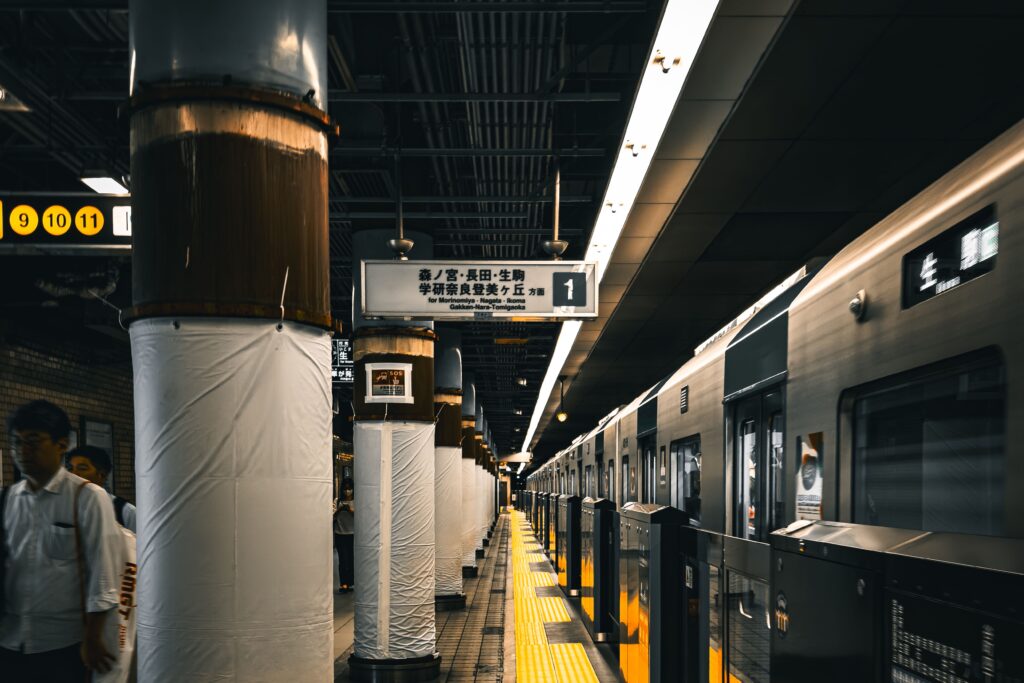
The Chuo Line extension from Cosmosquare to Yumeshima opened on January 19, 2025. C09 Yumeshima remained in normal weekday and weekend timetables after Expo 2025 ended.
Station numbering generally begins from the west or north at 11, leaving room for extensions. Through-running does not erase operator boundaries: Midosuji continues onto Kita-Osaka Kyuko, Chuo onto Kintetsu Keihanna and Sakaisuji onto Hankyu, but the outer sections are separate systems.
The simplest visitor strategy is to use Midosuji for the north-to-south city spine and Chuo for waterfront and east-to-west transfers. According to the Osaka Convention and Tourism Bureau’s final estimate, Osaka welcomed about 17.6 million international visitors in 2025, 21 percent more than in 2024.
The colored subway lines are only one part of Osaka’s rail network. The JR Osaka Loop Line, JR Yumesaki Line, Nankai, Hankyu, Hanshin, Kintetsu, Keihan and Osaka Monorail are separate operators or systems, even where stations connect directly.
A nationwide JR Pass covers eligible JR services under its conditions, but does not cover the subway, private railways or Osaka Monorail. A separate fare, compatible IC card or other valid product is required after changing away from JR.
Kansai Airports and Nankai list Nankai Rapi:t trips to Nankai Namba at about 34 or 39 minutes, depending on the service, while the Airport Express takes about 43 to 45 minutes before the connected Namba Metro complex.
Kansai Airports lists JR Haruka trips to Tennoji at about 30 minutes and Shin-Osaka at about 50 minutes. Tennoji connects to Midosuji M23 and Tanimachi T27; Shin-Osaka connects to Midosuji M13. It also lists the JR Kansai Airport Rapid to Tennoji at about 45 minutes.
Itami Airport also lacks a direct Metro station. Osaka Monorail runs from Osaka-Airport Station 11; an operator example reaches Shin-Osaka via Senri-chuo in about 29 minutes including a four-minute transfer allowance, while the direct monorail trip to Dainichi takes about 36 minutes before Tanimachi T11.
Universal Studios Japan is served by JR Universal-City on the JR Yumesaki Line, not by the subway. Bentencho C13 provides a practical hand-off to the JR Loop Line, followed by Nishikujo and JR Yumesaki.
| Attraction or destination | Line | Station | Practical tip |
|---|---|---|---|
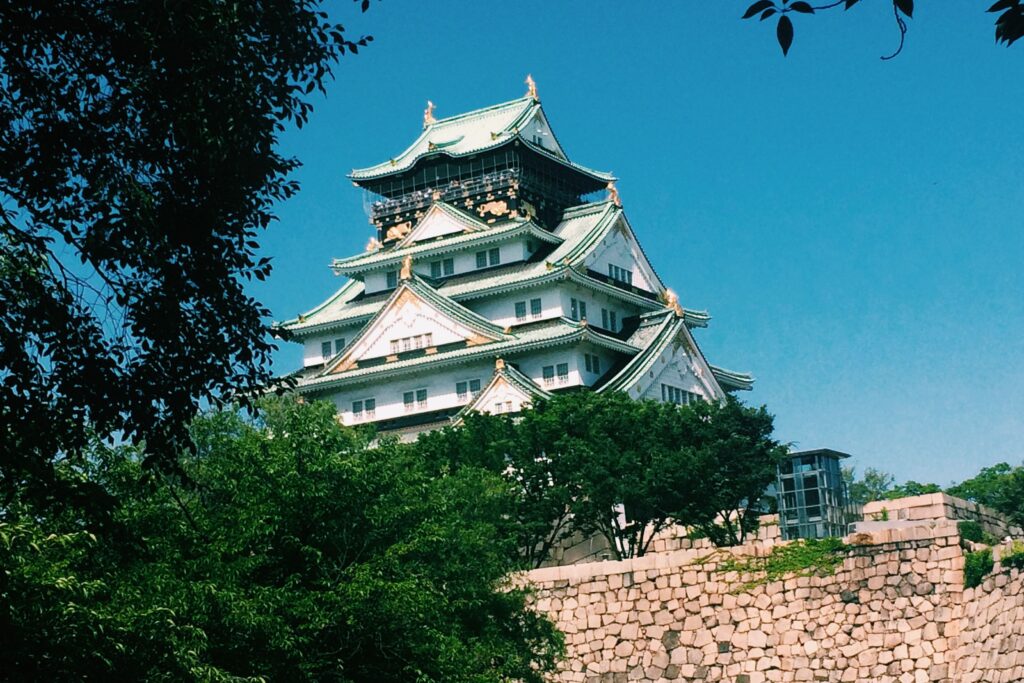
| Osaka Castle | Chuo / Tanimachi | Tanimachi 4-chome C18/T23 | Use Exit 9 for Osaka Castle Park, Castle Tower and Nishinomaru Garden. For a step-free route, take the elevator at Exit 1-A toward Sakuramon Gate. The grounds are extensive. |
| Dotonbori and Namba | Midosuji / Sennichimae / Yotsubashi | Namba M20/S16/Y15 | Use Exit 17 for Dotonbori, Ebisubashisuji and Shinsaibashisuji. The connected walk from the Yotsubashi platforms is longer. |
| Umeda and Grand Front Osaka | Midosuji | Umeda M16 | Use Exit 4 or 5 and follow the connecting passage toward Yodobashi Umeda and Ofukacho. Follow north-side signs in the large multi-operator complex. |
| Shinsekai and Tsutenkaku | Sakaisuji | Ebisucho K18 | Use Exit 3. The official destination guide gives a walk of about three minutes. |
| Osaka Aquarium Kaiyukan | Chuo | Osakako C11 | Use Exit 1 and allow about five minutes. Follow signs for Tempozan Marketplace and look for the Ferris wheel. |
| Kuromon Market | Sakaisuji / Sennichimae | Nippombashi K17/S17 | Use Exit 10 beside the market. The covered shopping street extends for about 580 m, making it practical as a walk-through food stop. |
| Shitennoji | Tanimachi | Shitennoji-mae Yuhigaoka T26 | Use Exit 4, then walk south for roughly five minutes. |
| Universal Studios Japan | JR Yumesaki Line, not the subway | JR Universal-City | Change from Chuo at Bentencho C13 via Exit 4 to the JR Loop Line. Travel via Nishikujo, then take JR Yumesaki to Universal-City, or remain on a through train when it is signed accordingly. |
Osaka Metro’s current fare table lists standard adult single fares of ¥190, ¥240, ¥290, ¥340 or ¥390, approximately $1.19 to $2.45 at the July 31, 2026 reference rate of 159.16 JPY per USD.
The Yumeshima section has an added charge, producing total adult fares of ¥330 to ¥480 (≈ $2.07 to $3.02). The Enjoy Eco Card excludes Yumeshima, while the Osaka Amazing Pass and the current 26-hour and 48-hour products include it.
The current Enjoy Eco Card and Digital Ticket pages list ¥820 (≈ $5.15) on weekdays or ¥620 (≈ $3.90) on Saturdays, Sundays and holidays for a full day of ordinary Metro and city-bus travel. The child price is ¥310 (≈ $1.95).
The official 2026/27 Osaka Amazing Pass information lists ¥3,500 (≈ $21.99) for one day or ¥5,000 (≈ $31.42) for two days and includes around 40 attractions plus defined transport sections. Its Osaka Itami Airport version costs ¥3,800 (≈ $23.88) for one day or ¥5,400 (≈ $33.93) for two days.
| Ticket | Price | Buy a ticket |
|---|---|---|
| Single journey | Adult ¥190 to ¥390 (≈ $1.19 to $2.45). A Yumeshima journey can total ¥330 to ¥480 (≈ $2.07 to $3.02). | Available on site |
| ICOCA | ¥2,000 (≈ $12.57), including a refundable ¥500 deposit (≈ $3.14). | Available on site |
| Enjoy Eco Card | Adult ¥820 weekdays (≈ $5.15) or ¥620 weekends and holidays (≈ $3.90); child ¥310 (≈ $1.95). Yumeshima excluded. | Available on site |
| Digital Osaka Metro and City Bus 1-Day Pass | Adult ¥820 weekdays (≈ $5.15) or ¥620 weekends and holidays (≈ $3.90); child ¥310 (≈ $1.95). Valid for the 2026/27 sales year; Yumeshima excluded. | Official digital ticket (SURUTTO QRtto). Operator app e METRO (membership, Japanese only): Google Play, Apple App Store. |
| 26-hour / 48-hour digital ticket | Adult ¥1,000 / ¥1,700 (≈ $6.28 / $10.68); child ¥500 / ¥850 (≈ $3.14 / $5.34). Yumeshima included. Sale ends September 30, 2026. | Official digital ticket (SURUTTO QRtto) |
| Osaka Amazing Pass 2026/27 | One day ¥3,500 (≈ $21.99); two days ¥5,000 (≈ $31.42). The ITM versions cost ¥3,800 (≈ $23.88) or ¥5,400 (≈ $33.93). | Official booking information |
Prices as of August 2026; fares: official Osaka Metro fare information. USD values use the Federal Reserve H.10 rate of 159.16 JPY per USD on July 31, 2026.
Pink ticket machines at every station sell single tickets, passes and ICOCA cards and can recharge IC cards. A physical Enjoy Eco Card receives its usage date when it is first inserted into the gate.
With ICOCA or another accepted interoperable IC card, tap the same card at entry and exit for about one second. One card is valid for one person, and ordinary recharges are generally made in ¥1,000 (≈ $6.28) increments up to ¥20,000 (≈ $125.66).
Contactless Visa, Mastercard, JCB, American Express, Diners Club, Discover and UnionPay cards or linked wallets work at the dedicated gate reader without registration. This open-loop option always charges the adult fare.
Digital ticket holders scan their QR code at compatible gates on entry and exit. The Japanese-language e METRO app is available through Google Play and the Apple App Store.
Osaka does not have one universal first or last train time. The official timetable varies by station, direction and final destination, so a late departure may terminate before the end of the line.
At Namba on the Midosuji Line, the first northbound train leaves at 5:10 AM for Minoh-kayano, and the final one leaves at 12:10 AM the next day for Shin-Osaka. Southbound trains run from 5:23 AM until 12:17 AM the next day for Nakamozu.
At Umeda, the first northbound train leaves at 5:18 AM for Esaka, and the final one leaves at 12:20 AM the next day for Shin-Osaka. Southbound trains run from 5:15 AM until 12:08 AM the next day for Nakamozu.
At Namba northbound on weekdays, trains depart every two to three minutes during the 8:00 AM hour and every four minutes from 11:00 AM through 3:59 PM. From 11:03 PM to 11:38 PM, they run every five minutes, then gaps widen to nine, eleven and twelve minutes.
At Namba northbound on weekends, trains usually run every three minutes during the 8:00 AM hour, with one four-minute gap. From 11:00 AM through 3:59 PM, they run every four minutes; the 11:03 PM to 12:10 AM departure pattern is the same as on weekdays.
There is a multi-hour overnight gap between the last and first Namba trains, so travelers should not assume 24-hour subway operation. Check the official station timetable and route search for the exact date and destination.
Yumeshima C09 is not merely an Expo-era stop. The Chuo Line extension has remained operational since January 19, 2025, and the current station page and post-Expo timetable continue to list weekday and weekend service.
The City of Osaka’s Yumeshima project page reported that developer selection was under way in July 2026 for about 50 hectares of former Expo land under Master Plan Version 3.0, approved in June, but this did not mean a completed new district.
The Osaka integrated resort planned for Yumeshima targets approximately autumn 2030 and was not operational in 2026. The existing Chuo Line service is current; the resort and wider site reuse remain future projects.
Fun Fact: New Tram began service in March 1981. The operator’s published New Tram technology history says the technology group behind it was recognized for the world’s first unmanned operation of an urban public transport system.
Use the PDF Download button directly below the viewer at the top of this page to open the official Osaka Metro PDF.
Yes. The official one-page Osaka subway map is available in English, and its vector artwork remains sharp when enlarged. Choose fit to page when printing.
Buy single tickets, passes and ICOCA at the pink station machines, or use a compatible IC card, supported contactless bank card or an eligible digital QR ticket. Use the same IC card at entry and exit; digital QR tickets are scanned at both gates.
No. The nationwide JR Pass covers eligible JR services under its conditions, but the subway, private railways and Osaka Monorail require separate payment.
In ordinary visitor usage, both terms refer to the city’s subway. The operator has used its current official brand since the company began business in 2018. The network itself has eight subway lines, while New Tram remains a separate urban transport system.
The line letters, colors and two-digit station numbers make transfers easy to follow. For example, Namba is M20 on Midosuji, S16 on Sennichimae and Y15 on Yotsubashi.
There is no single closing time for the whole network. At Namba, the Midosuji Line’s last departures are at 12:10 AM northbound and 12:17 AM southbound, but the final destinations differ and other stations have their own times.
No. KIX station is served by JR West and Nankai, so every Metro journey from the airport requires a change at a city station such as Namba, Tennoji or Shin-Osaka.
Take Nankai Rapi:t to Nankai Namba in about 34 or 39 minutes, or the Airport Express in about 43 to 45 minutes. For Tennoji, JR Haruka takes about 30 minutes before changing to Midosuji M23 or Tanimachi T27.
Take Osaka Monorail from Osaka-Airport Station 11. For Midosuji, change through Senri-chuo toward Shin-Osaka; the operator example totals about 29 minutes including a transfer allowance. Dainichi provides a direct monorail connection to Tanimachi T11.
No. Universal Studios Japan is served by JR Universal-City on the JR Yumesaki Line. A practical hand-off from the subway is Bentencho C13 to the JR Loop Line, then Nishikujo and JR Yumesaki.
The Osaka Metro map above is available on this page as a zoomable PDF to download.
Compare the Tokyo subway map, Seoul subway map, Hong Kong MTR map, Singapore MRT map and Bangkok Metro map, or browse all metro maps by city.
 (No Ratings Yet)
 Loading...