Seoul Subway Map 2026: Lines, Fares & Airport Trains
Last updated: 10 August 2026

Last updated: 10 August 2026
Current Seoul Subway service updates
Regular late-night extensions are event-specific, not part of the normal timetable. For a late journey, verify the station, direction and day in the first and last train data; operator times can differ.
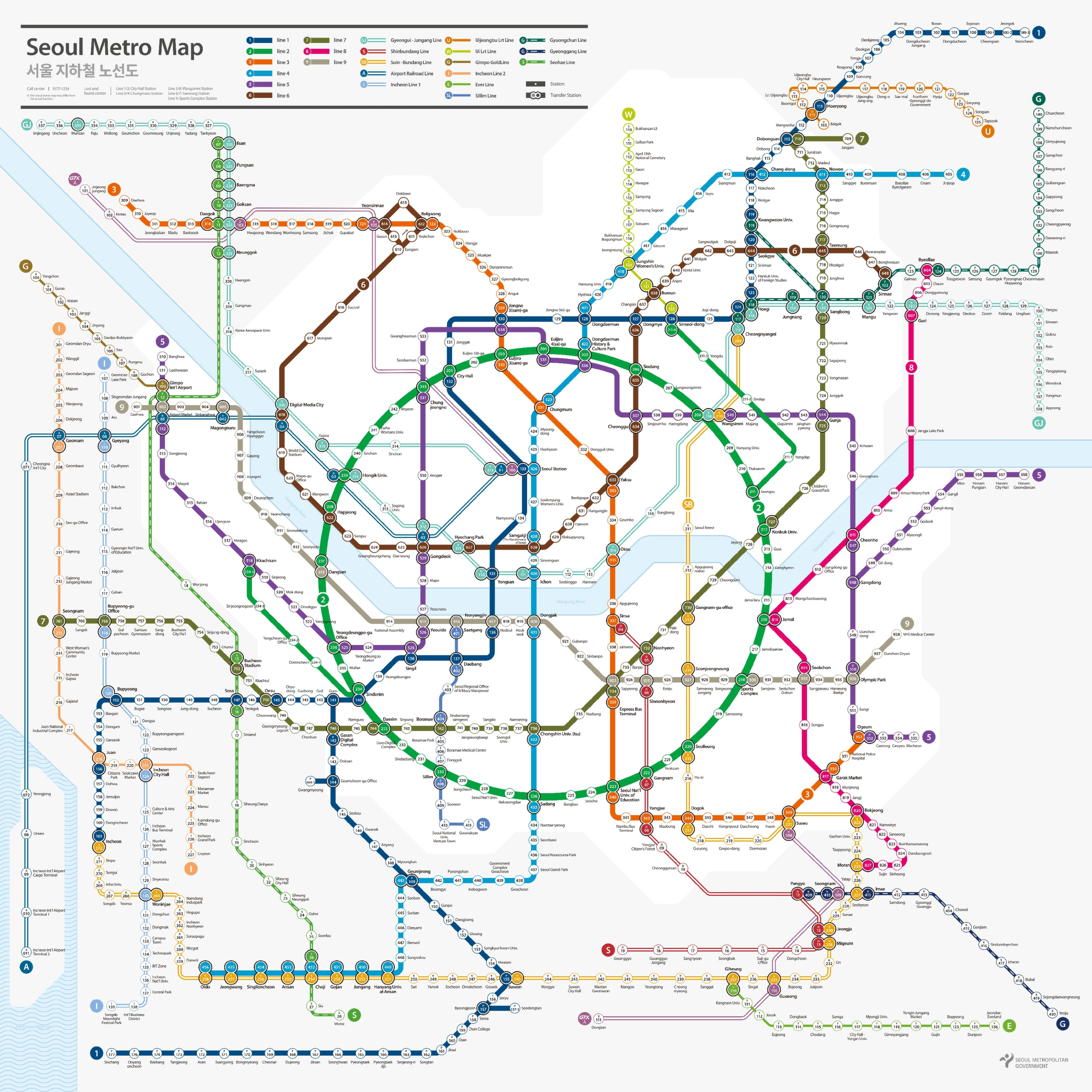
The Seoul subway map is the starting point for navigating a rail network that extends well beyond the city center. This 2026 guide explains the diagram, fares, cards, airport trains and useful stations without merging statistics from different operators.
The network diagram is the official English subway map provided by Seoul Metro and is delivered here in a lossless one-page PDF container. The official 6142 x 6142 JPEG itself is unchanged and is not recompressed; only the container format changes.
Contents
The Seoul Metropolitan Subway is easier to use than its multi-operator structure suggests. A government design report defines the citywide diagram as 23 lines and 624 stations. A separate traffic analysis recorded about 2.4 billion transported-passenger events across 273 stations in 2024 for the operator core.
The 23-line, 624-station citywide scope and Seoul Metro’s 273-station ridership scope describe different parts of the system. The ridership measure counts boardings plus transfer inflows. For city planning, an urban rail report counts Lines 1 to 9 plus Ui-Sinseol LRT and Sillim LRT as an 11-line, 383.2 km scope.
Seoul’s first linked subway service opened between Seoul Station and Cheongnyangni on August 15, 1974. Today, Seoul Metro runs the core of Lines 1 to 8, Korail operates substantial regional through-services, and other named lines have separate operators.
A single public transportation card normally works across lines and operators, creating an integrated metropolitan network for ordinary card use. Distance fares and premium supplements still apply. KTX is separate high-speed intercity rail, even at Seoul Station.
For travelers, the relevant groups are Lines 1 to 9, Seoul light rail and the key regional connections, including AREX, Gyeongui-Jungang, Suin-Bundang, Gyeongchun and Sinbundang.
The diagram combines visible line colors, station names, station codes and interchange symbols. Use it in four steps:
Operator boundaries matter less for ordinary card travel, but Sinbundang supplements, AREX Express tickets and Climate Card limits still require a separate check.
Visitors can navigate with line colors, station codes and station signs in Korean, English and Chinese. Universal English train announcements across every operator are not confirmed. T-money simplifies payment, while current apps distinguish local trains, express patterns, exits and transfers.
For a first trip on the network:
The integrated network makes operator boundaries less important for ordinary trips, but Sinbundang, AREX Express and Climate Card boundaries still require a fare check.
| Destination | Line | Station | Practical note |
|---|---|---|---|
| Gyeongbokgung Palace | Line 3 | Gyeongbokgung Station | Use Exit 5; the palace entrance is about 216 m away. |
| Myeongdong | Line 4 | Myeongdong Station | Exits 5 to 10 serve the Myeongdong shopping district. |
| Hongdae | Line 2, Gyeongui-Jungang Line, AREX | Hongik University Station | Exit 4 is about 50 m from the central Hongdae location listed by Visit Seoul. |
| Gangnam Station area | Line 2, Sinbundang Line | Gangnam Station | Exit 8 serves the underground shopping center, about 100 m away. |
| N Seoul Tower | Lines 3 and 4 | Chungmuro Station | There is no station at the tower. From Exit 2, take Namsan Circular Bus 01, then walk about 357 m from the Namsan Seoul Tower stop. |
| Bukchon Hanok Village | Line 3 | Anguk Station | Use Exit 3; the listed approach is about 516 m. Designated residential areas restrict visitor access from 17:00 to 10:00. |
| Dongdaemun Design Plaza | Lines 2, 4 and 5 | Dongdaemun History & Culture Park Station | Use Exit 1; DDP is about 37 m away. |
| Lotte World Adventure | Lines 2 and 8 | Jamsil Station | Use Exit 3; the attraction is about 271 m away. |
As of July 21, 2026, the adult base fare covers 10 km and costs KRW 1,550 (about USD 1.05) with a transit card or KRW 1,650 (about USD 1.12) with a single-use ticket. The current fare rules supersede older tourist pages.
Beyond 10 km, the fare rises by KRW 100 (about USD 0.07) for each 5 km through 50 km, then by KRW 100 for each 8 km. Sinbundang adds a section-based supplement of KRW 700 to 2,200 (about USD 0.47 to 1.49).
T-money is the flexible pay-as-you-go choice for most short visits. It covers metropolitan rail and buses, airport shuttles, taxis and selected retail.
Climate Card products for 1, 2, 3, 5 and 7 days are intended for foreign tourists and short-term visitors. They exclude Sinbundang, airport and intercity buses, non-Seoul buses and out-of-scope rail sections. Ordinary AREX coverage runs between Seoul Station and Gimpo Airport. A cardholder may exit at ICN T1 or T2 under the stated rules but may not board there, and the product is not an AREX Express ticket. Check the visitor pass conditions before airport travel.
| Ticket | Price | Ticket purchase |
|---|---|---|
| Single-use ticket | From KRW 1,650 (about USD 1.12), plus KRW 500 refundable deposit (about USD 0.34) | Available locally |
| Tmoney | Ride from KRW 1,550 (about USD 1.05); card price varies; minimum top-up KRW 1,000 (about USD 0.68) | Available locally |
| Climate Card 1-day | KRW 5,000 (about USD 3.38), plus KRW 3,000 physical card (about USD 2.03) | Available locally |
| Climate Card 2-day | KRW 8,000 (about USD 5.41), plus KRW 3,000 physical card (about USD 2.03) | Available locally |
| Climate Card 3-day | KRW 10,000 (about USD 6.76), plus KRW 3,000 physical card (about USD 2.03) | Available locally |
| Climate Card 5-day | KRW 15,000 (about USD 10.15), plus KRW 3,000 physical card (about USD 2.03) | Available locally |
| Climate Card 7-day | KRW 20,000 (about USD 13.53), plus KRW 3,000 physical card (about USD 2.03) | Available locally |
Prices as of July 21, 2026. USD values use the European Central Bank cross-rate dated July 21, 2026: USD 1 equals KRW 1,478.40. They are reference approximations, not guaranteed exchange rates.
Single-use tickets include a KRW 500 refundable deposit, returned at a deposit-return machine after the journey. Since March 17, 2026, 440 new machines across 273 Lines 1 to 8 stations have accepted international cards for these tickets.
T-money is sold at convenience stores and Lines 1 to 8 service centers. The minimum top-up is KRW 1,000, while the card purchase price varies. Tap in and out with one card per passenger so the integrated fare and transfer rules can be calculated.
A physical Climate Card costs KRW 3,000. Short-term passes begin on the charging day and cannot be loaded for later. International-card purchase and recharge is available at the 440 machines, with an average fee of about 3.7%.
The physical Climate Card is the safer tourist format because the mobile version requires Android 12 or later and domestic payment credentials described by the city.
Most services begin around 05:30 and finish around midnight. Exact first and last trains vary by station, direction, weekday or weekend pattern and operator, so a network-wide closing time is only a general planning window.
Frequency varies by line, direction and time, so no network-wide peak, off-peak or late interval is reliable. Timed connections require station-specific timetable data or a live planner.
After rail service ends, 14 regular N-bus routes normally operate from about 23:00 to 06:00. Routes should be checked through TOPIS or a current planner because a night bus does not simply reproduce every daytime rail journey.
Incheon International Airport (ICN)
Both terminals connect to AREX from the B1 Transportation Center. AREX Express runs from T2 through T1 to Seoul Station without an intermediate city stop. It takes 43 minutes from T1 or 51 minutes from T2 and currently costs KRW 13,000 (about USD 8.79) for a public, non-member adult ticket.
The Express uses a separate reserved-seat QR ticket, not T-money alone. Its booking flow accepts foreign-issued cards; ticket centers are at Seoul Station B2 and the B1 Transportation Centers at both airport terminals.
AREX All-Stop serves all 14 stations. It takes 59 minutes from T1 or 66 minutes from T2, although some trains take 2 to 6 minutes longer. Transit-card fares to Seoul Station are KRW 4,750 (about USD 3.21) from T1 and KRW 5,350 (about USD 3.62) from T2. T-money works on All-Stop, which also serves Hongik University and Gongdeok. Current values are listed in the airport operator’s fare table.
For live rail status and station details, Seoul Metro develops the official Android app and official iPhone app. The iPhone listing includes English and Korean, routes, live trains, delays, exits, restrooms and transfer information.
NAVER Map is the primary door-to-door recommendation for English-capable multimodal routing; its current iPhone listing confirms live transit functions. KakaoMetro is a current rail-focused alternative whose current iPhone listing declares English and Korean. Complete English support on every KakaoMetro platform is not confirmed.
Gimpo International Airport (GMP)
Gimpo Airport Station directly serves Lines 5 and 9 plus AREX, with station access from west-side escalators on Floor 1 in both terminals.
AREX directly serves Hongik University, Gongdeok and Seoul Station. The Gimpo to Seoul Station transit-card fare is KRW 1,750 (about USD 1.18), and the derived scheduled journey is about 22 minutes, subject to the specific timetable.
Line 5 directly reaches Gongdeok, Gwanghwamun and Jongno 3-ga. Line 9 directly reaches Yeouido, Express Bus Terminal, Sinnonhyeon and Bongeunsa. The right option depends on the destination, and no one Line 5 or Line 9 travel time applies across the city.
Seoul’s rail network is still growing. According to the city government’s Wirye test update, the 5.4 km, 12-stop tram is undergoing mainline and system testing during 2026, but no firm opening date is approved for publication.
The city government’s rail project schedule gives the 13.4 km Dongbuk light rail project between Wangsimni and Sanggye a late-2027 completion target. It schedules construction for the 4.1 km, four-station Line 9 Phase 4 toward Godeok-Gangil 1 through mid-2028. These are project timelines, not guaranteed passenger opening dates.
Fun Fact: A government design test report states that the citywide rail diagram was redesigned for the first time in 40 years. Its octolinear layout turns the Line 2 loop into a clear circle, and the eye-tracking tests reduced the time needed to locate a station by about 55% and a transfer station by about 69%.
Yes. This page provides the official English subway map from Seoul Metro in a lossless one-page PDF container. The source is a 6142 x 6142 JPEG. That JPEG is embedded unchanged and without recompression; only the container format changes.
Most service begins around 05:30 and ends around midnight. Exact first and last trains vary by station, direction, day type and operator, so late journeys require a station-level check.
An adult ride starts at KRW 1,550 (about USD 1.05) with a transit card or KRW 1,650 (about USD 1.12) with a single-use ticket. The base fare covers 10 km, after which distance increments apply.
T-money is the simplest pay-as-you-go option for most visitors. It is sold at convenience stores and Lines 1 to 8 service centers, with a minimum KRW 1,000 top-up. Tap at both entry and exit gates. A single-use ticket includes a KRW 500 refundable deposit.
Yes. The 1, 2, 3, 5 and 7-day passes are intended for foreign tourists and short-term visitors. Coverage excludes Sinbundang, airport and intercity buses, non-Seoul buses and out-of-scope rail sections. The card is not valid for AREX Express.
NAVER Map is the primary English-capable option for door-to-door public transport planning. The operator’s iPhone app also lists English and provides routes, live train positions, delays, exits and transfer details. KakaoMetro’s current iPhone listing declares English and Korean, but complete support across all platforms is not confirmed.
Take AREX from the B1 Transportation Center at either terminal. Express reaches Seoul Station in 43 minutes from T1 or 51 minutes from T2 and costs KRW 13,000 (about USD 8.79). All-Stop takes 59 or 66 minutes, sometimes 2 to 6 minutes longer, and costs KRW 4,750 or KRW 5,350 (about USD 3.21 or USD 3.62) by transit card.
Yes. T-money works on the AREX All-Stop Train because it accepts prepaid transportation cards. AREX Express requires a separate reserved-seat QR ticket, so T-money alone is not an Express ticket.
Gimpo Airport Station is directly served by Lines 5 and 9 and AREX. AREX runs directly to Hongik University, Gongdeok and Seoul Station, with a KRW 1,750 (about USD 1.18) transit-card fare to Seoul Station. Choose the service that minimizes transfers for the final destination.
You might also be interested in these metro maps – for comparison or for your next trip: