Busan Metro Map 2026 (Humetro): Lines, Tickets & Prices
Last updated: August 20, 2026

Last updated: August 20, 2026
Busan Metro service information
Before a time-sensitive or late-night journey, check the official live service information and the station-specific timetable.
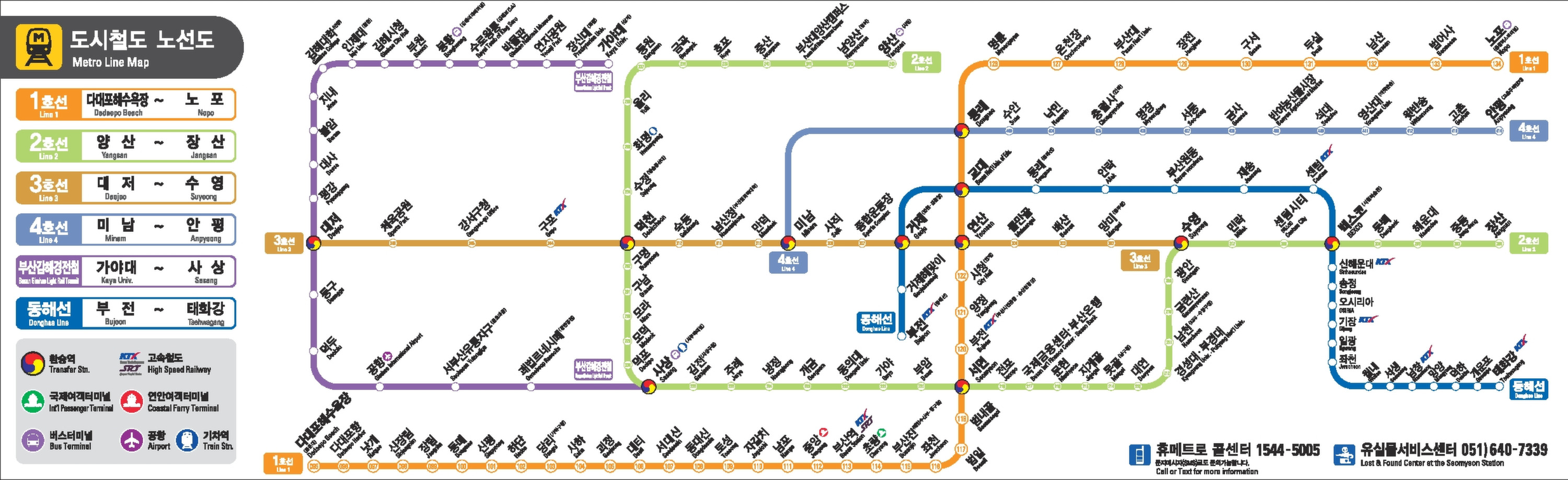
The Busan Metro Map is the fastest way to identify Lines 1 to 4, their interchange stations and the separate rail links that continue toward Gimhae Airport and Ulsan. The current official bilingual Busan Transportation Corporation map shows Humetro Lines 1 to 4, BGL and the Donghae Line to Taehwagang.
This Busan subway map guide adds what a diagram cannot explain alone: which operator runs each line and where day passes stop working, how card transfers are priced and which airport route fits Seomyeon, Busan Station or Haeundae.
Contents
Busan’s Line 4 stands apart from the rest of the network: a fully automated, rubber-tired K-AGT light-rail line rather than a conventional steel-wheel metro. Its trains have no driver’s cab, leaving an open view through the front window.
Busan Transportation Corporation, or BTC, operates the four numbered lines under the passenger brand Humetro. Line 1 opened on July 19, 1985, and the operating network totals 115.2 km as of the 2025 operating statement.
The operator’s 2025 operating statement reports 114 line-specific station entries. Six interchange complexes appear once on every line they serve, so the system has 108 distinct station complexes. The network carried 318.8 million journeys in 2025, averaging about 873,000 each day.
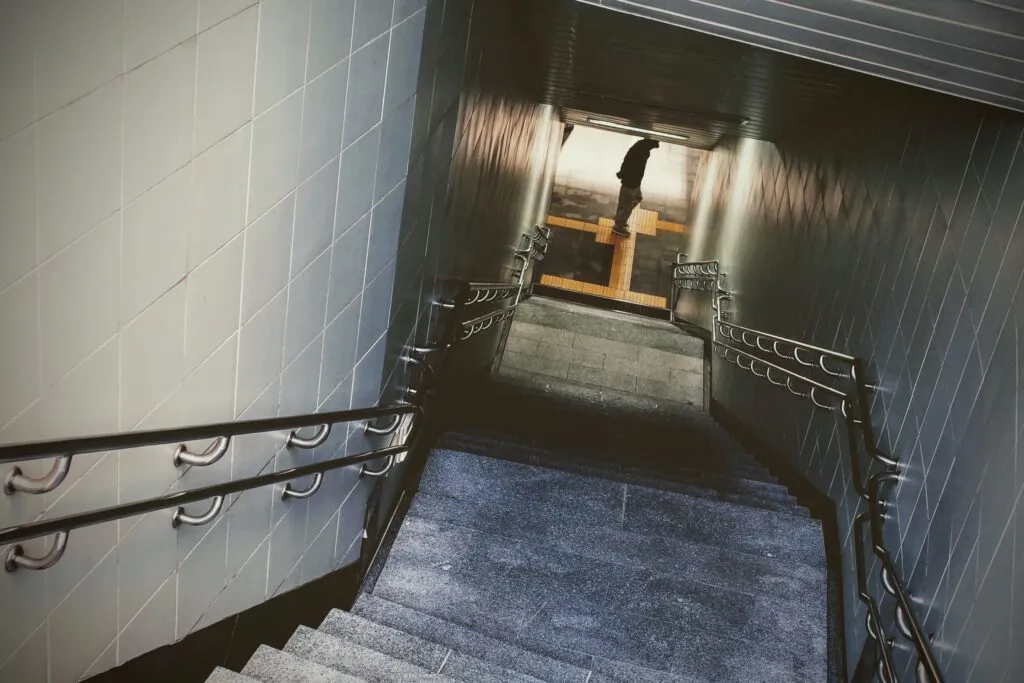
Seomyeon is the central interchange between Lines 1 and 2. Visitors traveling between Busan Station and the eastern beaches usually change here, while Sasang is the practical Line 2 interchange for the airport.
The Busan Metro Map combines three networks for orientation, but it does not place them under one operator. BGL and the Donghae Line remain separate from Lines 1 to 4.
A day pass for the four-line network does not cover BGL, the Donghae Line or buses. T-money and Cashbee are more flexible because one accepted transit card works on the subway, buses, BGL and the Donghae Line, and qualifies for the integrated transfer discount.
The Donghae Line is useful for travel through eastern Busan and onward to Ulsan. Fares start at Busan’s integrated base fare and then add ₩200 (≈ $0.14) for each further 10 km. Travel beyond the Busan area can also involve outer-zone supplements.
| Network shown on the map | Operator | Main travel role | Transfer and fare note |
|---|---|---|---|
| Humetro Lines 1 to 4 | Busan Transportation Corporation | Core urban network across Busan and Yangsan | Internal line changes stay within the four-line network; 1-day and 3-day passes apply only here |
| Busan-Gimhae Light Rail Transit | BGL Co., Ltd. | Sasang to Gaya University via Gimhae International Airport | Change at Sasang for Line 2 or Daejeo for Line 3; card transfer integration applies, but QR tickets are not through tickets |
| Donghae Line commuter rail | Korail | Bujeon through eastern Busan to Taehwagang in Ulsan | Change at Busan National University of Education, Geoje or BEXCO; card integration applies in Busan, with distance and outer-zone supplements |
Busan Metropolitan City counted 3,019,164 foreign visitors between January and October 2025, a record since the city began publishing these visitor figures in 2014. For most first visits, Lines 1 and 2 do the most work. Line 1 serves Busan Station and the Nampo/Jagalchi area, while Line 2 reaches Seomyeon, the beaches and the airport interchange at Sasang.
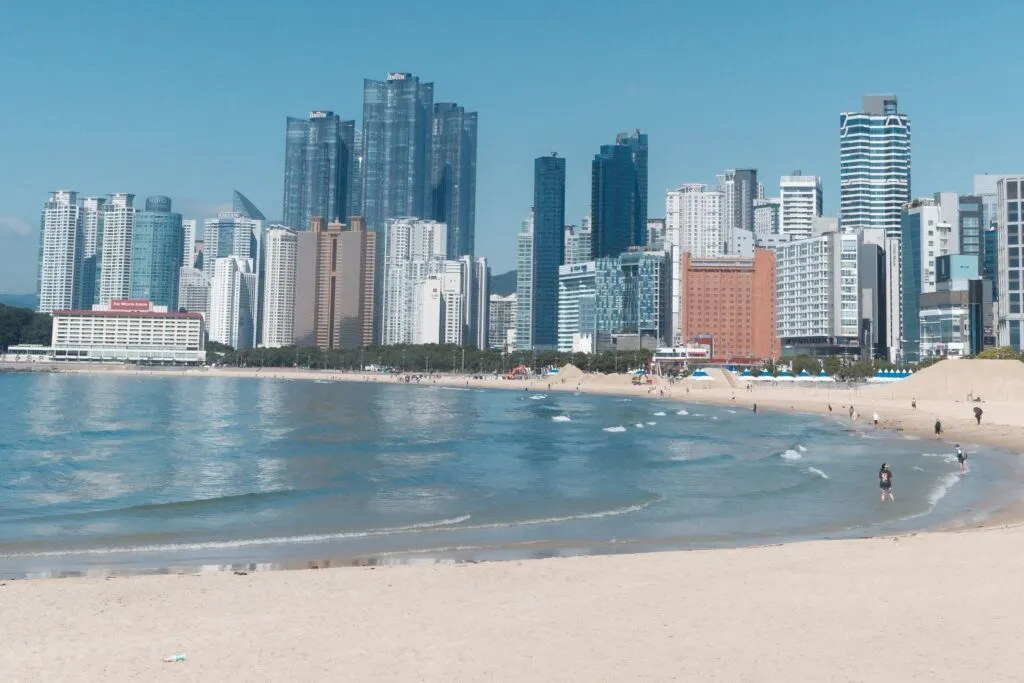
For several of these sights, the station is only the first stage of the trip. Gamcheon Culture Village and Beomeosa Temple still require a local bus, while Haeundae Beach and Jagalchi Market are short walks from their recommended stations.
From Busan Station to Haeundae, take Line 1 northbound to Seomyeon, change to Line 2 toward Jangsan and leave at Haeundae. The rail distance is 20.1 km, and rail time is roughly 45 to 55 minutes depending on the time of day.
Allow roughly 50 to 60 minutes from Busan Station to Haeundae Beach after waiting, changing and walking to the beach. This is more realistic than treating a rail-planner estimate as a door-to-door time.
The four numbered lines do not run directly to Gimhae International Airport (IATA: PUS). The terminal is on the separate purple Busan-Gimhae Light Rail Transit, with interchanges at Sasang and Daejeo.
Use Sasang for Line 2 when traveling to Seomyeon, Busan Station or Haeundae. Rail time is roughly 25 to 30 minutes to Seomyeon, 35 to 45 minutes to Busan Station and 55 to 65 minutes to Haeundae station.
For the Line 3 corridor, change at Daejeo; the airport to Daejeo segment takes about 8 to 10 minutes. Allow roughly 45 minutes to Busan Station and about 65 minutes to the Haeundae beach area after adding walking, waiting and transfer navigation.
The airport ground-transport information lists card-only limousine buses to Seomyeon/Bujeon for ₩6,000 (≈ $4.24) and Haeundae/Gijang for ₩9,500 (≈ $6.71).
| Attraction | Line | Station | Practical note |
|---|---|---|---|
| Haeundae Beach | Line 2 | Haeundae | Use Exit 3 or 5; the nearest beach access is about 5 minutes away |
| Gwangalli Beach | Line 2 | Gwangan or Geumnyeonsan | Gwangan Exit 5 is about 13 minutes from the central beach; Geumnyeonsan Exit 3 is about 10 minutes from the west side |
| Jagalchi Fish Market | Line 1 | Jagalchi | Exit 10 is about 6 minutes away; Nampo Exit 2 is an alternative |
| BIFF Square and Nampo | Line 1 | Jagalchi or Nampo | Use Jagalchi for BIFF Square; use Nampo for the Nampo and Yongdusan area, with Nampo Exit 7 about 7 minutes from Yongdusan Park |
| Seomyeon | Lines 1 and 2 | Seomyeon | Central interchange and commercial district |
| Gamcheon Culture Village | Line 1 | Toseong | Use Exit 6, then village bus Saha 1-1, Seo-gu 2 or 2-2 to Gamjung Elementary School, followed by about 5 minutes on foot |
| Beomeosa Temple | Line 1 | Beomeosa | Use Exit 5 or 7, walk about 5 minutes to Bus 90, then ride to Beomeosa |
| Centum City and Shinsegae | Line 2 | Centum City | Follow the signed underground passage; the connection takes about 2 minutes |
Current fare information uses distance-based sections. Section 1 covers journeys up to and including 10 km; Section 2 covers longer rides. Current adult fares took effect on November 1, 2025.
With T-money, Cashbee or another accepted transit card, adults pay ₩1,600 (≈ $1.13) for Section 1 or ₩1,800 (≈ $1.27) for Section 2.
A single-use QR ticket costs ₩1,700 (≈ $1.20) for Section 1 or ₩1,900 (≈ $1.34) for Section 2. Mobile tickets use the same adult fares as a transit card.
T-money or Cashbee is usually the simplest visitor choice because the same stored-value card works on the subway, buses, BGL and the Donghae Line. A single-use QR ticket is useful when no further integrated transfer is needed.
| Ticket | Price | Ticket purchase |
|---|---|---|
| T-money, Cashbee or accepted transit card, Section 1 | ₩1,600 (≈ $1.13) | Available from a station machine or convenience store |
| T-money, Cashbee or accepted transit card, Section 2 | ₩1,800 (≈ $1.27) | Available from a station machine or convenience store |
| Single-use QR ticket, Section 1 | ₩1,700 (≈ $1.20) | Available from a station machine |
| Single-use QR ticket, Section 2 | ₩1,900 (≈ $1.34) | Available from a station machine |
| Humetro mobile ticket, Section 1 | ₩1,600 (≈ $1.13) | Busan Subway app: Google Play and Apple App Store |
| Humetro mobile ticket, Section 2 | ₩1,800 (≈ $1.27) | Busan Subway app: Google Play and Apple App Store |
| 1-day pass | ₩6,000 (≈ $4.24) | Busan Subway app: Google Play and Apple App Store; BUSAN Pay: Google Play and Apple App Store |
| 3-day pass | ₩13,000 (≈ $9.18) | Busan Subway app: Google Play and Apple App Store; BUSAN Pay: Google Play and Apple App Store |
Prices as of August 2026; source: operator. US dollar amounts are converted at the rate of August 7, 2026 (USD 1 = KRW 1,415.95).
At a station machine, buy a transit card or a single-use QR ticket; transit cards are also sold at convenience stores. Transit cards can be topped up with cash at stations, and the QR machine accepts bills or coins. Each traveler needs a separate ticket.
At the entry gate, tap a transit card or scan the QR code. Repeat the same action at the exit gate so the system can calculate the distance-based fare.
The official Busan Subway app sells mobile tickets and day passes, and BUSAN Pay offers the same day-pass products. Download links for both apps are listed in the ticket table above.
The current transfer rules require an accepted transit card: tap out and board the next different mode within 30 minutes. Up to two transfers receive the discount. Cash and single-use QR tickets are not valid as through tickets.
The current adult total for a Humetro Section 1 to BGL Section 1 card journey is ₩1,600 (≈ $1.13). The former ₩500 (≈ $0.35) regional surcharge ended on September 19, 2025; Section 2 adds ₩200 (≈ $0.14) where applicable.
The 1-day and 3-day passes cover unlimited travel on Lines 1 to 4 only, not BGL, the Donghae Line or buses. Do not rely on a foreign contactless Visa or Mastercard at the gates; use T-money, Cashbee, a station QR ticket or an official mobile QR pass instead.
The subway is not a 24-hour system. The official station timetable shows that trains generally start around 5:00 AM and continue until shortly after midnight, but the last useful departure depends on the line, station, direction and destination.
Full-line terminal departures end earlier on Lines 1 and 2 than the final short-turn trains. Nopo, for example, has a 11:16 PM full-route Line 1 departure to Dadaepo Beach and an 11:31 PM short-turn departure to Sinpyeong.
Line 3’s last terminal departures are 11:59 PM from Suyeong and 11:40 PM from Daejeo. Line 4’s timetable extends to 12:20 AM from Minam, while the final Anpyeong departure toward Minam is at 11:43 PM.
Published headway information gives broadly 4 to 5 minutes at peak, 6 to 8 minutes off-peak and 10 to 13.5 minutes in quieter or late periods.
Weekend and holiday service runs less frequently, although terminal operating spans remain broadly similar. Check your station and direction before a very early or late trip.
There is no regular overnight rail service. After the last trains, use official bus information or a taxi; the A03 autonomous night-bus pilot ended on June 30, 2026 and is not a current option.
Three projects may change future editions of the map, and each remains at a different development stage.
The Sasang-Hadan Line, future Line 5, is under construction along 6.9 km with six new stations and a depot. The city’s May 2026 project notice schedules construction completion for December 2027.
The Yangsan Line spans 11.4 km with seven stations and a depot; the route runs between Nopo, Sasong in Yangsan (not the Line 2 interchange Sasang) and the Bukjeong area. A July 2026 project update targets passenger service in December 2026 and lists trial running from August 3 to October 5.
The planned Hadan-Noksan extension covers 13.5 km with 11 stations and a depot. A Busan City notice dated March 4, 2026 places the project at the design-proposal evaluation stage.
Fun Fact: Line 4 trains have no driver’s cab, so passengers can look through the front window along the automated route. Before opening, the K-AGT system underwent 100,000 km of testing; BTC now operates 17 six-car trains, comprising 102 cars.
For present-day travel, read the Busan subway map as three linked layers: Humetro for the urban core, BGL for the airport and Gimhae, and Korail’s Donghae Line for eastern Busan and Ulsan.
Use the PDF Download button to open the official bilingual Korean and English Busan Metro Map issued by Busan Transportation Corporation on December 24, 2025.
Yes. The current official integrated map is bilingual in Korean and English. It shows Humetro Lines 1 to 4, BGL and the Donghae Line to Taehwagang on one diagram.
Yes. Busan Transportation Corporation dated the current bilingual map December 24, 2025. It shows Humetro Lines 1 to 4, BGL and the Donghae Line to Taehwagang.
An adult fare paid by transit card or mobile ticket is ₩1,600 (≈ $1.13) for Section 1 and ₩1,800 (≈ $1.27) for Section 2. Single-use QR fares are ₩1,700 (≈ $1.20) and ₩1,900 (≈ $1.34). Buy at station machines or use a supported transit card or official mobile ticket.
Yes. T-money and Cashbee work on Humetro, buses, BGL and the Donghae Line. Tap out and board the next different mode within 30 minutes to receive the applicable integrated discount for up to two transfers.
No. Gimhae International Airport is served by the separate BGL. Change between BGL and Humetro at Sasang for Line 2 or Daejeo for Line 3.
The four Humetro lines do not serve the airport directly. Take BGL to Sasang for Line 2, or use Daejeo for Line 3. Rail time via Sasang is roughly 25 to 30 minutes to Seomyeon, 35 to 45 minutes to Busan Station and 55 to 65 minutes to Haeundae station; allow extra time for walking and transfers.
Take Line 1 to Seomyeon, change to Line 2 toward Sasang and transfer there to BGL for the airport. Rail time is roughly 35 to 45 minutes; allow extra time for walking, waiting and airport check-in.
Trains generally start around 5:00 AM and continue until shortly after midnight. Published gaps are broadly 4 to 5 minutes at peak, 6 to 8 minutes off-peak and 10 to 13.5 minutes at quieter times. Exact last useful departures vary by station, direction and destination.
You might also be interested in these metro maps – for comparison or for your next trip: