Valencia Metro Map 2026: Lines, Tickets & Prices
Last updated: July 15, 2026

Last updated: July 15, 2026
Current Service Updates
Due to track renewal work between Aeroport and Quart de Poblet, the last L3 train from Sunday to Thursday ends its run at Mislata-Almassil from 11:20 p.m.; the L5 continues to run to the airport as usual. The southern section of the network, damaged by the 2024 DANA flood, is fully back in passenger service. Metrovalencia publishes current operating notices in its official Service Updates.
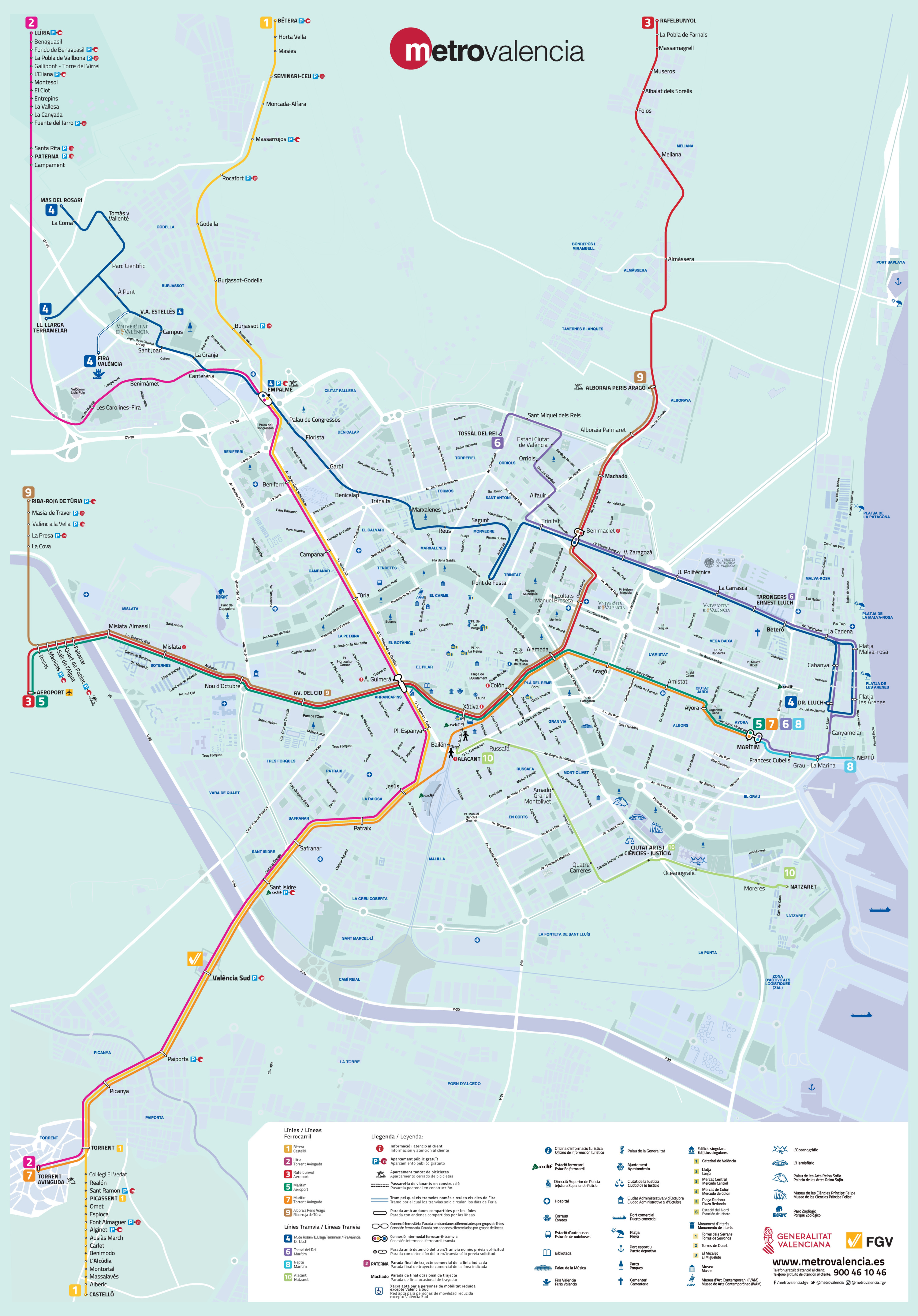
Valencia can be explored almost entirely by rail, both underground and above ground: the Valencia Metro map brings together ten lines that take you from the Old Town via the beaches to the airport. You can view and download the official Valencia Metro map as a zoomable PDF on this page. Here you will find the lines, 2026 ticket prices, the timetable and the airport connection.
Metrovalencia is one of the oldest local railways in Spain: its origin is the narrow-gauge Trenet, whose first line ran between Valencia and Llíria in 1888. Ferrocarrils de la Generalitat Valenciana took over modern operations in 1987, and the first underground section opened in 1988. Within Spain it stands alongside the Barcelona Metro as one of the country’s largest local rail networks; further along the Iberian Peninsula, the Lisbon Metro is a comparable system.
The network spans 161.4 route kilometers. Around 29.6 track-kilometers run in tunnels and 134.7 above ground. It comprises 147 stations, 38 underground and 109 above ground, and serves 35 municipalities in addition to Valencia. In 2025, the network carried around 91.6 million passengers.
The defining feature is its mixed character: classic tunnel and suburban rail lines meet above-ground tram lines, all built to meter gauge. Metro lines connect the city center and the airport, while the tram serves the coast and the harbor, among other areas. The city sits in Zone A, while the airport is a special fare zone; these zones divide the network into clear price bands.
System data 2026
Six lines are metro/rail lines and four are above-ground tram lines.
Metro/rail lines:
Tram lines / Tranvía:
By metro, travelers reach the Old Town, the Bioparc, the Ciudad de las Artes y las Ciencias and the airport. El Carmen, the Mercat Central and La Lonja are served by Xàtiva (L3, L5, L9) and Àngel Guimerà (L1, L2, L3, L5, L9). The Ciudad de las Artes y las Ciencias is connected by L10. You reach the Bioparc via Nou d’Octubre (L3, L5, L9). For the beaches and the harbor, tram lines run to Marítim.
Valencia Airport to the city: The Aeroport de València sits directly on L3 and L5. The ride to Xàtiva in the center takes around 20 minutes with no transfer. For AB+, the single ticket costs 4.80 € (approx. $5.48), or 2.00 € (approx. $2.28) per ride with TuiN.
Valencia Airport – three ways into the center: From Aeroport de València (Manises) you can choose between the metro, a taxi and the MetroBus 150. The metro is the fastest direct option, the bus the cheapest, and the taxi the most flexible around the clock.
| Mode | Time to center | Price (one-way) | Frequency & service |
|---|---|---|---|
| Metro L3/L5 | around 20 min (no transfer) | 4.80 € / approx. $5.48 (AB+); 2.00 € / approx. $2.28 with TuiN | frequent daytime service, daily |
| Taxi | around 20-25 min | usually 20-25 € / approx. $23-28 (incl. 12.50 € / approx. $14.25 airport supplement) | around the clock, 24 hours |
| MetroBus 150 (Fernanbus) | around 30 min | 1.45 € / approx. $1.65 (cash, on board) | every 23-30 min, Mon-Sat; no Sun/holidays |
| Destination | Line | Station | Note |
|---|---|---|---|
| Old Town, Mercat Central, La Lonja | L3, L5, L9 | Xàtiva | 5 to 15 minutes on foot |
| El Carmen, interchange hub | L1, L2, L3, L5, L9 | Àngel Guimerà | Station with the most lines in Spain |
| Ciudad de las Artes y las Ciencias, Oceanogràfic | L10 | Ciutat Arts i Ciències-Justícia | Tram, since 2022 |
| Malvarrosa and Las Arenas beaches | L4, L6, L8 | Platja les Arenes, Platja Malva-rosa | Tram to the coast |
| Bioparc and Turia park | L3, L5, L9 | Nou d'Octubre | around 10 minutes on foot |
| Aeroport de València airport | L3, L5 | Aeroport | around 20 minutes to the center |
| Harbor and Marítim beach | L4, L6 | Marítim | Tram lines |
The network charges by zone. Valencia lies in Zone A, while the airport is the special Zone +. A single Zone A ticket costs 1.50 € (approx. $1.71) and is valid for 90 minutes. The 40 percent discount on selected fares runs until December 31, 2026.
| Ticket | Price | Buy ticket |
|---|---|---|
| Single ticket, Zone A | 1.50 € (approx. $1.71) | View ticket |
| Single ticket, AB+ (airport) | 4.80 € (approx. $5.48) | View ticket |
| TuiN (1 zone) | 0.80 € (approx. $0.91) per ride | View ticket |
| TuiN, AB+ (airport) | 2.00 € (approx. $2.28) per ride | View ticket |
| SUMA 10, Zone A | 5.40 € (approx. $6.17) for 10 rides; 40% discount until Dec 31, 2026, regular 9.00 € | View ticket |
| SUMA T1 (24 h, AB) | 4.50 € (approx. $5.13) | Available on site |
| SUMA T2 (48 h, AB) | 7.50 € (approx. $8.55) | Available on site |
| SUMA T3 (72 h, AB) | 11.00 € (approx. $12.55) | Available on site |
Rates as of July 2026 (1 € = approx. $1.14). Source: Metrovalencia.
TuiN, SUMA 10 and the SUMA-T day passes all run on a rechargeable SUMA/Móbilis card. You buy and top it up at vending machines or in the FGV’s Metrovalencia oficial app. TuiN is validated on entry and exit in the metro, but only on entry on the tram. Children under ten travel free when accompanied. Traveling without a valid ticket costs 100.00 € (approx. $114.00) plus the ticket price.
The carrier card costs a one-time 1.10 € (approx. $1.25) in cardboard, 2.20 € (approx. $2.51) in plastic or 4.40 € (approx. $5.02) personalized. It is non-refundable.
Carrying bikes, pets & accessibility: New carry-on rules took effect on October 1, 2025. Folding bikes may travel folded across the whole network at any time. Conventional, non-folding bikes are capped at four per train, must ride in the last car and are not allowed in the tunnel sections or on the tram lines. Electric bikes, e-scooters and other personal mobility devices remain banned, except mobility aids for people with reduced mobility. Pets travel only in a carrier; assistance dogs may ride without one. On accessibility, the network is among Spain’s best: 99.5 percent of stations are step-free (84 elevators, 135 escalators), with only València Sud station on L1 still being rebuilt.
Operating hours and intervals vary by line, day of the week and station. For the exact first or last connection, use the official timetable information.
On Fridays, Saturdays and before public holidays, a metro and tram night service runs. The last departures through the center fall between 2:30 and 3:00 a.m. At night, the center is usually served every 10 to 20 minutes, and outer sections every 40 to 80 minutes.
The FGV Plan de Actuación 2026-2030 is worth around 839 million euros for the FGV network in Valencia and Alicante. Some 275 million euros are earmarked for modernizing existing infrastructure (tunnels, signalling, electrical systems), while further new lines and extensions are planned separately. After the DANA flash flood, passenger service on the southern network has been fully restored.
Fun Fact: The Alameda metro station was designed by architect Santiago Calatrava, who also created the neighboring Exposición bridge, popularly known as la Peineta. The station sits 10.5 meters below the old riverbed of the Turia.
The ghost station beneath the Mercat Central: Around 30 meters below the market hall lies a fully built station that never opened. Dug from 2007 for about 2.7 million euros using the cut-and-cover method – the deepest construction pit in the city at the time – it was meant to carry L10 through the Old Town to Pont de Fusta. The second construction phase, however, was never built; a five-level underground car park with 450 spaces opened above the shell in 2018. To this day, FGV does not rank the extension as a priority.
More metro maps
You buy tickets at vending machines or in the Metrovalencia oficial app. For TuiN and SUMA 10 you need a rechargeable carrier card costing 1.10 to 4.40 € (approx. $1.25 to $5.02).
SUMA T1 for 24 hours costs 4.50 € (approx. $5.13), T2 for 48 hours 7.50 € (approx. $8.55) and T3 for 72 hours 11.00 € (approx. $12.55). With the airport zone, T1+/T2+/T3+ cost 9.00 / 14.00 / 17.00 € (approx. $10.26 / $15.96 / $19.38).
L3 and L5 run directly from the Aeroport to Xàtiva in the center. The ride takes around 20 minutes; AB+ costs 4.80 € (approx. $5.48) as a single ticket or 2.00 € (approx. $2.28) with TuiN.
Metrovalencia operates ten lines: six metro/rail lines and four tram lines.
Folding bikes may travel folded at any time. Non-folding bikes are limited to four per train, ride in the last car and only on above-ground sections. E-scooters and electric bikes have not been allowed since October 2025.
You might also be interested in these metro maps – for comparison or for your next trip: