Beijing Subway Map 2026: Lines, Tickets & Prices
Last updated: August 20, 2026

Last updated: August 20, 2026
Current Beijing Subway service updates
Guangqumenwai on Line 17 remains temporarily closed, while Wangjingxi opened on January 31, 2026 as a three-line interchange. Official English service information is available for Lines 4-Daxing, 14, 16 and 17.
The Beijing Subway map provides an overview of a large and still-changing network. The June 2026 image is bilingual, so English-speaking visitors can match line numbers, interchange stations and airport branches before entering a station.
The Beijing Subway Map PDF is available for offline use, and its central interchange cluster can be enlarged before travel. The phrase Beijing metro map is also widely used, but the network’s English name is Beijing Subway.
Contents
Three subway expansions began trial operation on the same day, December 27, 2025: Line 17’s central section, Line 18 and the Line 6 southern extension, according to the city’s opening announcement.
The December 27, 2025 openings added 8.2 km and four stations on Line 17, 19.8 km and 11 stations on Line 18, and about 2 km with one station on the Line 6 southern extension. Guangqumenwai did not open with the Line 17 section.
A June 2026 municipal transport update reports 27 operating subway lines as of June 4, 2026.
After the December 27, 2025 openings, Beijing reported 30 operating urban-rail routes, 539 operating stations, 106 transfer stations and 909 km. This is not a subway-only count because Beijing’s urban-rail category also covers tram and other rail modes.
Operating responsibilities are shared. Beijing MTR runs Lines 4-Daxing, 14, 16 and 17 under several models. Its passenger hotline is 96123, while Beijing Mass Transit Railway Operation Corp. uses passenger hotline 96165.
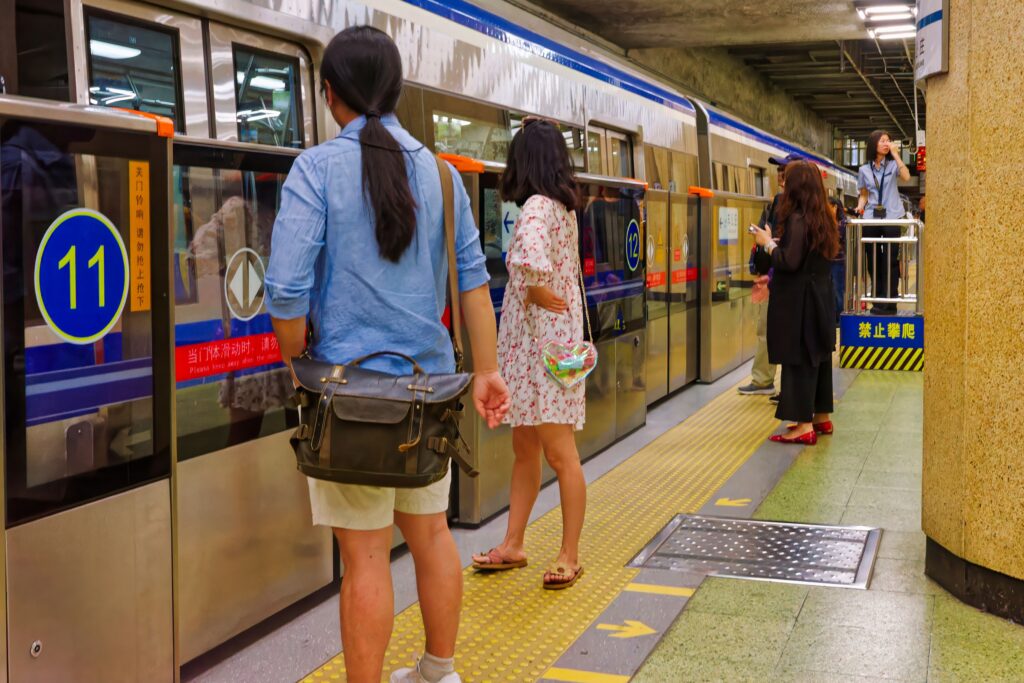
The Beijing Subway map uses line numbers and station names to organize journeys. For visitor trips, these services and interchanges cover the most common airport, sightseeing and railway connections:
Other useful interchange names visible across the network include Jianguomen, Fuxingmen, Ping’anli, Xi’erqi, Gongzhufen and Huoying. Route planning depends on the destination and direction because one station can have different first and last trains by direction.
Beijing Suburban Railway is a separate rail system, not another group of subway lines. This matters for a Badaling Great Wall trip, where the connection continues by high-speed or suburban train.
The Xijiao and Yizhuang T1 services are trams. Beijing BRT is a bus system. These systems are excluded from subway-only line, station and route-length totals.
The official 30-route, 539-station and 909-km headline is therefore a broader urban-rail aggregate. It must not be read as a 30-line subway-only total.
Security screening is part of station access, and platform signs show the direction and train destination.
For each attraction on the Beijing metro map, choose the most practical approach station. Tian’anmen Square on East Chang’an Avenue and the Forbidden City share an area but have different reservation and entrance rules and are therefore separate visits.
The Destinations table pairs each attraction with its line and approach station. Badaling and Mutianyu are included only with an explicit onward rail or bus connection because neither site has a subway station.
| Attraction or destination | Line | Station | Practical note |
|---|---|---|---|
| Tian'anmen Square | 1 | Tian'anmen East or Tian'anmen West | The square is on East Chang'an Avenue; a reservation 1 to 7 days ahead requires each visitor's name and passport number. |
| Forbidden City | 1 | Tian'anmen East or Tian'anmen West | These are approach stations; Meridian Gate is the sole entrance. No same-day tickets are sold, and the original booking document is required. |
| Temple of Heaven | 5 or 8 | Tiantandongmen or Tianqiao | Tiantandongmen Exit A or Tianqiao Exit C provides access. |
| Summer Palace | 4 | Xiyuan or Beigongmen | Xiyuan serves East Palace Gate; Beigongmen serves North Palace Gate. |
| Yonghegong (Lama Temple) | 2 or 5 | Yonghegong (Lama Temple) | This is a direct interchange between Lines 2 and 5. |
| Wangfujing | 1 or 8 | Wangfujing | Both lines serve the central shopping district. |
| Bird's Nest and Water Cube | 8 | Olympic Sports Center | Olympic Sports Center serves both venues. |
| Olympic Park | 8 or 15 | Olympic Park | Lines 8 and 15 both serve the interchange. |
| Nanluoguxiang | 6 or 8 | Nanluoguxiang | The shared station serves the surrounding hutong district. |
| Beijing Capital International Airport (PEK) | Capital Airport Line | Terminal 2 or Terminal 3 | Terminal 1 has no direct rail station. |
| Beijing Daxing International Airport (PKX) | Daxing Airport Express | Daxing Airport Station | The station is on B1 inside the terminal. |
| Badaling or Mutianyu Great Wall | No direct subway | Continue by mainline rail, suburban rail or bus | Badaling connects from Beijing North or Qinghe; Mutianyu requires a bus connection from Dongzhimen. |
The network does not provide a direct connection to the Great Wall. Badaling and Mutianyu have no direct subway station; subway routes reach transfer points, while the final segment uses mainline rail, suburban rail or bus.
Badaling connections depart from Beijing North Railway Station beside Xizhimen or from Qinghe Railway Station on Line 13 or the Changping Line. High-speed trains cover the rail segment to Badaling in about 30 minutes, excluding subway access and transfer time.
The S2 suburban service runs through Nankou toward Badaling, while its former Huangtudian origin has been closed since October 25, 2025. Bus 877 from Beitucheng provides another nonstop connection to Badaling.
Mutianyu is reached by the 916 Express from Dongzhimen, followed by a transfer at Huairoubeidajie to local bus H23, H3 or H71. This is a bus connection beyond the subway network.
PEK and PKX use different airport lines, stations and fares. The airport code determines the required service because the Capital Airport Line does not serve Daxing, and the Daxing Airport Express does not serve Capital Airport.
For PEK, the Capital Airport Line serves Terminal 3 and Terminal 2; Terminal 1 has no station. The airport’s Capital Airport Line information lists core-network interchanges at Dongzhimen, Sanyuanqiao and Beixinqiao and service about every 10 minutes.
Scheduled travel time from Dongzhimen is 22 minutes to Terminal 3 and 36 minutes to Terminal 2. In the other direction, it is 39 minutes from Terminal 3 and 25 minutes from Terminal 2. These are station-to-station schedule times.
For PKX, the Daxing Airport Express serves Daxing Airport Station on B1 inside the terminal. Caoqiao provides the interchange with Lines 10 and 19.
Beijing MTR Operation Administration reports a travel time of about 20 minutes from Caoqiao Station to Daxing Airport Station. From 5:41 AM to 10:30 PM, intervals are no longer than 9 minutes 20 seconds; from 10:30 PM to 11:00 PM, they are 15 minutes. No frequency is published for the Sunday 11:00 PM to 11:30 PM extension.
| Airport | Line | Terminals and station | Core interchange | Typical time | Fare and service window |
|---|---|---|---|---|---|
| Beijing Capital International Airport (PEK) | Capital Airport Line | Terminal 3 and Terminal 2; Terminal 1 has no direct station | Dongzhimen for Lines 2 and 13; Sanyuanqiao for Lines 10 and 12; Beixinqiao for Line 5 | From Dongzhimen: 22 minutes to T3 and 36 minutes to T2; return: 39 minutes from T3 and 25 minutes from T2 | CNY 25 (≈ USD 3.68); Dongzhimen to airport 6:00 AM to 10:30 PM; T3 to city 6:22 AM to 10:52 PM; T2 to city 6:36 AM to 11:10 PM |
| Beijing Daxing International Airport (PKX) | Daxing Airport Express | Daxing Airport Station on B1 inside the terminal | Caoqiao for Lines 10 and 19 | About 20 minutes from Caoqiao Station to Daxing Airport Station | Caoqiao to airport CNY 35 (≈ USD 5.16); Caoqiao departures 5:30 AM to 10:30 PM; airport departures Monday to Saturday 6:00 AM to 11:00 PM and Sunday 6:00 AM to 11:30 PM |
USD conversions in the airport comparison use the August 14, 2026 exchange rate. The listed prices apply only to the airport rail services.
| Ticket | Price | Where to buy |
|---|---|---|
| Capital Airport Line single journey | CNY 25 (≈ USD 3.68) | Available at the airport line station; eligible foreign contactless cards work at fare gates across the network. |
| Daxing Airport Express standard single journey | Up to 20 km: CNY 10 (≈ USD 1.47); up to 30 km: CNY 25 (≈ USD 3.68); over 30 km: CNY 35 (≈ USD 5.16) | Tickets are available from station ticket machines; eligible foreign cards can also be tapped at the gate. |
| Daxing Airport Express Business Class | CNY 50 (≈ USD 7.37) | Available locally at Daxing Airport Express stations. |
Prices as of August 2026; source: Beijing Capital International Airport rail fare information and Beijing MTR Operation Administration airport fare rules.
International visitors can tap eligible UnionPay, Mastercard, Visa, JCB or American Express contactless cards at fare gates across the Beijing Subway network without an app or advance ticket. The city’s international payment guidance confirms that the same five card networks also support station ticket purchases and top-ups.
On the PKX line, one person uses one card and the same physical card or mobile wallet at both gates. Security screening can add time to station access, particularly with luggage.
Yikatong is accepted on the Daxing Airport Express. An eligible bank card can also be tapped directly without buying, loading or returning a stored-value card.
There is no single network-wide closing time. First and last trains vary by station, direction and short-turn destination, so the boarding station’s timetable matters more than a citywide estimate.
The official Tian’anmen East timetable shows Line 1 trains toward Universal Resort from 5:21 AM to 11:23 PM, with short-turn service toward Sihui East until 12:05 AM. Trains toward Pingguoyuan run from 5:12 AM to 11:48 PM.
At Wangfujing on Line 1, the equivalent windows are 5:23 AM to 11:25 PM toward Universal Resort, with short-turn service until 12:07 AM, and 5:10 AM to 11:46 PM toward Pingguoyuan.
At Tiantandongmen on Line 5, service toward Tiantongyuan North runs from 5:27 AM to 11:18 PM; toward Songjiazhuang it runs from 5:43 AM to 11:31 PM. Olympic Park Line 15 has different direction-specific times.
Scheduled minimum intervals also vary. Line 14 trains run every 3 minutes on the weekday morning-peak short-route section and every 6 minutes on outer sections, while some weekend off-peak sections have 8-minute intervals.
Lines 16 and 17 use 6-minute peak and 8-minute off-peak or weekend minimum intervals. Holiday and major-event schedules can extend service or temporarily change station access.
A Beijing Municipal Government notice for the May Day 2026 return peak reports later subway trains alongside night buses, shuttles, taxis and ride-hailing support, but those arrangements were event-specific rather than normal service.
After the subway closes, night bus routes serving Beijing Railway Station include Night 5, 19, 24, 28 and 29.
The Beijing Subway map distinguishes operating infrastructure from future projects. Three sections opened on December 27, 2025, and Wangjingxi Station on Line 17 opened on January 31, 2026. Guangqumenwai remains temporarily closed.
Beijing’s 2026 urban-rail construction program covers nine projects totaling 150.6 km. This is a construction program, not an addition to current operating totals.
Line 22 between Hongmiao and Pinggu is under construction and has a late-2026 opening target after an earlier 2025 target was missed. The target does not mean that the line is already open.
The Daxing Airport Express north extension to Lize is also under construction. Its latest announced target is the end of June 2027, following earlier 2025 and 2026 targets.
M101 Phase I was under construction in early 2026. Major construction on Line 19 Phase II began on February 24, and R4 Phase I North began on June 2. These projects have no announced opening year.
Line 11 Phase II remains planned rather than under construction: its integrated plan has been formally approved, but construction has not begun. R1, also called the Jingxiong Express, is a separate regional railway and was still in testing and preparation in July 2026.
Fun Fact: Beijing’s first subway grew out of a civil-defense project: its first phase was completed in October 1969, but public trial service began only on January 15, 1971, using special visit tickets.
Security screening is part of station access, and platform signs show the direction and train destination.
An eligible contactless UnionPay, Mastercard, Visa, JCB or American Express card can be tapped directly at fare gates across the Beijing Subway network. This payment option requires no app or advance ticket.
The Beijing Subway map and line numbers provide consistent references. Route planning includes the destination, interchange stations and return direction.
Capital Airport Line serves PEK, and Daxing Airport Express serves PKX. PEK’s Capital Airport Line serves T3 and T2, not T1, and connects at Dongzhimen, Sanyuanqiao and Beixinqiao. From Dongzhimen, the scheduled trip takes 22 minutes to T3 and 36 minutes to T2. The fare is CNY 25 (≈ USD 3.68).
PKX’s Daxing Airport Express serves the B1 station inside the terminal and connects with Lines 10 and 19 at Caoqiao. The trip takes about 20 minutes from Caoqiao Station to Daxing Airport Station and costs CNY 35 (≈ USD 5.16).
Beijing had 27 operating subway lines as of June 4, 2026. Separately, the broader urban-rail category reports 30 operating routes, 539 operating stations and 909 km and includes other rail modes.
There is no network-wide closing time. Last trains vary by line, station, direction and short-turn destination. At Tian’anmen East, the last train toward Universal Resort leaves at 11:23 PM, while short-turn service toward Sihui East continues until 12:05 AM. At Wangfujing, the corresponding times are 11:25 PM and 12:07 AM.
Qinghe Railway Station is integrated with Line 13 and the Changping Line. Line 19 is a future connection, not a current service at Qinghe.
The Beijing Subway does not reach Badaling or Mutianyu directly. Badaling connections depart from Beijing North beside Xizhimen, from Qinghe or via Bus 877 from Beitucheng. Mutianyu connections use the 916 Express from Dongzhimen and local buses from Huairoubeidajie.
You might also be interested in these metro maps – for comparison or for your next trip: