Rotterdam Metro Map 2026: Lines, Tickets & Prices
Last updated: August 20, 2026

Last updated: August 20, 2026
Current Rotterdam Metro service updates
RET publishes disruptions, diversions and longer elevator or escalator outages through its current travel notices. Check the journey planner shortly before departure because work and special events can alter individual trips.
All current notices: RET service updates.
The Rotterdam Metro Map shows five lines, A through E, across a network of 70 physical stations in the RET timetable dated August 12, 2026. Download the official RET PDF above, then use this guide for routes, current fares, airport transfers and service patterns.
Contents
Rotterdam opened the Netherlands’ first metro on February 9, 1968. Today, Rotterdamse Elektrische Tram, usually shortened to RET, operates the five routes shown on the Rotterdam Metro Map.
RET’s timetable dated August 12, 2026 serves 70 physical stations. RET describes a network of more than 100 km, and the MRDH 2024 public-transport monitor recorded 100,654,477 boardings and check-ins. Transfers count again in that total.
The metro is only one part of local transport. RET organizes metro, tram and bus as separate operations. Waterbus has its own routes and tickets, while NS trains serve national rail stations such as Rotterdam Centraal, Alexander and Blaak.
The current RET route diagram assigns each service its own official color. Standard endpoints are useful for checking direction, although short workings and temporary timetable changes can end earlier.
Beurs is the only interchange shown for all five routes. Rotterdam Centraal connects Lines D and E with NS trains, while Schiedam Centrum and Blaak connect Lines A, B and C with the national rail network.
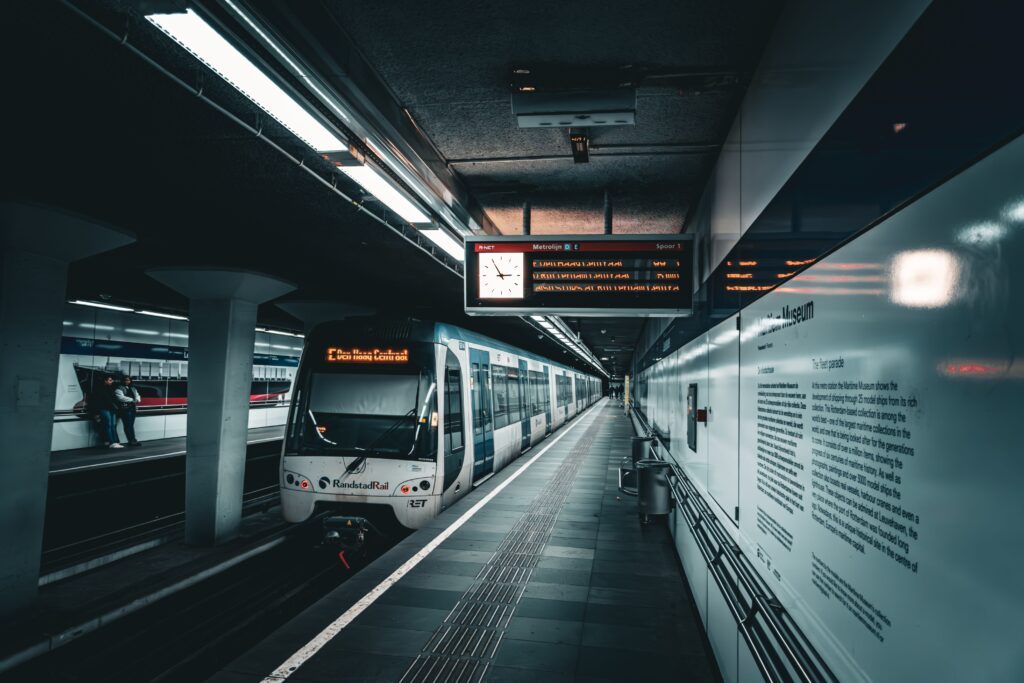
Line E is RET’s RandstadRail metro service between Rotterdam and Den Haag. HTM operates the separate RandstadRail branches toward Zoetermeer, so those tram services should not be counted as extra Rotterdam lines.
A direct Line E trip from Rotterdam Centraal to Den Haag Centraal takes 32 scheduled minutes in RET’s timetable dated August 12, 2026. Travelers should still check the departure selected for their trip.
Pay-as-you-go remains distance-based, with 2026 rates of EUR 0.178 per km (≈ USD 0.21 per km) in Rotterdam and EUR 0.201 per km (≈ USD 0.23 per km) in Den Haag. RET’s 2026 Uit-kaartje is not valid between Berkel Westpolder and Den Haag Centraal, an important product boundary for regional travel.
Line B continues west on the Hoekse Lijn to Hoek van Holland Strand. RET opened the final 1.2 km extension on March 31, 2023, placing the terminal close to the North Sea beach.
RET’s March 2023 opening release gave 37 minutes for the direct journey from Beurs to the beach. Rotterdam Centraal is not on Line B, so travelers change at Beurs. A Line D or E trip followed by Line B at Beurs took about 47 minutes in RET’s August 12, 2026 timetable, but the actual connection depends on the departure.
RET planned additional Line B trips from early May for the 2026 beach season. The operator also adds evening service on warm summer days, while noting that passengers use the coastal link in spring and fall as well.
Choose the line letter, then follow the destination shown at the end of that route. For cross-city trips, Beurs is the main A-E transfer point. NS symbols mark rail interchanges, not additional metro routes.
The local and official term is “metro”; “subway” is the common American English equivalent. The PDF uses a Dutch legend; station names, line letters and colors remain the key navigation cues.
For most trips, identify the nearest station, choose the line by letter and board toward its terminal. Central interchanges make the five-line system easy to combine, while some attractions still require a walk or a separate surface service.
The destination matrix keeps metro access separate from a more convenient tram or walking approach. It lists the line, nearest station and the practical final step for seven popular places.
Rotterdam The Hague Airport has no direct metro terminal. From Rotterdam Centraal, take Line E to Meijersplein/Airport and change to bus 33, which stops beside the departures hall.
Bus 33 also runs directly from Rotterdam Centraal to the airport. The airport’s public-transport directions state that this direct bus trip takes under 30 minutes. That time does not describe the Line E plus bus connection, whose total varies with the transfer.
Travelers can use OVpay at full fare. Bus 533 is an additional Meijersplein to airport shuttle listed in the standard planner, with its pilot scheduled through summer 2027.
Schiphol’s NS station is directly below the terminal. Intercity direct connects the airport with Rotterdam Centraal in 26 minutes, often without a change, before passengers transfer separately to Lines D or E.
The NS train from Schiphol Airport and the RET Metro require separate fares. The domestic Intercity direct supplement is EUR 3.20 (≈ USD 3.71), or EUR 1.92 (≈ USD 2.23) off-peak at a supplement pole, on top of the NS ticket.
| Destination | Line | Station | Practical note |
|---|---|---|---|
| Markthal and Cube Houses | A, B, C | Blaak | Markthal is directly beside the station. |
| Kop van Zuid, Wilhelminapier and south side of Erasmus Bridge | D, E | Wilhelminaplein | Continue on foot to Wilhelminapier; this stop is for the south side. |
| Euromast | A, B, C | Coolhaven | Continue on foot; Tram 8 to Euromast is the more direct surface option. |
| Museumpark and Kunsthal | A, B, C or D, E | Eendrachtsplein or Leuvehaven | Either station is about a 7-minute walk; Dijkzigt is about 10 minutes. |
| Rotterdam Centraal | D, E | Rotterdam Centraal | Transfer here between the two metro routes and NS trains. |
| Kralingse Bos and Kralingse Plas | A, B, C | Voorschoterlaan | No station is inside the park; allow a substantial walk or use a connecting service. |
| Diergaarde Blijdorp | D, E | Rotterdam Centraal | Walk about 10 minutes from the rear of the station toward the Riviera Hall side. |
Fares are distance-based unless a time or day product is chosen. RET’s 2026 travel-balance conditions set pay-as-you-go at EUR 1.16 (≈ USD 1.35), then add EUR 0.178 per km (≈ USD 0.21 per km) in Rotterdam or EUR 0.201 per km (≈ USD 0.23 per km) in Den Haag. These prices apply as of August 12, 2026.
The USD conversions use the European Central Bank reference rate of EUR 1 = USD 1.1605 on August 19, 2026. Products have different time limits and network boundaries, so the cheapest choice depends on the number and type of trips.
| Ticket | Price | Buy ticket |
|---|---|---|
| Pay as you go | EUR 1.16 (≈ USD 1.35) base plus EUR 0.178/km (≈ USD 0.21/km) in Rotterdam or EUR 0.201/km (≈ USD 0.23/km) in Den Haag | Use OVpay or an OV-chipkaart at the gate. |
| RET 2 hours | EUR 5.50 (≈ USD 6.38) | Available locally; unlimited RET bus, tram and metro travel for two consecutive hours. |
| RET 1 day adult | EUR 12.00 (≈ USD 13.93) | RET app: Google Play and Apple App Store; developer and provider: Rotterdamse Electrische Tram N.V. / RET N.V.; also at metro machines, RET Service Point and Primera. |
| RET 1 day child, ages 4 to 11 | EUR 6.00 (≈ USD 6.96) | Available locally. |
| RET 1 day family | EUR 21.00 (≈ USD 24.37) | App-only via RET app: Google Play and Apple App Store; developer and provider: Rotterdamse Electrische Tram N.V. / RET N.V. |
| RET 1 day group for 2/3/4/5 people | EUR 24.00/27.00/29.50/32.00 (≈ USD 27.85/31.33/34.23/37.14) | App-only via RET app: Google Play and Apple App Store; developer and provider: Rotterdamse Electrische Tram N.V. / RET N.V. |
| Tourist Day Ticket | EUR 17.50 (≈ USD 20.31) | Sold at metro ticket and top-up machines; valid on participating South Holland bus, tram, metro and OV-Waterbus services, but not trains or night buses. |
The purchase and validation process starts after choosing a fare. Contactless OVpay accepts Maestro, Mastercard, V PAY and Visa through a physical debit or credit card, smartphone or smartwatch, without preregistration.
Each traveler needs a separate payment medium. Tap in at the gate or post and tap out with the exact same card or device. A physical card and its phone-wallet version count as different cards, even when both use the same bank account.
At a transfer, check out from the first service and check in for the next. A change within 35 minutes normally charges the base fare only once, except when transferring to or from an NS train.
At Rotterdam Centraal, an airport passenger must check out from NS and then check in with RET. The national train and the local network are separate operators with separate fares.
Keep unused cards away from the reader to avoid card clash. A missed RET check-out normally triggers a EUR 4.00 (≈ USD 4.64) correction fare. OVpay errors can be corrected from six hours after travel until 60 days later.
An OV-chipkaart also works for one passenger at a time and requires check-in and check-out, including transfers. The 1-day product ends no later than 4:00 AM the next day, so it is not a rolling 24-hour ticket.
There is no reliable single opening and closing time for the entire system. RET publishes schedules by route, date, direction and station, and first and last departures vary materially between weekdays and weekends.
For example, the September 2026 timetable shows Line D departures from Rotterdam Centraal from 5:50 AM to 12:47 AM on Tuesday. On Friday and Saturday, the last departure was 1:50 AM.
On central sections of Lines A through D, trains usually ran every 10 minutes during weekday daytime service and every 15 minutes later. Sunday service was usually every 15 minutes in the September 2026 timetables.
Outer branches differ. In the September 2026 timetables, the Line B beach branch ran mostly every 20 minutes by day and every 30 minutes later on Tuesday. Line E was roughly every five minutes through inner Rotterdam, while direct service to Den Haag was mostly every 10 minutes.
Rotterdam Metro closing times depend on the route and day. Individual weekend tables include departures around 2:00 AM, followed by an overnight gap, while some Sunday morning services start substantially later than weekday trains.
Use the journey-planner button above for an exact trip. RET’s schedule is organized by line, direction, date and station, which is more dependable than a single citywide last-train time.
The system is not a 24-hour service. RET instead operates 13 night-bus routes on Friday night into Saturday and Saturday night into Sunday, generally from about 12:45 AM until after 6:00 AM.
Night buses usually run hourly. Services toward Hoogvliet and Spijkenisse can run every 30 minutes. Current route numbers are 1, 2, 3, 4, 5, 7, 8, 9, 10, 11, 13, 16 and 19; route 13 serves Rotterdam Airport.
Current investment centers on capacity, vehicles, workshops, signaling and station projects rather than a newly approved route. MRDH’s February 2026 investment decision committed almost EUR 1 billion (≈ USD 1.2 billion) to modernization, with several milestones extending into the 2030s.
The Oostflank decision illustrates why proposals need careful labeling. Metro was one option studied in 2020, but the current official solution is a new tram between Zuidplein and Kralingse Zoom, not a new line for this network.
Fun Fact: In 2024, passengers traveled 689,159,150 passenger-km across the system.
The PDF Download button opens the official one-page A3 RET map with a Dutch legend.
Choose a line letter and board toward the terminal shown for your direction. Beurs connects all five lines, while Rotterdam Centraal links Lines D and E with NS trains.
Use OVpay with a contactless card, phone or watch, or use an OV-chipkaart or time-based ticket. Every passenger must check in and check out with the same payment medium.
The 2026 pay-as-you-go fare starts at EUR 1.16 (≈ USD 1.35), then adds EUR 0.178 per km (≈ USD 0.21 per km) in Rotterdam or EUR 0.201 per km (≈ USD 0.23 per km) in Den Haag. Fixed options include a EUR 5.50 (≈ USD 6.38) two-hour ticket and a EUR 12.00 (≈ USD 13.93) adult day ticket.
Last trains vary by line, station and day. September 2026 weekend timetables include departures around 2:00 AM, but the system then closes for an overnight gap. Check the selected journey before travel.
Yes. The city has a five-line rapid-transit system, locally called the Rotterdam Metro. In American English, “subway” is the common equivalent.
Yes. RET also operates trams, but tram and metro are separate operations. Do not count tram routes, buses, Waterbus routes or NS trains as extra metro lines.
There is no station at the terminal. Take Line E to Meijersplein/Airport and transfer to bus 33, or take direct bus 33 from Rotterdam Centraal, which the airport says takes under 30 minutes.
Take an NS train from the station below the terminal at Schiphol Airport to Rotterdam Centraal. Intercity direct takes 26 minutes; check out from NS, then enter RET separately on Line D or E.
Yes. Line E reaches Den Haag Centraal, while Line B reaches Hoek van Holland Strand. The RET timetable dated August 12, 2026 gives 32 minutes from Rotterdam Centraal to Den Haag; the March 2023 RET opening release gave 37 minutes from Beurs to the beach.
You might also be interested in these metro maps – for comparison or for your next trip: