Brussels Metro Map 2026 (STIB-MIVB): Lines, Tickets & Fares
Last updated: August 20, 2026

Last updated: August 20, 2026
Current Brussels Metro Service Updates
Trams 4 and 10 are suspended between Porte de Hal/Hallepoort and Gare du Midi/Zuidstation until the end of April 2027 because of construction on the central Premetro corridor. Before traveling, check the official traffic information for planned works, strikes and real-time changes.
The Brussels Metro Map for 2026 is the current full-size STIB-MIVB network plan for the Brupass zone (the shared Brussels fare zone). This STIB map has English legend text. It shows the four genuine Metro lines, 1, 2, 5 and 6, together with connecting tram, bus and rail services. The plan is dated April 2026 and valid from April 27, 2026.
This guide explains the Metro and Premetro distinction, the most useful stations for visitors, airport connections, 2026 fares, operating patterns and the latest official Metro 3 status.
Brussels celebrates 50 years of Metro service in 2026: the first genuine Metro opened on September 20, 1976. STIB-MIVB, the Brussels public transport operator, operates today’s four-line network, whose Metro axis measures 39.8 km.
The opening network formed an 11 km Y with 16 inaugurated stations. The operator’s annual operating statistics report 69 Metro and Premetro stations combined. The figure includes underground Premetro tram stops, so it is not a Metro-only station count.
Lines 1 and 5 share the central section from Beekkant to Merode. Lines 2 and 6 share the Simonis to Elisabeth section, while Line 6 continues toward Heysel/Heizel and Roi Baudouin.
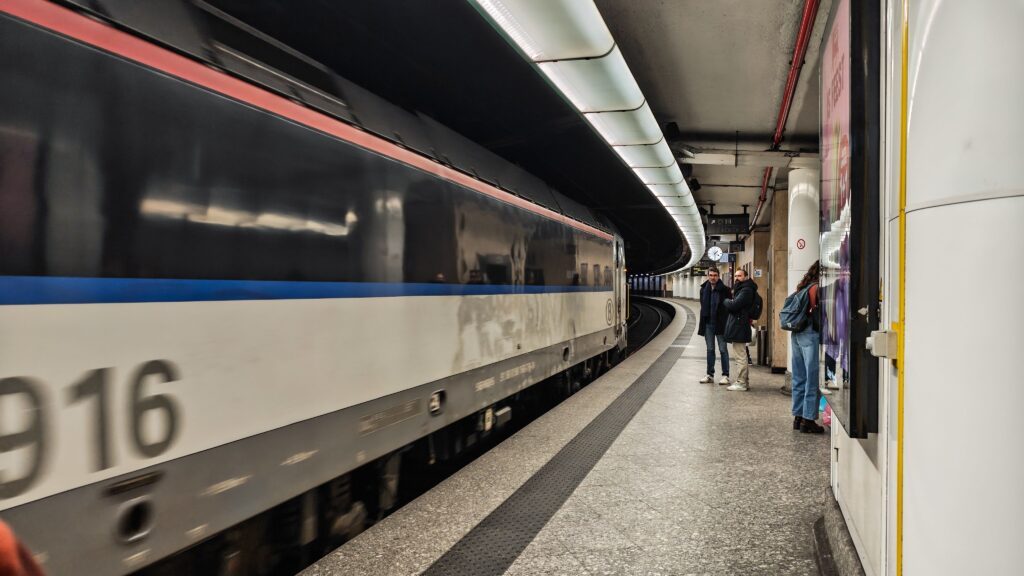
The published line lengths are 12.5 km for Line 1, 10.3 km for Line 2, 17.3 km for Line 5 and 15.5 km for Line 6. Because lines share track, adding these figures does not give the total route length of 39.8 km.
Premetro is tram service through underground infrastructure, not an extra part of the four-line Brussels Metro. This distinction matters because an underground platform can look like a subway station even though the vehicle remains a tram.
Trams 4 and 10 use the central North to Midi Premetro corridor. Bourse/Beurs is a Premetro stop served by those trams, not a genuine Metro station. Tram 7 remains a tram service between Heysel and Vanderkindere.
The old Tram 3 designation is not current. Tram 10 took over its corridor in 2024, and the 2026 official feed and current Brussels Metro Map contain no standalone Line 3.
| Mode | Lines or services | How it appears on maps | What travelers need to know |
|---|---|---|---|
| Metro | Lines 1, 2, 5 and 6 | Numbered Metro routes with their official color codes | These are the only four genuine Brussels Metro lines in 2026. |
| Central Premetro | Trams 4 and 10 | Tram routes entering an underground central corridor | The vehicles remain trams. Bourse/Beurs is a Premetro stop, and current works affect the Midi section. |
| Tram 7 | Heysel to Vanderkindere service | A numbered tram route that connects with the wider rapid-transit network | It is not a Metro line. A replacement bus runs north of Docks until August 30, 2026. |
| Former Tram 3 | Replaced by Tram 10 in 2024 | No standalone Line 3 on the April 2026 network plan | Do not confuse the former tram number with the Metro 3 construction program. |
The Metro works best as one part of a multimodal city network. Metro lines cover major interchanges and outlying attractions, while Premetro trams, surface trams, buses, SNCB/NMBS trains and short walks often provide the more direct central connection.
For Grand-Place, take Lines 1 or 5 to Gare Centrale and continue on foot. Bourse/Beurs may look Metro-like underground, but it is a Premetro stop for trams 4 and 10. Manneken Pis is a walking continuation from the Grand-Place area, not a separate Metro destination.
Use Line 6 to Heysel/Heizel for the Atomium, Lines 1 or 5 to Schuman for the European Quarter and Lines 2 or 6 to Louise/Louiza for the Palace of Justice area.
| Sight | Line | Station | Practical tip |
|---|---|---|---|
| Grand-Place | Metro 1 or 5 | Gare Centrale | Continue on foot through the historic center. |
| Manneken Pis | Metro 1 or 5 | Gare Centrale | A short walk from Grand-Place; it has no station of its own. |
| Atomium | Metro 6 | Heysel/Heizel | Line 6 is the direct Metro route for the Atomium area. |
| European Quarter | Metro 1 or 5 | Schuman | Schuman is the mapped stop for the European Commission area. |
| Parc du Cinquantenaire | Metro 1 or 5 | Merode or Schuman | Both stations are a short walk from the park. |
| Sablon and Marolles | Metro 2 or 6 | Porte de Hal/Hallepoort | Bus 95 serves Grand Sablon; trams 8, 92 and 93 serve Poelaert. |
| Palace of Justice | Metro 2 or 6 | Louise/Louiza | Continue from Louise toward the Palace of Justice area. |
| Royal Palace | Metro 2 or 6 | Trône/Troon | Trône/Troon is the mapped Metro stop for the Royal Palace. |
| Bourse/Beurs | Premetro trams 4 and 10 | Bourse/Beurs | This underground stop is Premetro, not Metro. Check the current construction diversion. |
Brussels Airport, BRU, has no Metro line. Direct SNCB/NMBS trains run several times per hour, with fewer services on weekends and late in the evening, and take approximately 11 minutes from Bruxelles-Nord, 18 minutes from Bruxelles-Central and 23 minutes from Bruxelles-Midi, according to the official airport rail details. The airport station is directly below the terminal at level -1.
Airport rail tickets generally include the Brussels Airport Supplement, formerly called the Diabolo fee. When it is not included, the supplement rules set the charge at €6.90 (≈ $7.96).
Airport Line 12 is the road-based alternative and reaches the European Quarter in about 30 minutes, serving Schuman, Maelbeek and Luxembourg. From the airport toward the city, the airport bus fare details list Airport2City at €7.90 (≈ $9.11) contactless or on MOBIB and €8.40 (≈ $9.69) on paper.
An Airport2City ticket includes STIB transfers within the first hour, with connections at Schuman for Lines 1 and 5 and Trône/Troon for Lines 2 and 6. In the opposite direction, from the city to Brussels Airport, normal STIB tickets apply.
Brussels South Charleroi Airport, CRL, is a separate airport with no terminal rail station. The non-stop Flibco shuttle from Bruxelles-Midi runs about every 20 minutes and takes around 55 to 60 minutes. Check the current shuttle schedule and fare before booking.
A single STIB journey costs €2.40 (≈ $2.77) contactless, and contactless charges are capped at €8.50 (≈ $9.80) per day. STIB-only products suit travelers using Metro, tram and bus within the operator’s network, and contactless payment is usually the simplest choice for individual journeys. The current fare schedule has applied since February 1, 2026.
Brupass combines STIB-MIVB, second-class SNCB/NMBS, De Lijn and TEC within the Brussels zone. Brupass XL extends the zone by an 11.5 km outer ring and adds 200 TEC and De Lijn bus stops; the XL area covers more than 50 SNCB/NMBS train stations in total, but it does not cover Line 12 from Brussels Airport.
MOBIB is the reusable smartcard for loaded products. The card costs €6.00 (≈ $6.92), lasts five years, and the anonymous Basic version can suit travelers who need products beyond simple bank-card tapping.
The official Brussels Card combines admission to participating museums with discounts for 24, 48 or 72 hours. Transport is a separate matching-duration add-on with unlimited STIB-MIVB bus, tram and Metro travel, including Noctis and Line 12 in both airport directions, but no trains; it is not Brupass.
| Ticket | Price | Buy ticket |
|---|---|---|
| STIB contactless single | €2.40 (≈ $2.77) | Tap an accepted contactless bank card or wallet at the validator. |
| STIB paper single | €2.90 (≈ $3.35) | Available from red GO machines, KIOSK and BOOTIK, not on board. |
| STIB contactless daily cap | Maximum €8.50 (≈ $9.80) | Applied automatically to the same contactless payment token. |
| STIB paper day ticket | €9.00 (≈ $10.38) | Available from official station sales channels. |
| Brupass single | €2.70 (≈ $3.11) | Official STIB-MIVB app: Apple App Store and Google Play, or official sales channels. |
| Brupass 10 journeys | €18.90 (≈ $21.80) | Official STIB-MIVB app: Apple App Store and Google Play, or official sales channels. |
| Brupass day ticket | €9.50 (≈ $10.96) | Available from official sales channels. |
| Brupass XL single | €3.60 (≈ $4.15) | Official STIB-MIVB app: Apple App Store and Google Play, or official sales channels. |
| Brupass XL 10 journeys | €25.20 (≈ $29.07) | Official STIB-MIVB app: Apple App Store and Google Play, or official sales channels. |
| MOBIB or MOBIB Basic card | €6.00 (≈ $6.92) | Available through official STIB-MIVB sales channels. |
| Brussels Card 24 h + STIB option | €41.00 (≈ $47.29) + €9.00 (≈ $10.38) | Official Brussels Card shop, or the official Brussels Card app: Apple App Store and Google Play. |
| Brussels Card 48 h + STIB option | €53.00 (≈ $61.14) + €16.95 (≈ $19.55) | Official Brussels Card shop, or the official Brussels Card app: Apple App Store and Google Play. |
| Brussels Card 72 h + STIB option | €59.00 (≈ $68.06) + €21.50 (≈ $24.80) | Official Brussels Card shop, or the official Brussels Card app: Apple App Store and Google Play. |
Prices as of August 2026; source: STIB-MIVB fare schedule. USD conversions use the European Central Bank reference rate of €1 = $1.1535 on August 7, 2026.
Buy at red GO machines, KIOSK and BOOTIK, in the official app, or tap an accepted contactless card at the validator; tickets are not sold on board. Red GO machines sell paper products and Basic cards, while blue machines reload MOBIB. Digital Brupass and Brupass XL singles and 10-journey products use an activated dynamic QR code in the official app.
For contactless travel, use the same bank card, phone or watch throughout the journey. The contactless payment details explain the daily cap and accepted methods. The same payment token cannot be used for more than one passenger. Contactless payment covers STIB-MIVB only and does not turn into a four-operator Brupass.
A transfer must begin no later than minute 59 after the first validation, and the entire journey may last no more than two hours. With MOBIB, validate when boarding, entering a station and at every transfer.
Brussels public transport is not generally free. Children under six travel free with a paying adult, and children aged 6 to 11 need the under-12 pass loaded on a MOBIB card.
The Brussels Card can be bought through the official online shop, at official sales points or in its official app via the Apple App Store and Google Play. After purchase, the museum card can be activated within one year.
For the transport add-on, enter the Event Pass code at a STIB GO machine to collect a separate paper ticket. Its 24-, 48- or 72-hour validity starts with the first bus, tram or Metro journey and can begin independently of the museum card.
The accepted contactless schemes include Maestro, Bancontact, Visa and Mastercard, as well as V PAY and Visa Debit. Apple Pay, Google Pay, Samsung Pay, Garmin Pay and Fitbit Pay are supported when linked to an accepted payment method.
All USD amounts are approximate and use the European Central Bank reference rate of €1 = $1.1535 on August 7, 2026. Ticket prices shown here have been effective since February 1, 2026.
Most STIB services operate seven days a week from about 5:00 AM to midnight. Use these hours only as a general guide. Exact first and last Metro departures depend on the line, terminal, direction, weekday or weekend, and the active calendar timetable.
The official summer weekday schedules dated June 29, 2026 for Line 1, Line 2, Line 5 and Line 6 show full terminal trips beginning between about 5:06 AM and 5:40 AM. Final terminal departures range from about 12:04 AM to 12:30 AM, with short workings on Line 5 requiring extra attention.
For direction-specific examples, Line 1 starts around 5:27 AM from Stockel and 5:36 AM from Gare de l’Ouest. Line 6 starts around 5:06 AM from Elisabeth and 5:25 AM from Roi Baudouin.
Summer weekday service is generally every 7 to 8 minutes per line, widening to about 10 minutes late in the day. Early weekend intervals are often around 15 minutes. Shared sections receive both paired lines. Frequencies on special-event days differ from the regular timetable.
Noctis is an 11-line night bus network, not an overnight Metro. The night-bus service details state that buses leave the Central area every 20 to 30 minutes on Friday and Saturday nights from midnight to 3:00 AM.
Use the journey planner and select Departure, Arrival or Last passage for the intended date. The planner covers Metro, tram, bus and train and is safer than assuming a universal last train.
The Metro 3 label does not describe a new operating line in 2026. As of August 8, 2026, the official regional decision calls for the southern Albert to Gare du Nord works to be completed for higher-capacity Premetro tram operation, not a near-term heavy-Metro conversion.
The Constitution tunnel, Toots station and the Midi to Anneessens tunnels are being completed to remove the Lemonnier bottleneck and improve Premetro capacity. A permit for the Palais du Midi link was granted on June 16, 2026, with covered work planned from December 2026.
The proposed northern extension from Gare du Nord to Bordet is fully suspended, including its turning facility, while technical, financial and strategic options are reassessed. Current official documents provide no opening or commissioning date.
Work-zone restoration around Gare du Nord began on August 3, 2026 and is expected to take around eight months. This does not constitute construction of an operating northern Metro extension.
Fun Fact: The operator’s anniversary feature highlights more than 90 permanent artworks installed in Metro areas, turning routine station passages into a substantial public art collection.
No. Brussels Airport, BRU, has no Metro line. Direct trains reach Bruxelles-Nord, Bruxelles-Central and Bruxelles-Midi in about 11 to 23 minutes, while Airport Line 12 reaches the European Quarter in about 30 minutes. Brussels South Charleroi Airport is separate and uses a non-stop shuttle from Bruxelles-Midi.
Choose Lines 1, 2, 5 or 6 on the Brussels Metro Map, then buy a paper ticket, load a MOBIB product or tap an accepted contactless payment method. Validate at the gate and validate MOBIB again at each transfer.
No. A standard STIB journey costs €2.40 (≈ $2.77) contactless or €2.90 (≈ $3.35) on paper. Only children under six travel free, and only when accompanied by a paying adult.
Pay with an accepted contactless bank card or wallet, a paper ticket, or a product loaded on MOBIB. Use one payment token per passenger and keep the same token for transfers and daily capping.
No. International visitors may search for a Brussels subway map, but the local English name is Brussels Metro. The official plan also displays Premetro trams, which remain separate from the four genuine Metro lines.
You might also be interested in these metro maps – for comparison or for your next trip: