Guangzhou Metro Map 2026: Lines, Tickets & Prices
Last updated: August 20, 2026

Last updated: August 20, 2026
Current Guangzhou Metro service alerts
Airport South has been closed to passenger service since May 7, 2026, and Line 3 trains pass through without stopping. Use Airport North for T2. For T3, municipal guidance directs passengers to the Gaozeng shuttle or the separate Baiyun Airport East intercity station. Check the Terminal 1 transport notice and airport transfer guidance before travel.
This Guangzhou Metro Map combines the current network edition with practical information for international visitors. Guangzhou uses Metro as the system’s official English name.
The current Guangzhou Metro system map is the operator’s bilingual edition published on July 30, 2026. The PDF download is a conversion of the map image. The last English-language PDF dates from February 2025 and omits lines opened since then.
According to a Guangzhou Transport Bureau report, Line 18 is designed for speeds of up to 160 km/h and is one of the fastest urban metro connections in the world. Its first section opened in 2021 as a 58.3 km underground express route with eight stations.
Guangzhou’s first Metro section opened on June 28, 1997. Today, Guangzhou Metro Operating Group Co., Ltd. runs passenger service, while the municipally owned Guangzhou Metro Group is its parent company.
The Huadu District Transport Bureau’s June 2026 inventory documents 19 operating lines. Guangzhou’s December 2025 network notice recorded 397 line stops and 779.9 km. After Chigang opened and Airport South closed, the count on August 6, 2026 stands at 397 station stops, with interchanges counted once per line rather than once per station complex.
The 19-line count includes Lines 1 through 14, Lines 18, 21 and 22, the Guangfo Line to Foshan, and the Zhujiang New Town APM. The APM remains a distinct line and technology within the passenger and fare system.
This boundary matters because Guangdong Intercity, the Suishen or Guangzhou-Dongguan-Shenzhen Intercity, CRH services and China Railway are not Metro lines. They may connect with the urban network, but they use separate operating and ticket systems.
Municipal January 2026 passenger figures show an average of about 9.3 million passenger trips per day in 2025. The network carried about 14.1 million trips on December 31, 2025, indicating the pressure major travel dates can place on stations.
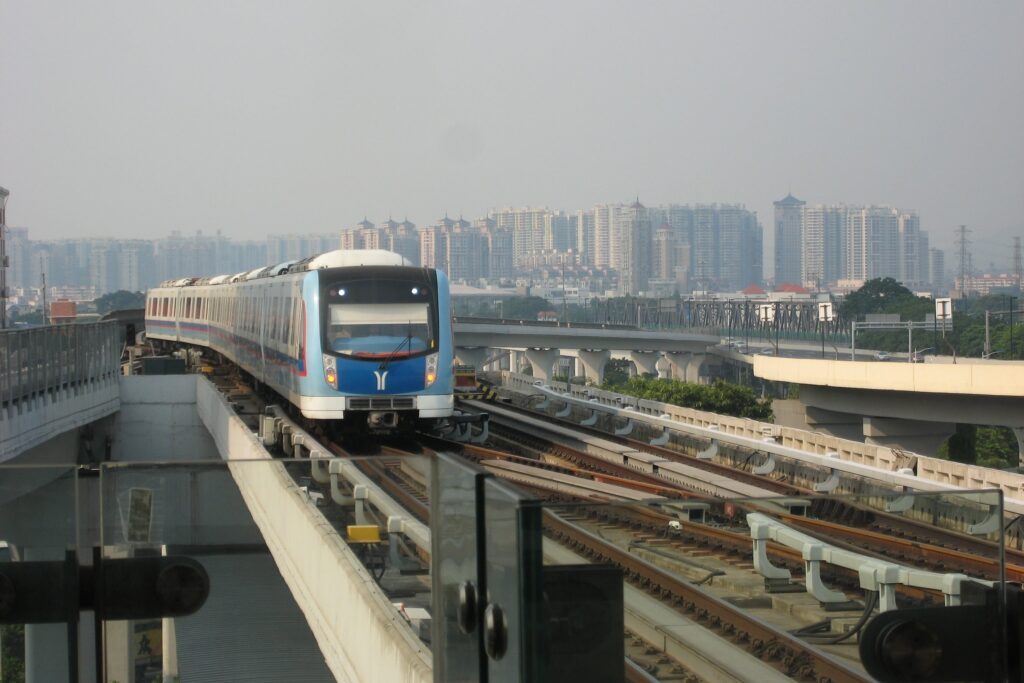
Official line names, colors and termini:
The network changed rapidly in 2025 and 2026. Line 10 and the east and west sections of Line 12 opened in June 2025, Line 13 Phase II east and Line 14 Phase II followed in September, and the full Line 22 Panyu Square to Fangcun corridor opened in December.
Chigang on Line 12 entered passenger service on February 13, 2026 and added an interchange with Line 8. Airport South stopped serving passengers on May 7, which leaves the network at 397 station stops on the same counting basis.
Using the system is straightforward once visitors allow time for the entrance checks. Passengers walk through a security gate, while bags and packages pass through an X-ray scanner at the station entrance.
Station names and directional signs are shown in Chinese and English. Operating and interchange announcements use Mandarin, Cantonese and English, although this does not mean every staff conversation is available in English.
For travelers who need assistance, official guidance documents tactile paths, Braille signs and help phones. Most stations have elevators between concourse and platform, but only some have street-to-concourse elevators, especially at older stations. Assistance can be requested through 96891.
The airport information below reflects services as of August 6, 2026.
Terminal 2 is the simple case. Airport North on Line 3 serves T2, and trains toward Tiyu Xilu continue directly to Zhujiang New Town without a transfer.
From Baiyun International Airport Terminal 2, take Line 3 from Airport North to Yantang, then change to Line 6 toward Xunfenggang and exit at Beijing Lu for Beijing Road.
Terminal 1 closed for passenger operations on May 7, 2026. Since that date, Airport South has not been served, and no reopening date has been announced.
For Terminal 3, municipal travel guidance directs Metro passengers to Line 3 or Line 9 at Gaozeng for the dedicated terminal shuttle. The shuttle fare is CNY 2 (≈USD 0.29). The other T3 option is the separate Baiyun Airport East intercity station inside the terminal transport center. Line 22 does not run to the airport: it currently operates between Panyu Square and Fangcun.
Exact travel times to Zhujiang New Town and Beijing Lu depend on the selected service and transfer. Check the station-specific schedule shortly before travel. If a late T2 arrival is after the final Line 3 service, check the airport’s current ground-transport options for that date.
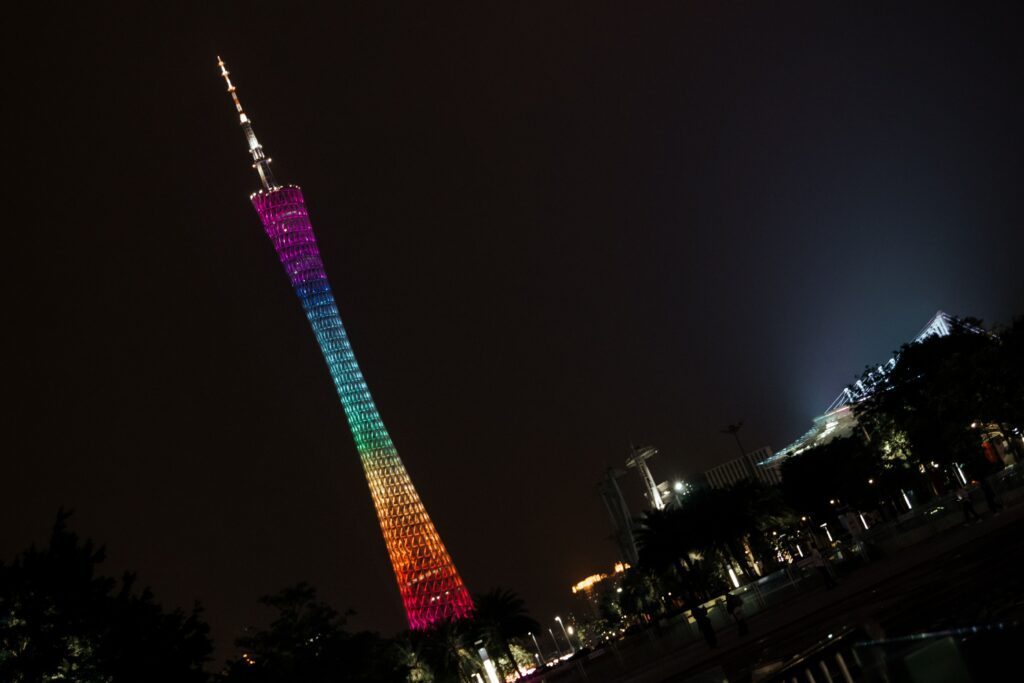
The operating routes below were published for the 139th Canton Fair on April 15, 2026. Detailed area-to-exit guidance comes from the official September 2025 fair handbook, so visitors should still match their current badge and hall information.
For the Canton Fair Complex, use Line 8 to Xingangdong or Pazhou, or Line 11 to Pazhou. The correct station and exit depend on the exhibition area and on the hall listed on the visitor’s current badge or in the current exhibitor information.
The September 2025 fair handbook sends Areas A and D to Xingangdong Exit A, Area B to Pazhou Exit A or B on Line 8 or Exit E or F on Line 11, and Area C to Pazhou Exit C.
Changing between Lines 8 and 11 at Pazhou is shown as a designated out-of-station interchange. Visitors should not assume it behaves like a platform-to-platform transfer inside one paid area.
From T2, the official Fair route uses Line 3 to Kecun and Line 8 to Pazhou or Xingangdong. From Guangzhou East Railway Station, Line 11 provides a direct ride to Pazhou.
| Attraction | Line | Station | Practical tip |
|---|---|---|---|
| Canton Tower | Line 3 or APM | Canton Tower | Official guidance names Exit A or B. Do not confuse the APM with Haizhu Tram Line 1. |
| Shamian Island | Lines 1 and 6 | Huangsha | Exit E serves the riverside square. Choose the exit that best matches the destination on Shamian Island. |
| Chen Clan Ancestral Hall | Lines 1 and 8 | Chen Clan Academy | Use Exit D for the Guangdong Folk Arts Museum and ancestral hall. |
| Beijing Road | Line 6 | Beijing Lu | Use the named station and follow the signs for your destination; exit guidance varies. |
| Zhujiang New Town | Lines 3 and 5 | Zhujiang New Town | Follow the line and exit signs for the specific CBD destination. |
| Canton Fair Complex (Pazhou) | Lines 8 and 11 | Xingangdong or Pazhou | Match the station and exit to the exhibition area and confirm the current hall. |
| Baiyun Mountain | Line 11 | Yuntai Garden | This is the southern Yuntai Garden and Moxing Summit approach, not the only mountain entrance. |
| Guangdong Museum | APM | Guangzhou Opera House | Use Exit B. |
Regular fares use distance bands. Guangzhou’s municipal fare schedule sets the network range at CNY 2 to CNY 20 (≈USD 0.29 to USD 2.95) as of August 6, 2026. The APM is the exception, with a flat CNY 2 fare (≈USD 0.29).
A 24-hour pass costs CNY 20 (≈USD 2.95), and a 72-hour pass costs CNY 50 (≈USD 7.37). Their clock starts with the first gate entry, not at the time of purchase.
Tiered discounts apply once eligible monthly public-transport spending reaches CNY 80 (≈USD 11.80).
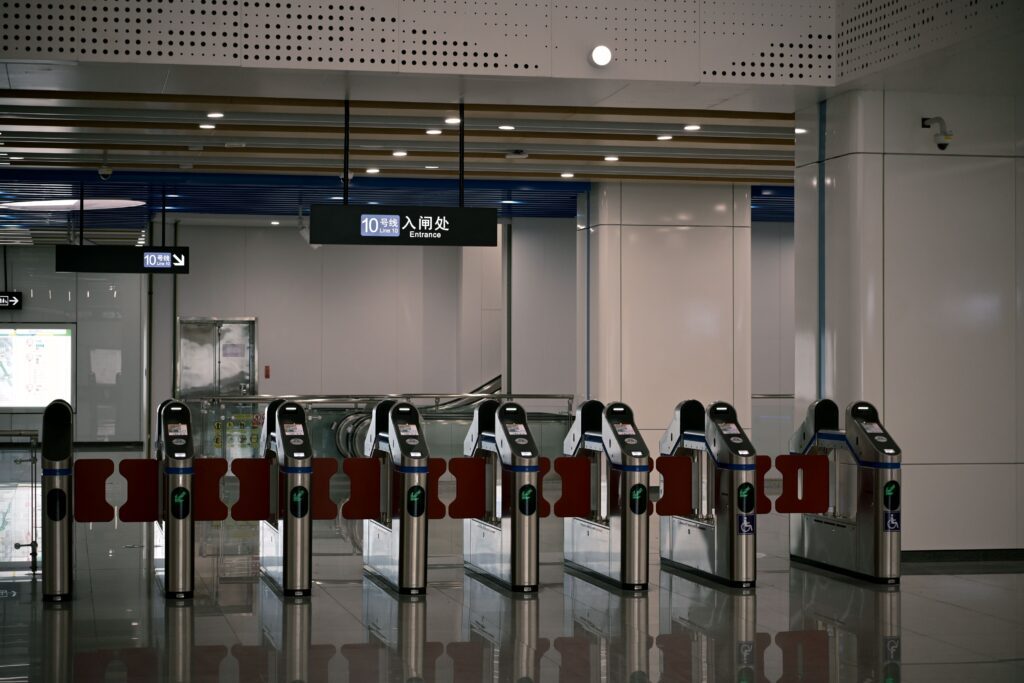
| Ticket | Price | Buy ticket |
|---|---|---|
| Single journey | CNY 2 to CNY 20 (≈USD 0.29 to USD 2.95) | Buy with RMB cash at a station machine or counter, subject to machine acceptance. |
| Direct contactless gate payment | CNY 2 to CNY 20 (≈USD 0.29 to USD 2.95) | Tap a supported physical Visa, Mastercard, American Express or JCB card directly at the entry and exit gates. No app or paper ticket is needed. |
| APM single journey | CNY 2 (≈USD 0.29) | Ask at the station service center which payment methods are accepted. |
| 24-hour pass | CNY 20 (≈USD 2.95) | Ask at the station service center about current availability. |
| 72-hour pass | CNY 50 (≈USD 7.37) | Ask at the station service center about current availability. |
| Alipay transport QR | Distance fare applies | Install Alipay from Google Play or the Apple App Store. In Alipay, open Transport, select Guangzhou and set up the Metro QR after completing any requested identity and card checks. |
| WeChat Metro QR | Distance fare applies | Install WeChat from Google Play or the Apple App Store, then open the Guangzhou Metro QR Code mini-program in WeChat. Setup requirements may vary by account and card issuer. |
The simplest option for foreign visitors is to tap the same supported physical contactless card at entry and exit. Guangzhou’s international visitor payment notice confirms Visa, Mastercard, American Express and JCB acceptance at every station since October 12, 2025, subject to issuer approval.
If the card is declined, carry RMB cash and buy a single ticket at a machine or service counter. A single ticket is valid only on the purchase day and from the station where it was bought.
Alipay is a practical alternative: open Transport, choose Guangzhou, complete any identity checks and generate the Metro QR. WeChat offers the Guangzhou Metro QR Code mini-program, although account and card-issuer steps may differ.
Whichever ticket, card or QR platform is chosen, use the same payment method at both gates. Do not split one journey between different cards or QR platforms.
Guangzhou Metro service centers do not handle Yang Cheng Tong top-ups, returns or replacements, so check card prices, deposits and refund terms at the point of sale.
The operator’s official app is available on the US Apple App Store. As of August 6, 2026 it has no current official Google Play listing, so use Alipay or WeChat if you want to pay by QR code.
All USD conversions use the People’s Bank of China central parity rate of USD 1 to CNY 6.7808 on August 20, 2026. USD amounts are rounded to two decimal places and may change with exchange rates.
There is no single opening and closing time for the whole network. The Guangzhou Transport Bureau’s operating standard requires each line to run for at least 15 hours daily, while first and last trains are published by station, direction, line, service variant and calendar date.
Guangzhou Metro frequencies vary by line and time of day. A December 2025 service notice scheduled Line 22 to run about every 4 minutes 50 seconds during weekday peak periods after its full corridor opened. Other Guangzhou Metro lines use different service intervals, which also vary by time of day.
After-midnight trains documented in 2026 were special Spring Festival or New Year operations, sometimes with drop-off-only intermediate stops. They do not establish regular overnight service or a 24-hour network.
Visitors should use the station-specific timetable shortly before travel, especially for the airport and Canton Fair. The April 2026 Canton Fair schedules applied only to that event and do not represent regular year-round service.
Expansion continues, but construction and passenger service must be kept separate. Guangzhou’s 2026 government work program lists eight Metro sections under continued construction, including central Line 12 and later sections of Lines 13, 14 and 18.
Line 13 Phase II west was still not carrying passengers on July 10, 2026. The project covers about 25.3 km and 19 underground stations, with late 2026 stated as a planning target rather than a guaranteed opening date.
The future rail link from Fangcun to Baiyun Airport is also still a separate intercity project. Work around Airport North remained in the approval and construction process in June 2026, while the older end-2027 target remains a plan, not a promise.
Fun Fact: The Zhujiang New Town APM is a distinct automated people-mover technology, yet it sits inside the passenger fare network. Unlike the distance-based lines, it charges a flat CNY 2 (≈USD 0.29) per journey.
Select PDF Download to open a PDF conversion of the operator’s July 30, 2026 bilingual system map. The operator publishes the map as an image rather than a PDF.
Tap the same supported physical Visa, Mastercard, American Express or JCB card at the entry and exit gates. Alipay and the WeChat Guangzhou Metro QR Code mini-program are alternatives after account and identity prompts. The official operator app is available from the US Apple App Store, but had no current official Google Play listing as of August 20, 2026.
Use Line 8 at Xingangdong or Pazhou, or Line 11 at Pazhou. Match the station and exit to the current exhibition area. The transfer between Lines 8 and 11 at Pazhou is designated as an out-of-station interchange.
From Terminal 2, board Line 3 at Airport North. Zhujiang New Town is direct; for Beijing Road, change at Yantang to Line 6 for Beijing Lu. For Terminal 3, use the shuttle from Gaozeng or the separate Baiyun Airport East intercity station. Airport South does not serve passengers, and Line 22 does not run to the airport.
Alipay and WeChat both offer a Guangzhou Metro QR option. Install either app from Google Play or the Apple App Store before travel, then complete any account, identity and card prompts.
You might also be interested in these metro maps – for comparison or for your next trip: