Delhi Metro Map 2026: Routes, Tickets & Prices
Last updated: July 24, 2026

Last updated: July 24, 2026
Delhi Metro service updates
Phase IV changed materially on 8 March 2026, when the Majlis Park to Maujpur-Babarpur and Deepali Chowk to Majlis Park corridors opened. The July 2026 DMRC network map still records one station on the Pink extension as under construction. Check current DMRC service information before travel.
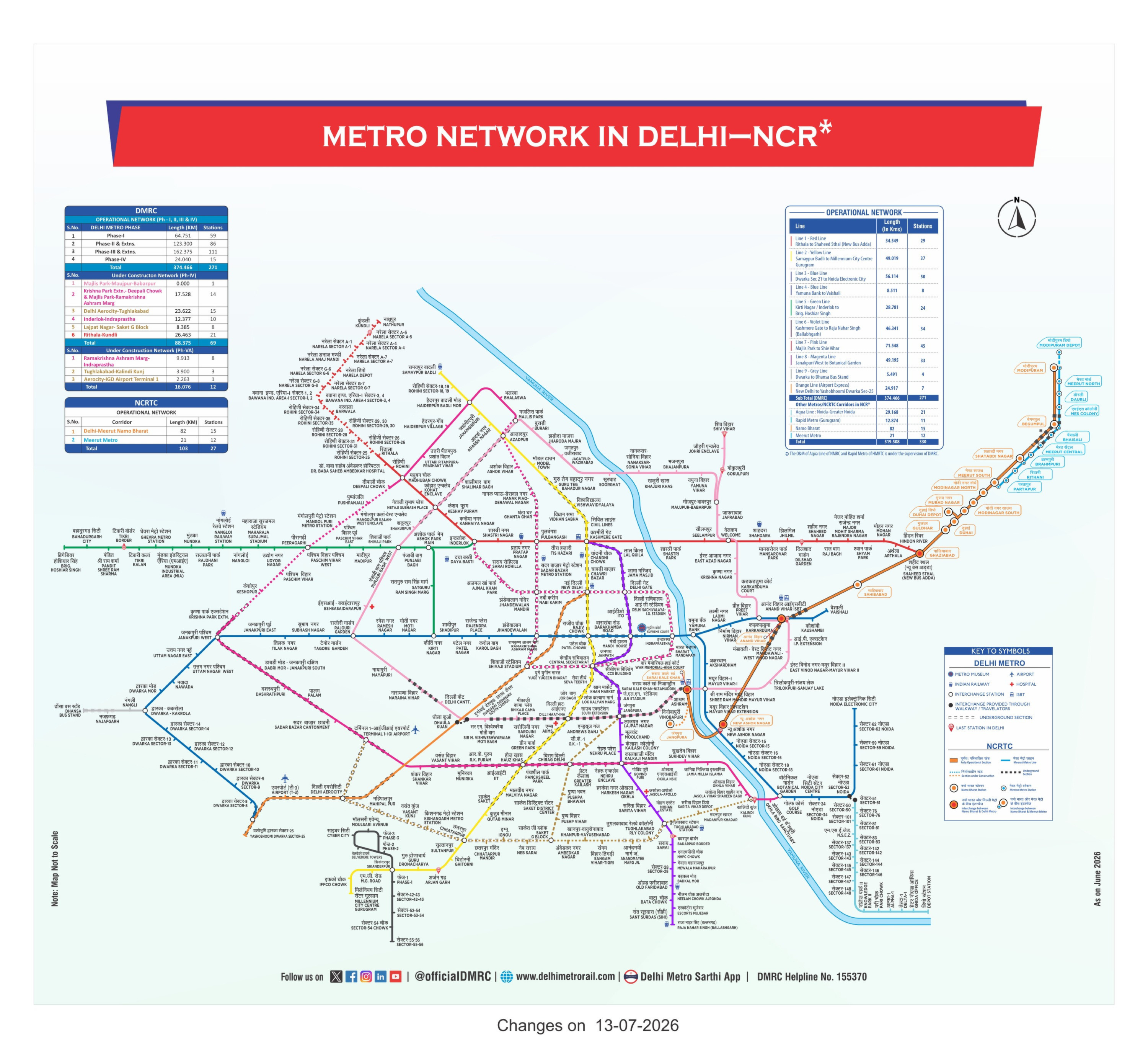
The Delhi Metro Map PDF is the starting point for reading a network that crosses Delhi and the NCR. The guide below separates the core DMRC figures from connected systems and turns the map into practical decisions for airport transfers, fares and major visitor destinations.
Use the Delhi Metro Map as a network key before choosing a route. First identify the colour, then confirm the correct terminus and finally check whether the destination needs an interchange. This sequence is especially important on the two Blue entries and on airport journeys.
Contents
The July 2026 DMRC network map contains an unusual counting puzzle: one colour appears as two numbered entries, with the Blue Line listed as Line 3 and Line 4. Across the full diagram, the network covers 374.5 km and records 271 station counts. It lists Line 1 through Line 9 plus the Airport Express, while treating several connected NCR rail systems separately.
Passenger services began in 2002. The DMRC network map gives the most precise current subtotal, but its 271 figure is a station count rather than a declared count of unique station complexes. Interchange stations may therefore affect comparisons with other sources.
The official line register also explains the apparent counting puzzle. The Blue Line occupies two numbered entries, Line 3 and Line 4, while the Airport Express is listed separately from Lines 1 to 9. Readers should use the colour and termini together when following the Delhi Metro route map.
The PDF download should be used as the visual authority for interchange geometry. Line names, endpoints and station totals above follow the July 2026 DMRC edition, not a third-party route planner.
The DMRC subtotal does not include every coloured rail service a visitor may encounter across Delhi NCR. The official diagram labels the Aqua Line and Rapid Metro as “Other Metros in NCR”, even though DMRC supervises or carries out operational work for them.
Noida Metro Rail Corporation operates the separate 29.7 km Aqua Line with 21 stations. Rapid Metro belongs to the Haryana system, with operations entrusted to DMRC after Haryana Mass Rapid Transport Corporation took over the concession in 2019. It charges a flat ₹20 (≈ $0.21) fare.
Namo Bharat is a regional high-speed service run by the National Capital Region Transport Corporation. Its operator explicitly distinguishes it from a metro. Indian Railways appears only as a connection category and is not included in the DMRC subtotal.
The operator boundary between DMRC and connected NCR systems matters when comparing a Delhi NCR metro map with official system statistics. A route can connect conveniently to the core network without becoming a DMRC line, station or kilometre.
Visitors can use the network to reach major monuments, Old Delhi, rail terminals and both airport terminals, but the correct station is only the first decision. Several attractions still require a final walk or road transfer.
For travel from New Delhi to Terminal 1, Hauz Khas is the required interchange between the Yellow and Magenta lines. Central Secretariat serves both Yellow and Violet and is the official tourism reference point for India Gate and the National Zoological Park.
Several destinations require an onward walk or road transfer, so station names should not be treated as door-to-door access. Akshardham and Old Delhi Railway Station have documented walking guidance, while the final approach to Red Fort, Qutub Minar, India Gate, Humayun’s Tomb and the zoo should be checked locally.
Read each row below as a starting point rather than a door-to-door promise. For the old city, Chandni Chowk and Lal Qila serve different purposes: the first is documented for the market and railway station, while the second is the 2026 choice for Red Fort.
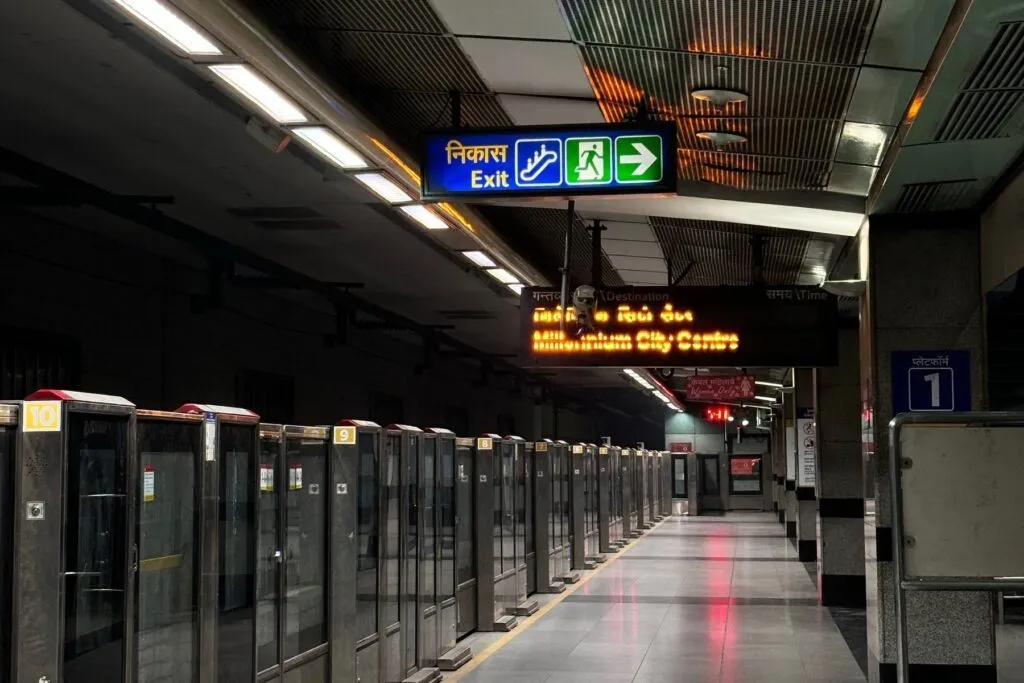
For southern monuments, the station names can be deceptively similar to the attraction names. The official tourism itinerary pairs Qutub Minar with Qutab Minar station. Plan an onward road transfer and check local conditions before setting out.
| Attraction or destination | Line | Station | Practical note |
|---|---|---|---|
| Red Fort | Violet Line | Lal Qila | Use Lal Qila for the fort and confirm the final entrance approach locally. |
| Qutub Minar | Check current route | Qutab Minar | Use Qutab Minar station and plan an onward road transfer to the complex entrance. |
| India Gate | Yellow or Violet Line | Central Secretariat | Delhi Tourism names this as the nearest station; allow for an onward road transfer. |
| Humayun's Tomb | Violet Line | Jangpura | Delhi Tourism names Jangpura; confirm the final transfer to the entrance locally. |
| Akshardham | Check current route | Akshardham | Walk 350 m from the metro station to Gate 1. |
| Chandni Chowk market | Yellow Line | Chandni Chowk | This is the official tourism station for the market area. |
| Old Delhi Railway Station | Yellow Line | Chandni Chowk | The documented walk between the railway station and metro station is 350 m. |
| National Zoological Park | Yellow or Violet Line | Central Secretariat | The official itinerary assigns the zoo to this station; confirm the onward road transfer locally. |
Indira Gandhi International Airport (IGI) has two different metro decisions. Terminal 3 has a direct Airport Express connection from New Delhi, while Terminal 1 uses the Magenta Line and requires a Yellow Line interchange at Hauz Khas when starting from New Delhi.
The DMRC journey planner for New Delhi to Airport (T-3) station gives 16 minutes 18 seconds and ₹64 (≈ $0.66). Terminal 3 provides direct access at the arrivals level, with ticket machines in domestic and international arrivals.
For Terminal 1, the DMRC journey planner changes at Hauz Khas and includes a 10-minute interchange allowance. The complete New Delhi trip takes 46 minutes 40 seconds and costs ₹43 (≈ $0.45) on weekdays or ₹32 (≈ $0.33) at the listed weekend fare.
Travellers changing terminals can also use the airport shuttle. It runs around the clock every 20 minutes; non-connecting passengers pay ₹25 (≈ $0.26). This is a road shuttle, not a rail line.
Indira Gandhi International Airport’s Terminal 3 passenger information lists a first train at 05:30 and the last arrival at 23:30, with 10-minute peak and 15-minute off-peak intervals. These airport-specific figures are not universal operating hours.
| Airport terminal | Metro line | Boarding or interchange station | Verified journey time and fare | Practical access note |
|---|---|---|---|---|
| Terminal 3 | Airport Express or Orange Line | New Delhi direct | 16 min 18 sec and ₹64 (≈ $0.66) | Direct access at Terminal 3 arrivals level; ticket machines in domestic and international arrivals. |
| Terminal 1 | Yellow Line then Magenta Line | Change at Hauz Khas | 46 min 40 sec including 10-minute interchange; ₹43 (≈ $0.45) weekdays or ₹32 (≈ $0.33) at the listed weekend fare | Magenta Line access serves arrivals and departures. |
| Terminal transfer | Airport shuttle | Airport terminal shuttle points | Every 20 minutes; ₹25 (≈ $0.26) for non-connecting passengers | Operates 24 hours and is not part of the rail network. |
Regular fares are distance-based. DMRC’s fare notice effective from 25 August 2025 sets six weekday levels at ₹11, ₹21, ₹32, ₹43, ₹54 and ₹64, equal to approximately $0.11, $0.22, $0.33, $0.45, $0.56 and $0.66.
On Sundays and national holidays, the six published levels are ₹11, ₹11, ₹21, ₹32, ₹43 and ₹54. All dollar conversions use the European Central Bank cross-rate of USD 1 = INR 96.57 on 22 July 2026.
All banks’ National Common Mobility Cards (NCMC) are accepted across the core network and Airport Line. DMRC also identifies the Virtual Smart Card as an option, while its app ecosystem supports QR tickets on all lines and recharge for existing smart cards. DMRC grants a 10% discount on every smart-card or NCMC journey, plus a further 10% during off-peak hours (until 08:00, 12:00 to 17:00 and after 21:00). Tourist Cards offer unlimited rides on DMRC lines, though not the Airport Express: a 1-day card costs ₹200 (≈ $2.07) and a 3-day card ₹500 (≈ $5.18), each including a ₹50 refundable deposit.
The current store name is Delhi Metro Sarthi App, and both stores identify DMRC as the publisher. Older DMRC reports use the name Momentum 2.0 (Sarthi).
Single-journey QR tickets carry a time limit to complete the trip: for example, 65 minutes for journeys up to 2 km, 100 minutes for 12 to 21 km and 180 minutes for the longest distances. Frequent Airport Express riders can also buy multi-trip cards, such as a 10-trip card valid 15 days or a 30-trip card valid one calendar month; a New Delhi to IGI Airport 10-trip card costs ₹490 (≈ $5.07) and the 30-trip card ₹1,390 (≈ $14.39).
| Ticket | Price | Buy ticket |
|---|---|---|
| QR ticket | Applicable distance-based fare: ₹11 to ₹64 (≈ $0.11 to $0.66) on weekdays | Android app / iOS app |
| Virtual Smart Card | Applicable distance-based fare | Android app / iOS app |
| National Common Mobility Card (NCMC) | Applicable distance-based fare; cards from all banks are accepted | Use a bank-issued National Common Mobility Card. |
| Existing Delhi Metro Smart Card | Applicable distance-based fare | Recharge in Android app / Recharge in iOS app |
QR booking, the Virtual Smart Card and conventional smart-card recharge are available through the official Sarthi app.
DMRC states that metro services are generally available from 06:00 to 23:00, though the exact first and last train depends on the line, station and direction. The official app provides station information and first and last train data, making it the appropriate current check before an early departure or a late arrival. Trains run every 2.5 to 5 minutes across the network and every 10 minutes on the Airport Express.
The specific clock and frequency set published in Terminal 3 passenger information applies only to that airport service: first train at 05:30, last arrival at 23:30, then 10-minute peak or 15-minute off-peak intervals.
Phase IV now has both operational and active construction sections. The July 2026 DMRC network map records 24.0 km and 15 station counts as operational, while 88.4 km and 69 station counts remain under construction.
DMRC’s 2024/25 annual report records that the 1.8 km Janakpuri West to Krishna Park Extension section began passenger service on 5 January 2025. A Press Information Bureau announcement records the 8 March 2026 opening of the roughly 12.3 km Majlis Park to Maujpur-Babarpur corridor and the roughly 9.9 km Deepali Chowk to Majlis Park corridor.
The July 2026 DMRC network map still lists one station on the Pink extension under construction without additional route length.
The July 2026 DMRC network map records 17.5 km and 14 station counts for the remaining Magenta sections. It also lists the 23.6 km Golden Line from Delhi Aerocity to Tughlakabad, the 12.4 km Inderlok to Indraprastha corridor, the 8.4 km Lajpat Nagar to Saket G Block corridor and the 26.5 km Rithala to Kundli corridor.
The Press Information Bureau records Phase V(A) as separate from Phase IV and totalling 16.1 km. A further bureau release says DMRC began construction work at Central Secretariat for the Central Vista corridor on 24 June 2026. Published target dates are not confirmed opening dates.
Only sections confirmed in passenger service count toward the operational total. Approved or partly built corridors remain separate from the active network.
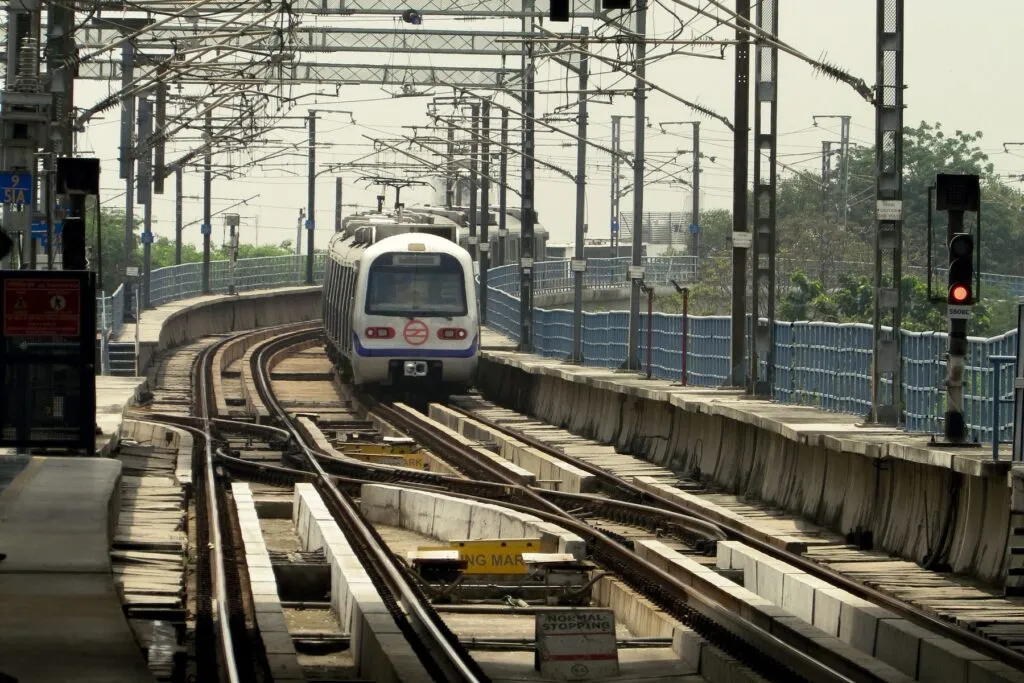
Every train has a separate Ladies’ Coach, and seats are reserved for women in the other coaches. Travellers should confirm the coach position at the station rather than assume one position across the network.
Fun Fact: Passenger service began on 24 December 2002, so the network marks its operating anniversary on Christmas Eve.
From Terminal 3, take the Airport Express directly to New Delhi. The trip takes 16 minutes 18 seconds and costs ₹64 (≈ $0.66). From Terminal 1, use the Magenta Line and change at Hauz Khas for the Yellow Line toward central Delhi.
The July 2026 diagram lists Lines 1 through 9 plus the Airport Express. The Blue Line is divided between Line 3 and Line 4, so numbered entries and unique colour names should not be treated as the same count.
The pure DMRC subtotal records 271 station counts as of July 2026. It does not label them as 271 unique station complexes, and it excludes the separately listed Aqua Line and Rapid Metro.
There is no single start time for the whole network. First and last trains vary by station, line and direction, and the official app provides current first and last train information. Terminal 3 passenger information separately lists 05:30 for the first airport train.
Chandni Chowk on the Yellow Line is the documented connection. The primary-source visitor directions record a 350 m walk between Old Delhi Railway Station and Chandni Chowk station.
Delhi Tourism assigns the National Zoological Park to Central Secretariat, served by the Yellow and Violet lines. Allow time for an onward road transfer from the station.
Delhi Metro Rail Corporation (DMRC) is the corporation behind the core network diagram and the official Sarthi app. Its July 2026 subtotal is the basis used for the network figures in this guide.
The official app ecosystem supports conventional smart-card recharge. Use the current Sarthi listing published by DMRC rather than similarly named third-party apps.
You might also be interested in these metro maps – for comparison or for your next trip: