Lyon Metro Map 2026: Lines, Tickets & Prices
Last updated: August 20, 2026

Last updated: August 20, 2026
Current Lyon Metro service updates
Works, strikes and replacement services appear by line in the official live service status. Check it shortly before traveling because a dated disruption overrides the base timetable.
The diagram gives visitors a compact view of the city’s four Metro lines and their connections. If you searched for a Lyon subway map, the term used on local signs and official passenger information is Lyon Metro.
TCL’s current network map is dated September 2025 and appears in the English catalog’s July 2026 update.
Line C climbs toward the Croix-Rousse over a 936 m rack section with a maximum gradient of 17.6%, a rare technical legacy of the former funicular alignment.
According to a June 2026 technical study co-authored by SYTRAL Mobilités, the Lyon Metro has four lines, 42 unique stations, and about 34.6 km of route. The first Metro section opened in 1974, followed by Lines A and B in 1978.
The passenger-facing brand is TCL, the organizing authority is SYTRAL Mobilités, and RATP Dev has operated the Metro and funiculars since January 1, 2025. SYTRAL Mobilités reports that the Lyon Metro carries more than 200 million journeys per year.
The current network diagram reflects the latest extension. Line B reached Oullins Centre and Saint-Genis-Laval Hôpital Lyon Sud on October 20, 2023, adding 2.4 km and two stations.
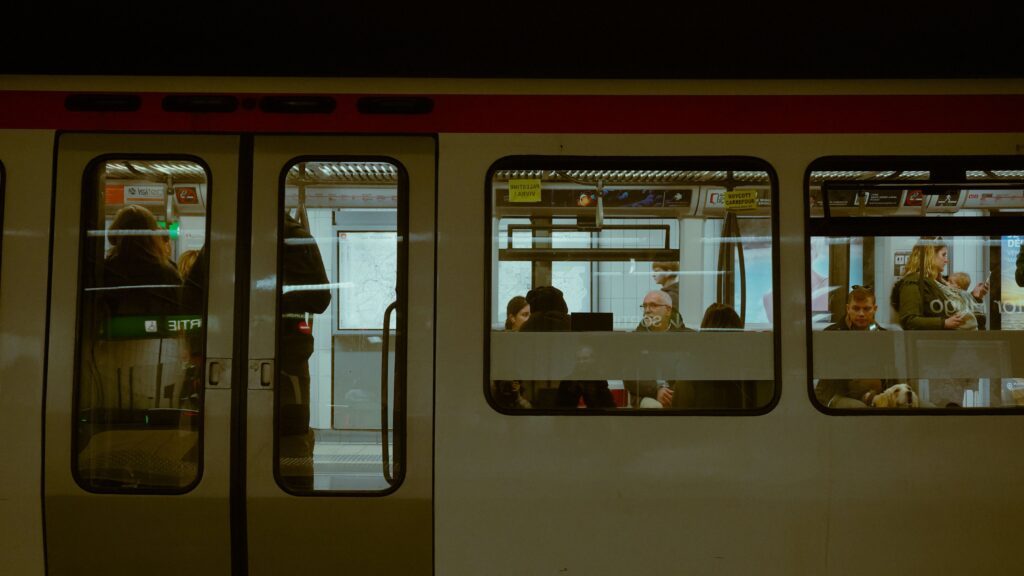
The Metro interchanges are Charpennes Charles Hernu for A/B, Hôtel de Ville Louis Pradel for A/C, Bellecour for A/D and Saxe-Gambetta for B/D.
F1 and F2 appear on the network diagram but are funiculars, not Metro lines. Both leave from Vieux Lyon: F1 serves Saint-Just, while F2 serves Fourvière and is the correct connection for the basilica.
Tram, Rhônexpress, trolleybus and bus are separate connecting modes. This distinction matters at Confluence and at the airport, where a traveler must change mode rather than look for a fifth Metro line.
The simplest approach is to choose the station nearest the destination, trace one of the four lettered lines, and note any interchange before entering the network. Fare purchase and validation instructions appear after the full ticket table below.
Metro is practical for many central journeys, but the best mode depends on the destination. Trams cover areas without a direct Metro stop, buses extend coverage, and F1/F2 climb from Vieux Lyon. For trips along the Rhône or Saône, choose the station and mode that best serve the destination.
Visitors can use Metro lines A through D for central sights, transfer at Part-Dieu for Lyon-Saint-Exupéry Airport, and check current fares, purchase and validation rules, and operating hours before traveling.
The destination matrix combines the Lyon Metro map with visitor destinations and shows where a change of mode is required. Fourvière requires F2 after Metro D, while Confluence requires tram T1 or T2 after changing at Perrache.
Choose the station before starting the trip, then check the practical note for a final walk or a change of mode. F1 serves Saint-Just, while F2 serves Fourvière; neither funicular counts as a Metro line.
| Sight / destination | Line | Station | Practical note |
|---|---|---|---|
| Vieux Lyon | Metro D | Vieux Lyon (Cathédrale Saint-Jean) | Old-town access; F1 and F2 connect in the same station complex. |
| Basilica of Notre-Dame de Fourvière | Metro D + funicular F2 | Vieux Lyon (Cathédrale Saint-Jean), then Fourvière | Change to F2. F1 goes to Saint-Just. |
| Place Bellecour | Metro A or D | Bellecour | Direct Metro interchange on Place Bellecour. |
| Gare de Lyon-Part-Dieu | Metro B | Gare Part-Dieu Vivier Merle | Mainline station access; Rhônexpress leaves from the separate Villette side. |
| Confluence district | Tram T1 or T2, not Metro | Hôtel de Région Montrochet | No direct Metro stop; change from A at Perrache to T1 or T2. |
| Parc de la Tête d'Or | Metro A | Masséna | Continue on foot via rue Tête d'Or; the Metro does not enter the park. |
| Croix-Rousse district | Metro C | Croix-Rousse | Central stop for the plateau and district. |
| Presqu'île / Hôtel de Ville | Metro A or C | Hôtel de Ville (Louis Pradel) | Best for City Hall, the opera, and northern Presqu'île; Cordeliers or Bellecour is more convenient for other parts of Presqu'île. |
Lyon-Saint-Exupéry Airport has no Metro station. From the airport, take Rhônexpress to Gare Part-Dieu Villette, then cross the SNCF station to Gare Part-Dieu Vivier Merle for Metro B.
Rhônexpress is a separate express tram and rail shuttle. The scheduled ride from Part-Dieu takes 29 minutes, with departures every 15 minutes from 6:00 a.m. to 9:00 p.m. and every 30 minutes earlier and later in the day.
Standard adult online fares, valid as of August 20, 2026, are €16.00 (≈ $18.69) one way and €28.00 (≈ $32.71) return. Machine prices are €17.10 (≈ $19.97) and €29.80 (≈ $34.81); buying onboard adds €4.00 (≈ $4.67) per transaction.
TCL and Rhônexpress use separate tickets, and neither fare is valid on the other service. Review transfer directions and current fare details before departure.
TCL divides its network into six tariff areas, zones 1 through 5 plus an external zone, and does not sell a one-zone ticket. Most visitor journeys use zones 1+2 across Metro, tram, bus and funicular.
Short-stay choices include single and 10-trip tickets, 24-hour, 48-hour and 72-hour passes, plus a seven-day pass. The Pass Tribu covers two to five people traveling together under TCL’s official adult/minor composition rules.
The Lyon City Card includes unlimited TCL travel in zones 1+2 for 24, 48, 72 or 96 hours, but excludes Navigône. Standard prices are used below rather than temporary online discounts.
The TCL fares and standard Lyon City Card prices below apply as of August 20, 2026.
| Ticket | Price | Buy ticket |
|---|---|---|
| Zone 1+2, 1 trip | €2.10 (≈ $2.45); 1 hour | Machines, sales points or Open Payment on eligible lines. A rechargeable TCL ticket costs €0.20 (≈ $0.23). |
| Zone 1+2, 10 trips | €20.00 (≈ $23.36); 1 hour per trip | Machines and sales points. Reload a TCL card in the official TCL app: Google Play and Apple App Store. |
| 24-hour pass | €6.90 (≈ $8.06) | Machines and sales points. |
| 48-hour pass | €13.00 (≈ $15.19) | Machines and sales points. |
| 72-hour pass | €18.00 (≈ $21.03) | Machines and sales points. |
| 7-day pass | €23.20 (≈ $27.10) | Machines and sales points. |
| Pass Tribu | €7.00 (≈ $8.18) | Machines and sales points; not available through Open Payment. |
| Group 1 trip | €1.70 (≈ $1.99) per person | For at least 10 people traveling together; group sales conditions apply. |
| Adult group day | €3.40 (≈ $3.97) per person | For at least 11 adults; group sales conditions apply. |
| Youth or school group day | €2.40 (≈ $2.80) per person | For at least 11 travelers under 18; group sales conditions apply. |
| Lyon City Card 24 hours | €32.00 (≈ $37.38) standard price | Official visitor pass shop. |
| Lyon City Card 48 hours | €44.00 (≈ $51.40) standard price | Official visitor pass shop. |
| Lyon City Card 72 hours | €56.00 (≈ $65.41) standard price | Official visitor pass shop. |
| Lyon City Card 96 hours | €68.00 (≈ $79.43) standard price | Official visitor pass shop. |
Buy a rechargeable ticket at a machine or sales point, then validate when entering a station or boarding. Validate again at each transfer except a direct Metro-to-Metro interchange; re-entering a Metro or funicular station requires another validation.
Open Payment accepts CB, Mastercard, Visa, Google Pay, Apple Pay and Samsung Pay on a red validator.
TCL Open Payment works on most lines in zones 1 and 2, costs €2.10 (≈ $2.45) for one hour, and caps at €6.90 (≈ $8.06) per day after more than three trips.
For two to five travelers using TCL Open Payment, tap the same physical card or mobile wallet once per person within ten seconds and repeat each tap at transfers.
A physical card and that card in a phone or watch wallet count as different payment methods, so do not switch during the journey.
The main TCL app can buy and reload tickets onto a TCL card, but a reload can take up to one hour without Hoplink.
On an iPhone, the app reloads the physical card rather than turning the phone into the ticket. Both official store links appear in the Buy ticket column above.
First trains leave their terminals between 4:35 and 5:01 a.m., depending on line and direction. Standard last departures range from 12:01 to 12:25 a.m.; use the timetable button because these are departures from terminals, not arrivals at every station.
The official line schedules show weekday peak intervals through August 30, 2026 of about 4-7 minutes on A, 2-4 minutes on B, 7-8 minutes on C and 2-4 minutes on D.
After 9:00 PM, intervals are about 8 minutes on Line A, 5 minutes on Line B, 7-8 minutes on Line C, and 4-6 minutes on Line D.
All four Metro lines continue until around 2:00 a.m. on Fridays and Saturdays. Terminal last departures then range from 1:40 to 2:05 a.m., so late travelers should check the relevant direction rather than rely on a single network-wide cutoff time.
Pleine Lune night buses PL1 through PL4 run from September through June on nights after Thursday, Friday and Saturday. They leave Cordeliers at 1:20, 2:30, 3:40 and 4:50 a.m. The service does not run in July or August.
For timetable changes, consult TCL night service details and the TCL live service status page.
The schedules effective August 31, 2026 list the same first and last departure times. Check the current line schedule before traveling because service intervals may change.
The latest completed expansion is Line B’s October 20, 2023 extension to Oullins Centre and Saint-Genis-Laval Hôpital Lyon Sud. The program now emphasizes automation, train capacity, and renewal; no new Metro line has been approved.
The modernization program runs to 2035. Plans include Line A automation and renewal with 20 four-car trains, a new Line C fleet and double track between Hénon and Cuire, plus new MPL25 trains and controls for Line D.
Capacity on Line B is increasing in stages. Since February 11, 2026, three coupled four-car formations operate during weekday peaks, about one every 15 minutes.
As of August 2026, TEOL remains the formally documented project but is politically under review. Metro E has been proposed for revival, but there is no approved timetable; neither project is a settled new Metro opening.
Fun Fact: A Grand Lyon technical paper describes Line D as the first driverless conventional or large-profile Metro, distinguishing it from earlier driverless urban railways.
In Lyon, standard last terminal departures are between 12:01 and 12:25 a.m. On Fridays and Saturdays, all four lines run until around 2:00 a.m., with exact last times depending on line and direction.
On the TCL network, buy a rechargeable ticket or use Open Payment on most lines in zones 1 and 2. Contactless users tap a red validator and keep the same physical card, phone or watch for the complete journey.
Yes. The Lyon Metro has four lines, A through D, 42 unique stations, and about 34.6 km of route. F1 and F2 are funiculars and do not count as Metro lines.
No. Lyon trams, Metro trains, buses, and funiculars are paid TCL modes within the selected zones. Rhônexpress has its own separate fare and is not covered by an ordinary TCL ticket.
From Lyon-Saint-Exupéry Airport, take Rhônexpress to Gare Part-Dieu Villette. The shuttle takes 29 minutes and usually runs every 15 minutes from 6:00 a.m. to 9:00 p.m. For onward travel by Metro, cross the SNCF station to Gare Part-Dieu Vivier Merle and take Line B.
Yes. TCL has zones 1 through 5 plus an external zone and sells no one-zone ticket. The common zones 1+2 fare covers Metro, tram, bus and funicular travel within those zones.
Select PDF Download to open the current TCL map as a zoomable PDF.
You might also be interested in these metro maps – for comparison or for your next trip: