San Francisco BART Map 2026: Lines, Tickets & Prices
Last updated: July 19, 2026

Last updated: July 19, 2026
Current BART service alerts
Some Sunday through Thursday trips between Daly City, SFO and Millbrae may take about 30 minutes longer after 9:00 pm during summer 2026. Check the live service advisories before a late airport journey.
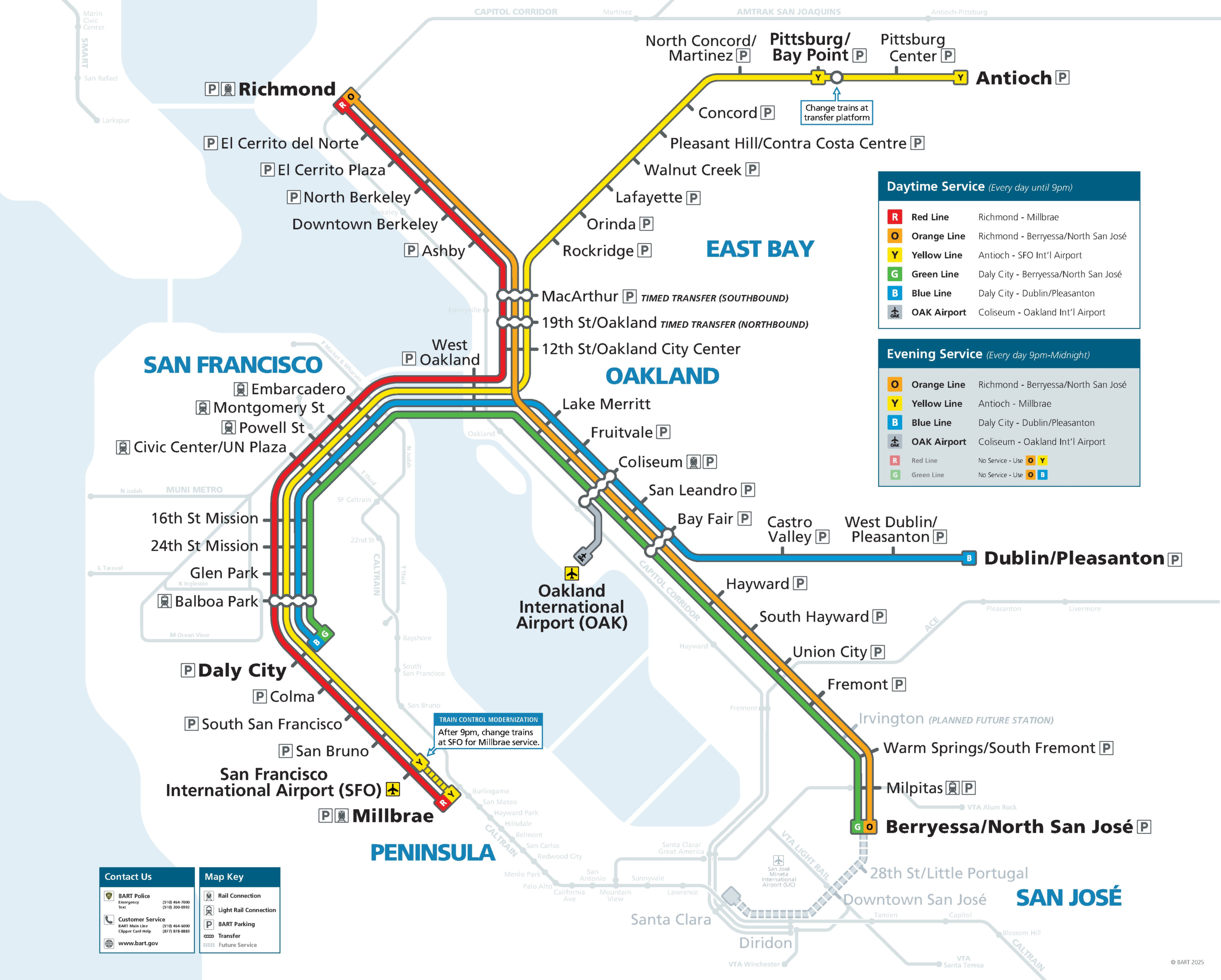
BART is the Bay Area’s regional heavy-rail system, with 50 stations across 131.4 miles, a direct station at SFO and distance-based fares. Five daytime lines change to a three-line pattern after 9:00 pm, and riders can pay with Clipper or a supported contactless card or device.
Table of Contents
BART is the Bay Area’s regional heavy-rail network. It serves 50 stations across 131.4 miles, including eight stations in San Francisco between Embarcadero and Balboa Park.
Calendar-year 2025 ridership totaled 55.6 million, with an average of 180,649 weekday trips.
Passenger service began on September 11, 1972. BART was the first new regional transit system built in the United States in 65 years.
As of February 9, 2026, BART had received and certified 1,070 Fleet of the Future cars. The Phase 2 target is 1,129 cars.
The official BART system map displays five color-coded heavy-rail lines operating before 9:00 pm under the schedule in effect on July 19, 2026:
The BART system map shows the Oakland Airport Connector separately from these five lines. It is an automated, cable-propelled people mover between Coliseum and OAK, not a sixth heavy-rail line. The former eBART project is now presented to passengers as BART to Antioch and uses diesel trains on separate tracks.
The BART system map shows five-line service every day until 9:00 pm and three-line service from 9:00 pm to midnight. The Red and Green lines stop running in the late evening, leaving the Yellow, Orange and Blue lines in operation.
The shift on the BART map from five to three lines after 9:00 pm affects airport and cross-bay trips. The Yellow Line remains the direct line between downtown San Francisco and SFO. Yellow Line trains also serve the Millbrae branch after 9:00 pm, with a transfer at SFO where required.
BART serves eight stations inside San Francisco and provides the fast regional link through the Market Street corridor, the Mission District and southern neighborhoods. It then continues to SFO, the Peninsula, the East Bay and northern Santa Clara County.
Embarcadero, Montgomery Street, Powell Street and Civic Center/UN Plaza are the four central stations. Balboa Park is the last station within the city boundary; Daly City is outside San Francisco.
No. BART is regional heavy rail, while Muni Metro is San Francisco’s six-line light-rail system operated by SFMTA. The systems share station complexes at Embarcadero, Montgomery, Powell and Civic Center, but use different platform levels and separate fare gates.
To transfer, leave the platform level, follow the signs at the concourse and pass through the correct fare gates. The BART system map does not include Muni Metro, and a Muni Visitor Passport does not include travel on BART.
The San Francisco BART map helps riders check the destination station, line color and terminus before entering the fare gates. BART connects downtown San Francisco, SFO, the Peninsula, the East Bay and northern Santa Clara County. San Francisco recorded 23.7 million visitors in 2025.
Keep belongings in sight, remain aware of your surroundings and follow staff instructions. Check current service advisories and elevator status before travel. Every BART station has elevators, although some trips require two different elevators.
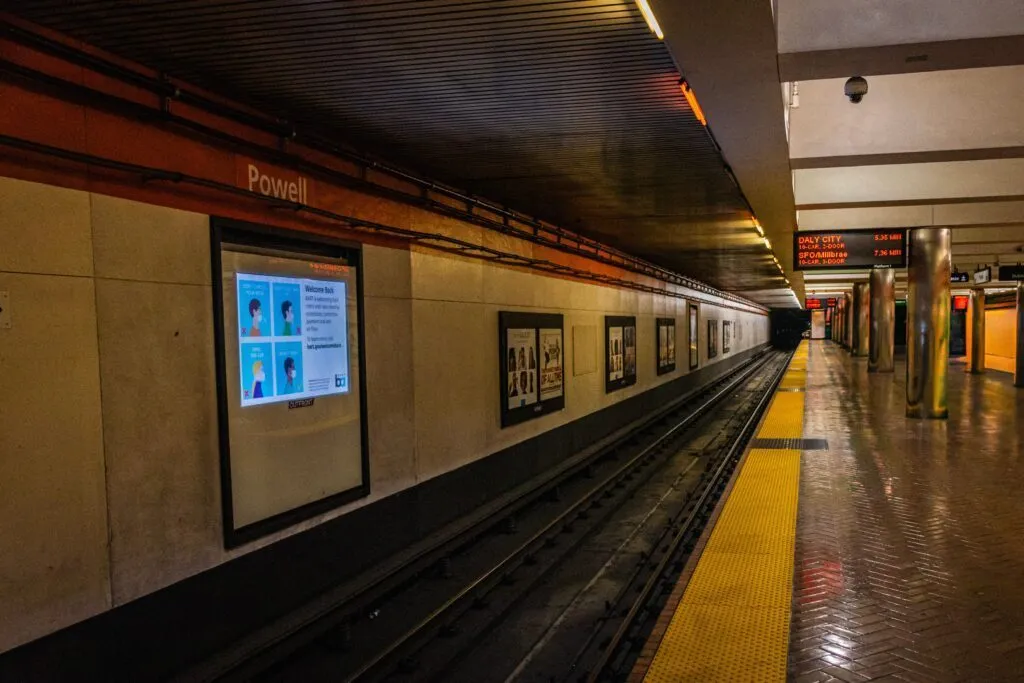
Lines on the BART map are daytime service before 9:00 pm. After 9:00 pm, the Red and Green lines do not run; use the BART trip planner for available Yellow, Orange and Blue Line connections.
| Destination | Line | Station | Practical tip |
|---|---|---|---|
| Ferry Building | Blue, Green, Red, Yellow | Embarcadero | One block away; ferries and the F historic streetcar are separate connections. |
| Exploratorium / central waterfront | Blue, Green, Red, Yellow | Embarcadero | Walk about 0.6 miles north along the waterfront to Pier 15. |
| Union Square | Blue, Green, Red, Yellow | Powell St. | Follow the station signs for Union Square. |
| SFMOMA | Blue, Green, Red, Yellow | Montgomery St. | Walk about 0.3 miles to 151 Third Street. |
| Mission District murals | Blue, Green, Red, Yellow | 16th St Mission / 24th St Mission | Clarion Alley is 0.1 miles from 16th; Balmy Alley is 0.4 miles from 24th. |
| Asian Art Museum / Civic Center | Blue, Green, Red, Yellow | Civic Center/UN Plaza | Walk about 0.1 miles to 200 Larkin Street. |
| Oakland Museum of California | Blue, Green, Orange | Lake Merritt | Leave toward Oak Street; the museum is one block away. |
| Fox Theater / Uptown Oakland | Orange, Red, Yellow | 19th St Oakland | Use the 19th/Broadway exit and walk one block to Telegraph Avenue. |
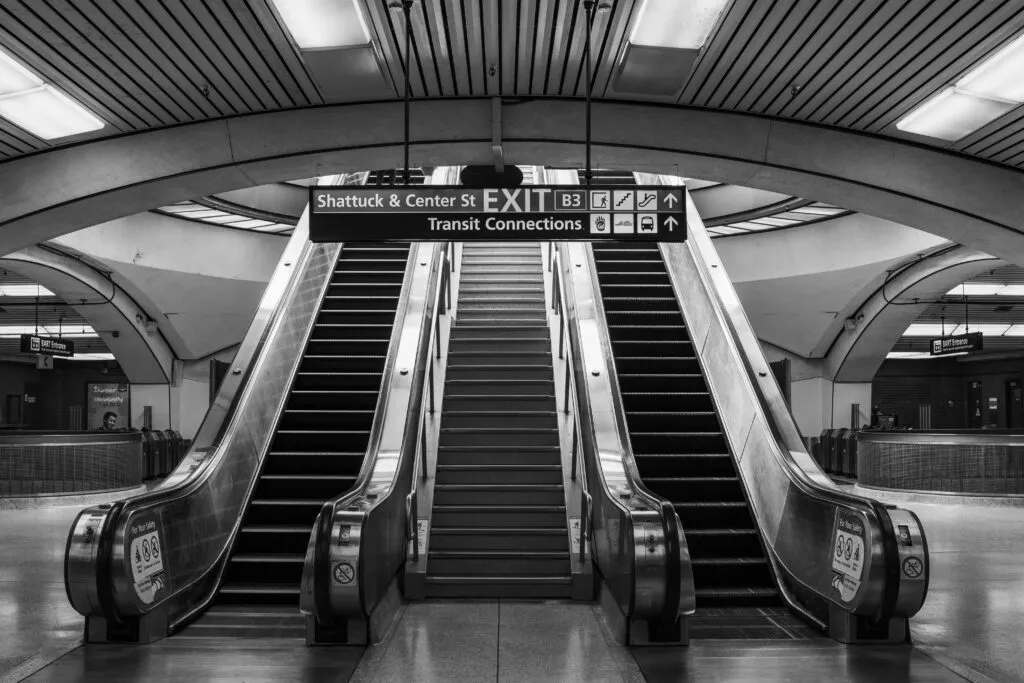
| UC Berkeley campus | Orange, Red | Downtown Berkeley | Walk east from Shattuck and Center; the visitor center is 25 to 30 minutes away. |
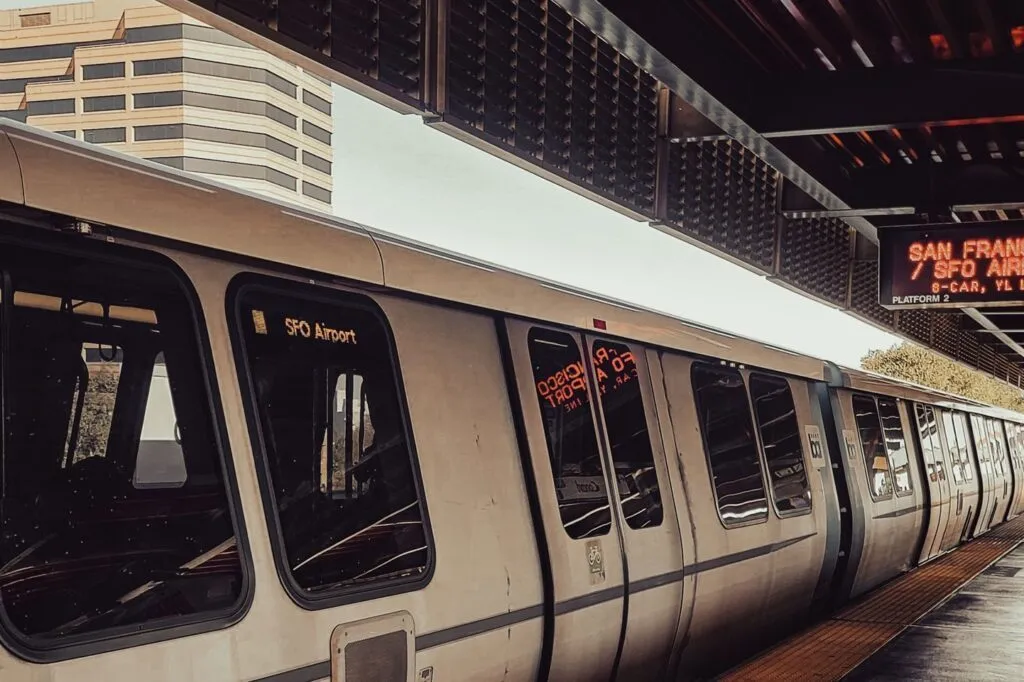
SFO has a direct BART station in the International Terminal on the Departures/Ticketing Level, near the G Gates. The free 24-hour AirTrain stops at Garage G/BART Station, and both AirTrain lines connect with the rail station.
During daytime service, take the Yellow Line toward Antioch or the Red Line toward Richmond for Powell Street and the other downtown stations. After 9:00 pm, the Red Line stops running and the Yellow Line remains the direct downtown service.
A July 20, 2026 weekday itinerary from SFO to Powell Street takes 28 minutes. The adult one-way fare was $11.80 on July 19, 2026. Tap in and out with the same card or device.
The Terminal 3 AirTrain stop is closed until a replacement opens in 2027. The Terminals 2 & 3 stop currently serves both terminals, with a covered outdoor walk for Terminal 3.
Take the Oakland Airport Connector from OAK to Coliseum, pay at Platform 3 and transfer to the main BART network. The ride to Coliseum takes about nine minutes. During daytime service, take the Blue or Green Line toward downtown San Francisco.
The OAK station is opposite Terminal 1 baggage claim and near Terminal 2. Its BART station name is Oakland International Airport Station.
In a July 20, 2026 example, OAK to Powell Street took 43 minutes and cost $13.45. The OAK-to-Coliseum portion cost $7.95 on the same date.
The connector runs every six minutes until 11:00 pm and then every 20 minutes within its weekday, Saturday and Sunday operating windows.
BART is not free. Its fares are based on distance, and only children age four and under travel free. There is no general weekly or monthly pass. Adult visitors can use Clipper or direct contactless payment, while eligible discounts require the appropriate Clipper card.
Next-Generation Clipper launched regionwide on December 10, 2025. As of June 24, 2026, the migration was still underway: two million cards had migrated and 48% of trips were using the new platform.
| Ticket | Price | Buy ticket |
|---|---|---|
| Contactless bank card or wallet | Full distance-based adult fare | Tap a supported Visa, Mastercard, American Express or Discover card at the gate. |
| Clipper card | Distance-based fare; $3.00 one-time fee for a plastic card | Available from station vending machines or through the official iOS and Android apps. |
| START or Youth Clipper | 50% off the adult fare | Eligible Clipper card required. |
| Senior or Access Clipper | 62.5% off the adult fare | Eligible Clipper card required. |
| High-Value Discount | $45.00 for $48.00 value or $60.00 for $64.00 value | Available only through autoload on a registered Clipper card. |
| Montgomery Street to SFO, one way | Adult $11.80; START $5.90; Youth $5.90; Senior/Access $4.40 | Fare example dated July 19, 2026. |
All stations have Clipper vending machines. Paper tickets are no longer sold or accepted. With Clipper, tap in and out; the system deducts the distance fare automatically.
For direct Tap and Ride, no registration or stored value is required. Each rider must use a separate card or device and tap in and out with that same card or device. A card in a mobile wallet and its physical counterpart are treated as two different payment methods.
Direct contactless payment charges the full adult fare. A digital Clipper card stored in Apple Pay or Google Pay remains a transit card; it is different from tapping a bank card through the same wallet.
Under the timetable in effect on July 21, 2026, regular service runs from 5:00 am to midnight on weekdays, 6:00 am to midnight on Saturdays and 8:00 am to midnight on Sundays. Exact first and last usable trains vary by station, direction and transfer, so use the official trip planner for a specific journey.
Before 9:00 pm on weekdays, Yellow Line trains run about every 10 minutes between SFO and Pittsburg/Bay Point. The separate Antioch service runs about every 20 minutes, with a timed transfer at the transfer platform. The other four main BART lines run about every 20 minutes.
Before 9:00 pm on weekends, all five lines run about every 20 minutes. After 9:00 pm, the Yellow, Orange and Blue lines run about every 20 minutes.
BART does not run overnight. The regional All Nighter network has more than 20 bus routes operated by five agencies, generally between midnight and 5:00 am.
Useful examples include Muni Owl, AC Transit routes 800 and 805, and SamTrans 397 OWL between San Francisco, SFO, Millbrae and Palo Alto.
Early Bird Express is a limited weekday network before rail service starts, not continuous night service. Its six patterns are 701, 702, 703, 704, 713 and 714.
Fleet renewal and the extension toward central San José are BART’s most visible long-term developments for travelers. The six-mile Silicon Valley Phase II project is under construction from Berryessa/North San José through downtown San José to Santa Clara, with four planned stations.
Passenger service is targeted for 2037, but that year is not a guaranteed opening date. The Irvington project still lacks complete design, property acquisition, funding, and current cost and ridership estimates. Link21 remains in an early planning phase without a fixed alignment or station list.
The adopted FY27 budget preserves current service and discounts and includes no fare increase under its assumed regional funding measure. A three-line network, 30-minute frequencies and a 9:00 pm close from January 2027 remain a contingency if new funding fails, not current 2026 service.
Fun Fact: The 3.6-mile Transbay Tube was the world’s longest immersed tube from 1974 to 2010 and reaches a depth of 135 feet beneath the water surface. Its 57 sections, each approximately 330 feet long, were fabricated, floated into position and sunk.
You might also be interested in these metro maps – for comparison or for your next trip:
BART is Bay Area Rapid Transit, the regional heavy-rail network serving San Francisco and other Bay Area communities. It has 50 stations across 131.4 miles.
BART stands for Bay Area Rapid Transit. The public district was formed in 1957, and passenger service began in 1972.
BART serves eight stations within San Francisco, including four central Market Street complexes, two Mission stations and stops farther south to Balboa Park. Regional trains continue to SFO, the Peninsula, the East Bay and Berryessa/North San José.
Yes, but two systems must be distinguished. BART provides regional heavy rail, while the separate six-line Muni Metro serves city light-rail corridors.
No. Fares depend on distance. Only children age four and under travel free, while eligible Youth, Senior, Access and START riders receive discounts through Clipper.
Adults can tap a supported contactless bank card, Apple Pay or Google Pay directly at the gates, or use Clipper. Each rider must use a separate card or device and tap in and out with that same card or device.
Yes. Adult riders can use direct contactless payment without registration or stored value. It charges the full adult fare, so discounted travel still requires an eligible Clipper card.
The adult fare from SFO to Powell Street was $11.80 on July 19, 2026. A July 20, 2026 weekday itinerary takes 28 minutes.
Yes. SFO has a BART station in the International Terminal. During daytime service, take the Yellow Line toward Antioch or the Red Line toward Richmond for Powell Street. After 9:00 pm, the Yellow Line remains the direct downtown service. The adult fare was $11.80 on July 19, 2026.
Take the separate automated connector from OAK to Coliseum, pay at Platform 3 and transfer to the main BART network. During daytime service, take the Blue or Green Line toward downtown San Francisco. In a July 20, 2026 example, OAK to Powell Street took 43 minutes and cost $13.45.
Regular service ends around midnight. The exact last usable train depends on the station, direction and required transfer, and BART does not operate rail service overnight.
Regular service starts at 5:00 am on weekdays, 6:00 am on Saturdays and 8:00 am on Sundays. Station-specific first trains can differ.
Stay aware of your surroundings, keep belongings in sight, follow staff instructions and report concerns by phone, intercom, police or the BART Watch service. Check current service advisories and elevator status before travel.