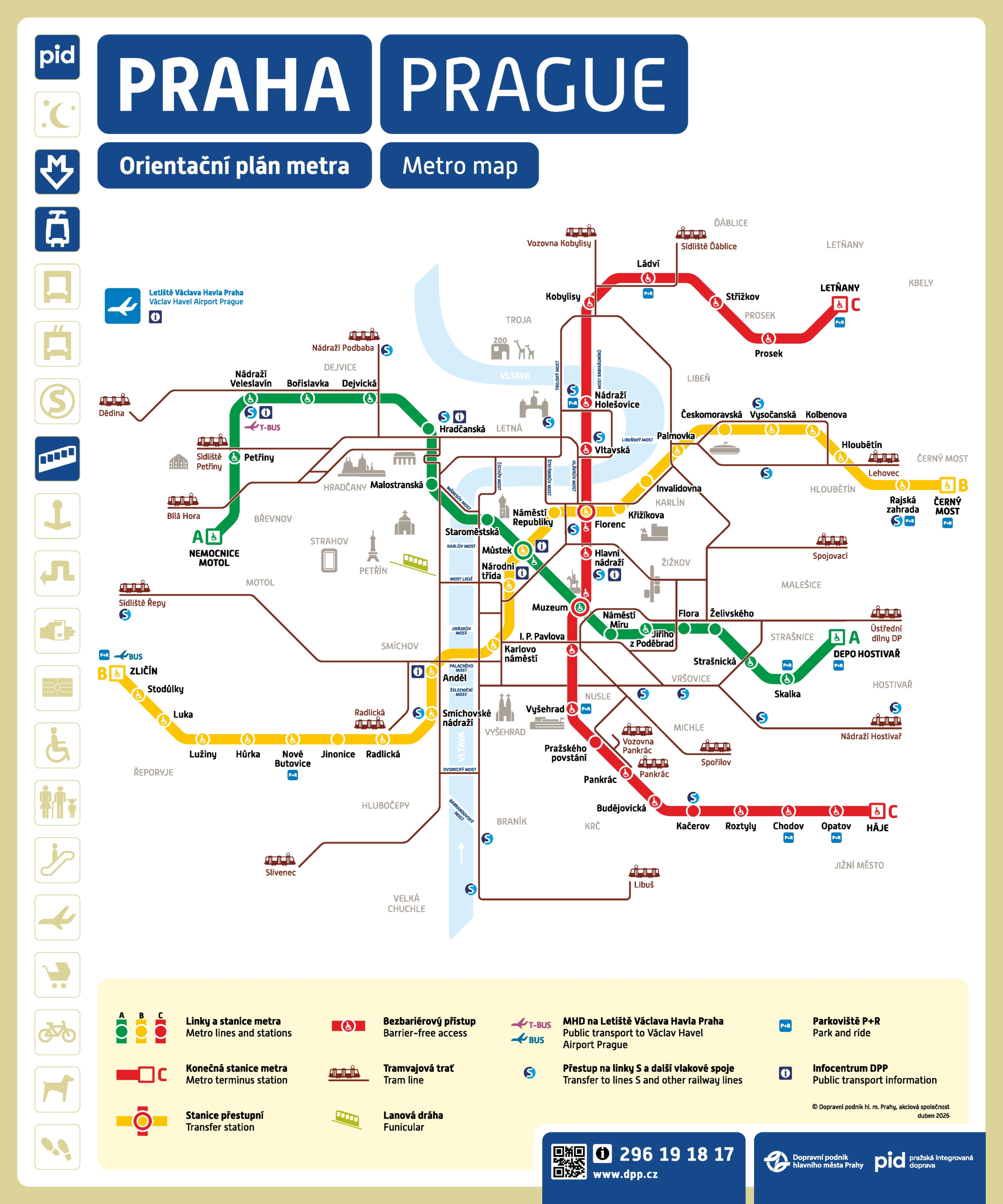
Prague Metro Map 2026: Lines, Tickets & Prices
Last updated: July 15, 2026

Last updated: July 15, 2026
Current Service Updates
Night service: The Prague Metro does not run overnight. Between around midnight and 04:30, night trams and buses take over on the regular PID fare (full details in the timetable section below).
Current service and disruption updates: DPP passenger information · network information via the PID portal.
The Prague metro map, also known as the Prague subway map, shows a clear network that is easy for travelers to read: three lines, 65.4 kilometers, 61 stations. Above you can view the official network map as a zoomable PDF, along with every line, the current 2026 ticket prices, operating hours and the connection to Václav Havel Airport.
Contents
The Prague Metro is a comparatively young system that has grown rapidly: the first section of Line C opened on May 9, 1974 between Kačerov and Sokolovská with nine stations. Line A followed on August 12, 1978 and Line B on November 2, 1985. Today the Prague Metro is the backbone of the city’s public transport.
The operator is the Dopravní podnik hl. m. Prahy (DPP), the city’s municipal transport company. Fares and tickets run through the Prague Integrated Transport network (PID, Pražská integrovaná doprava), which combines metro, tram and bus under a single ticket.
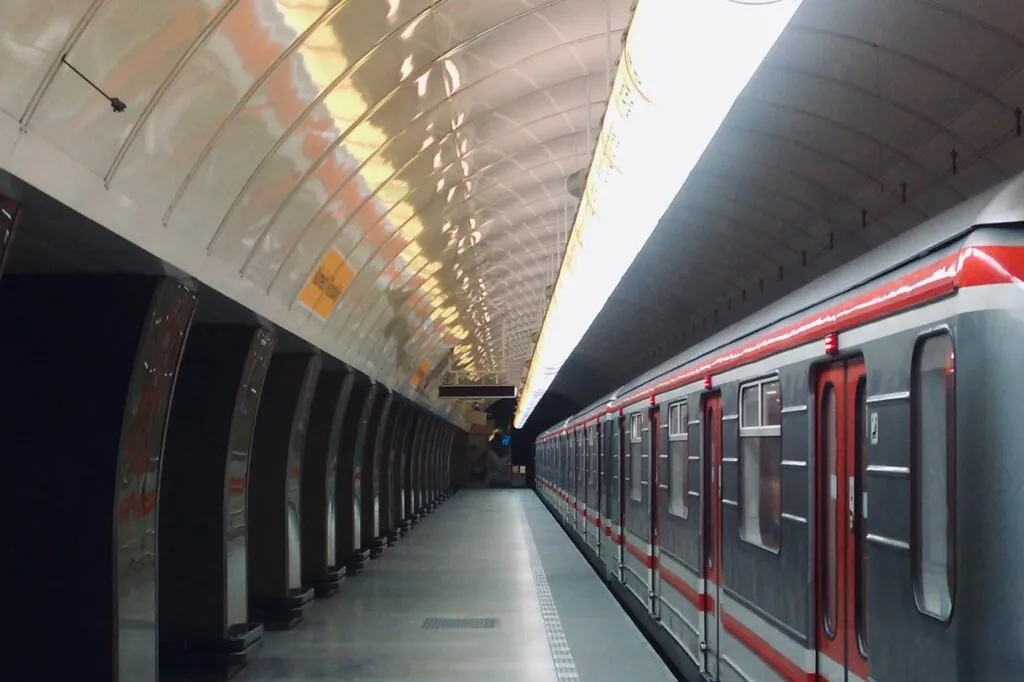
The network spans 65.4 kilometers and 61 stations across three lines. Where the Prague metro map shows different figures (such as “57” or “58 stations”), these reflect different counting methods: the DPP counts the three interchange stations separately for each line, reaching 61, while 58 stations are physically separate. Most of the 61 stations offer step-free access. Across all lines, around one million passengers use the metro each day; in the full year 2025 the figure was 369.7 million passengers (as of December 31, 2025).
One feature stands out right at the entrance: the Prague Metro is an open system without turnstiles. You validate your ticket at a machine before the escalator, or tap your bank card contactlessly on the reader; checks are carried out at random.
The Prague metro map shows three lines; a fourth is under construction (see below). Colors and termini:
The three lines meet in an interchange triangle: Line A and Line B cross at Můstek, A and C at Muzeum, and B and C at Florenc. The termini and routes of Lines A, B and C have not changed since Line A was last extended to Nemocnice Motol in 2015.
Prague welcomed around 8.3 million visitors in 2025 (up 3 percent year over year); for most of them the metro is the fastest way to connect the main station, the Old Town and the top sights. The most important attractions lie along the three lines:
The table below shows how to reach Prague’s most popular destinations by metro, including the line, the nearest station and a practical tip:
| Destination | Line | Station | Note |
|---|---|---|---|
| Prague Castle | Line A (green) | Malostranská | Nearest station for the castle district |
| Old Town Square & Charles Bridge | Line A (green) | Staroměstská | Short walk to the square and the bridge |
| Wenceslas Square (lower end) | Lines A, B | Můstek | A/B interchange at the foot of the square |
| Wenceslas Square (upper end) & National Museum | Lines A, C | Muzeum | A/C interchange at the top of the square |
| Vyšehrad | Line C (red) | Vyšehrad | Directly at the Vyšehrad fortress |
| Praha hlavní nádraží (main station) | Line C (red) | Hlavní nádraží | Direct metro stop at the main railway station |
| Václav Havel Airport | Line A (green) | Nádraží Veleslavín | Transfer to trolleybus 59, about 15 min (no direct metro) |
There is no direct metro connection to Václav Havel Airport. The fastest link by public transport is trolleybus 59: it runs from Terminals 1 and 2 to Nádraží Veleslavín station on metro Line A in around 15 minutes. Trolleybus 59 replaced the former bus route 119 on March 6, 2024.
Alternatively, bus 100 takes you to Zličín (Line B) in about 18 minutes. The paid Airport Express reaches Praha hlavní nádraží (the main station) on Line C in around 40 minutes; note that it requires a separate ticket, as regular PID tickets are not valid on board.
Prague uses a time-based ticket system: a single ticket is valid for a set period and covers any number of transfers between metro, tram and bus. On January 1, 2026 the network introduced a new PID fare, under which the digital ticket via the app is slightly cheaper than the paper ticket. The most important Prague Metro tickets at a glance (paper price / app price):
| Ticket | Price (paper / app) | Buy a ticket |
|---|---|---|
| 30-minute ticket | 39 CZK / 36 CZK (≈ $1.83 / $1.69) | Android · iOS (PID Lítačka) |
| 90-minute ticket | 50 CZK / 46 CZK (≈ $2.35 / $2.16) | Android · iOS |
| 24-hour ticket | 150 CZK / 140 CZK (≈ $7.05 / $6.58) | Android · iOS |
| 72-hour ticket | 350 CZK / 340 CZK (≈ $16.45 / $15.98) | Android · iOS |
| Monthly pass (Prague) | 550 CZK (≈ $25.85) | Available on site |
Prices as of July 2026 (new PID fare from January 1, 2026); source: DPP price list and pid.cz. USD values converted at the rate 1 CZK = $0.047 (as of July 2026). Children up to 15 and seniors from 65 travel free in Prague (with proof of age); those aged 60 to 65 pay half fare. Where to buy: the official “PID Lítačka” app (published by the City of Prague) or vending machines and counters in the stations.
A detailed hands-on guide to tickets, prices and fines is available in the video below:
You can pay in the PID Lítačka app by bank card, Apple Pay or Google Pay. At the metro entrances you can also pay contactlessly right at the reader (open payment) with a bank card or smartphone; no separate ticket is then required.
Anyone traveling without a valid ticket pays a 1,200 CZK (≈ $56.40) fine on the spot; if paid later it rises to as much as 2,000 CZK (≈ $94.00). The SMS ticket is the most expensive option: 30 minutes cost 42 CZK (≈ $1.97) and 90 minutes 55 CZK (≈ $2.59), and it works only with a Czech mobile number.
All three lines run daily from around 05:00 to midnight. At peak times trains arrive every two to four minutes, and off-peak every five to ten minutes, so waiting is rarely an issue.
There is no dedicated metro night service. Between midnight and around 04:30 the night network takes over: the night trams 91-99 every 30 minutes, with a central transfer at the Lazarská stop, plus night buses 901-917 and regional buses 951-960. The regular PID fare applies, with no night surcharge.
The network keeps growing: Line D (blue) will be Prague’s fourth metro line. It is set to connect Náměstí Míru with the Písnice depot, running 10.6 kilometers with 10 stations, fully automatic and driverless, with platform screen doors.
The first construction section, Pankrác to Olbrachtova, is structurally well advanced; the main construction of the second section, Olbrachtova to Nové Dvory (three new stations), started in June 2026 and is scheduled to take 72 months. The line is being built by a consortium of Subterra, HOCHTIEF CZ, HOCHTIEF Infrastructure and BeMo Tunneling for around 29.99 billion CZK (≈ $1.41 billion), excluding VAT. The DPP gives the second half of 2032 for the first operating section, Pankrác to Nové Dvory (press release dated June 19, 2026); the full build-out to Náměstí Míru and Písnice will follow later, and the operator has not yet named a fixed date (media reports suggest around 2036).
So for your visit, continue to plan around the three existing lines.
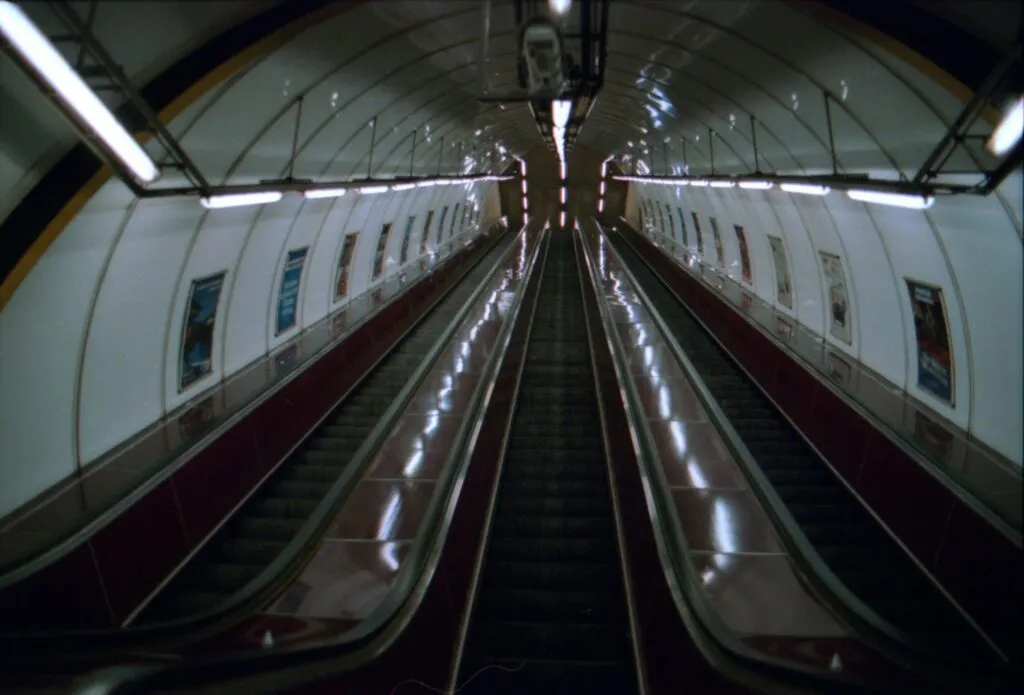
Fun Fact: At around 53 meters deep, Náměstí Míru station on Line A is the deepest metro station in Prague. Its escalator, reportedly 87 meters long, is the longest in the entire European Union: it climbs 43.5 vertical meters over 533 steps, and the ride takes 2 minutes and 21 seconds. Anyone getting on or off here also completes, quite incidentally, the longest escalator ride in the EU.
The 30-minute ticket costs 39 CZK (app 36 CZK) and the 90-minute ticket 50 CZK (app 46 CZK), which is around $1.83 and $2.35. A 24-hour ticket is 150 CZK (≈ $7.05). Children up to 15 and seniors from 65 travel free (as of July 2026).
You buy your ticket through the official PID Lítačka app (by bank card, Apple Pay or Google Pay) or at vending machines and counters. At the metro entrances you can also pay contactlessly with a bank card or smartphone right at the reader. A paper ticket is validated at the machine before the escalator.
Tickets are available from the ticket machines and counters in the stations, and digitally in the PID Lítačka app (published by the City of Prague, available for Android and iOS). For contactless payment at the reader you only need a bank card or a smartphone.
Yes. Children up to and including age 15 and seniors from age 65 travel free in Prague, each with proof of age. People between 60 and 65 pay half fare; a 24-hour ticket costs them 75 CZK (≈ $3.53).
The Prague Metro has three lines: A (green), B (yellow) and C (red), with a total of 61 stations across 65.4 kilometers. They meet in the interchange triangle of Můstek (A/B), Muzeum (A/C) and Florenc (B/C). A fourth, driverless Line D (blue) is under construction.
You will find the official Prague metro map PDF at the top of this page as a zoomable file to download. It comes from the official DPP orientation map and uses internationally legible line colors and symbols, so you can read it at a glance.
The deepest station is Náměstí Míru at around 53 meters. Its escalator, reportedly 87 meters long, is considered the longest in the European Union; the ride over 533 steps takes a good two minutes.
There is no direct metro connection to Václav Havel Airport. The fastest way is trolleybus 59 from Terminals 1 and 2, which reaches Nádraží Veleslavín station on metro Line A in around 15 minutes. Alternatively, bus 100 takes you to Zličín on Line B in about 18 minutes.
You might also be interested in these metro maps – for comparison or for your next trip: