Rome Metro Map 2026: Lines, Tickets & Prices
Last updated: July 12, 2026

Last updated: July 12, 2026
Current Rome Metro Service Updates
ATAC publishes current closures, replacement services and other travel-relevant updates on its official website and in the official ATAC app with real-time information.
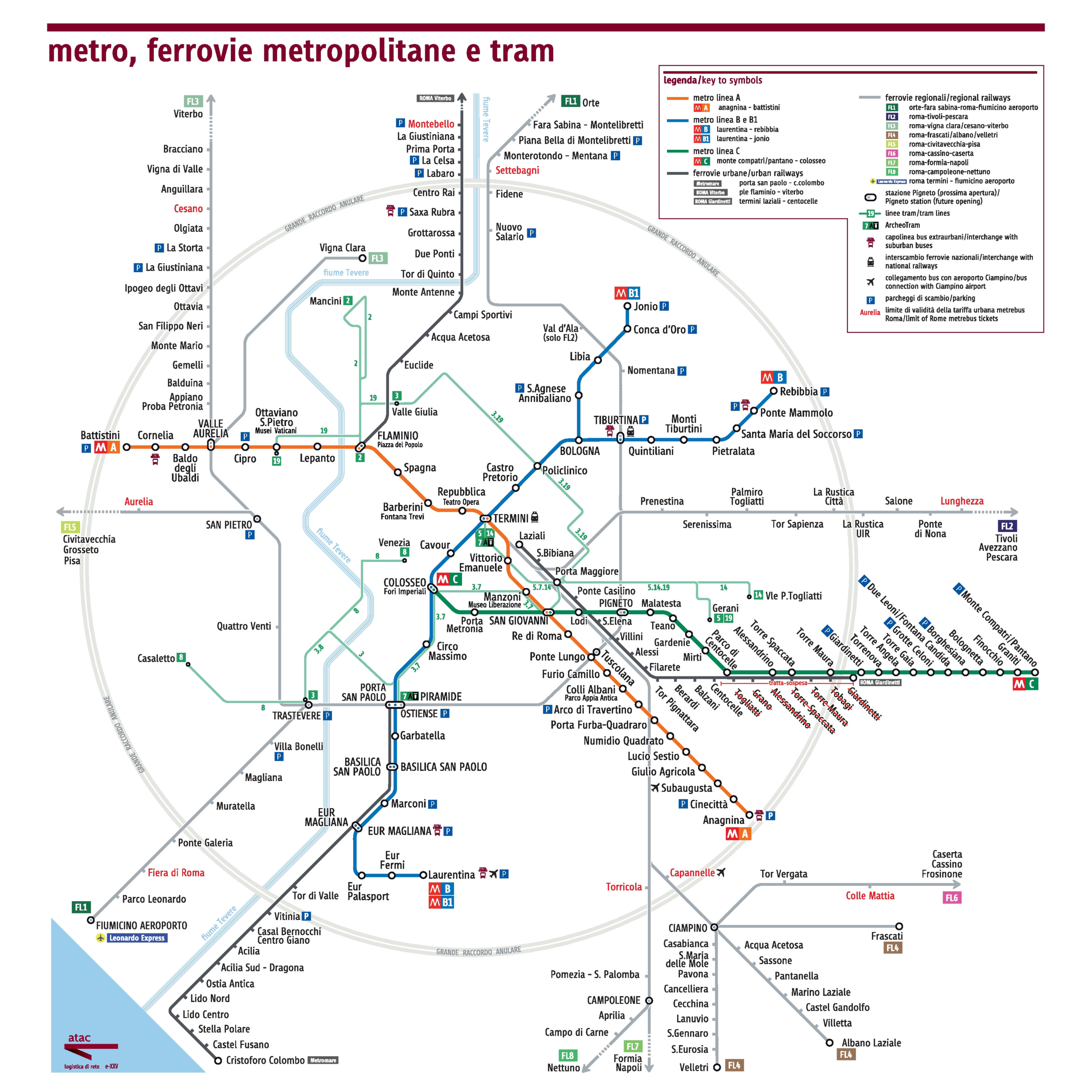
The map above looks surprisingly simple at first glance. That is precisely what makes the system unusual: Rome has one of the smallest metro networks among Europe’s major capitals. The official zoomable PDF above shows lines A, B, B1 and C. This guide explains the 2026 ticket prices, operating hours and airport connections.
The Rome Metro covers about 62.5 kilometers (July 2026; the 2024 municipal statistic lists 59.4 km) and has 77 stations. It is one of the shortest metro networks among the large European capitals. By comparison, the Madrid Metro is the largest network in the EU. Rome’s ancient underground remains and frequent archaeological discoveries make tunnel construction unusually difficult. The system is operated by ATAC S.p.A. (Azienda per la Mobilità di Roma Capitale), with support from Roma Servizi per la Mobilità.
Rome’s first metro route, now Line B, opened on February 9, 1955. Line A followed in 1980, while the newest route, Line C, began service on its first section in 2014. The network carried about 173.3 million passengers in 2024, an increase of 7.3 percent from 2023.
Line C is the network’s technological standout because it is fully driverless. Thirteen automated six-car trains, each 109.4 meters long, can carry up to 24,000 passengers per hour in each direction. It is Italy’s longest fully automated metro line.
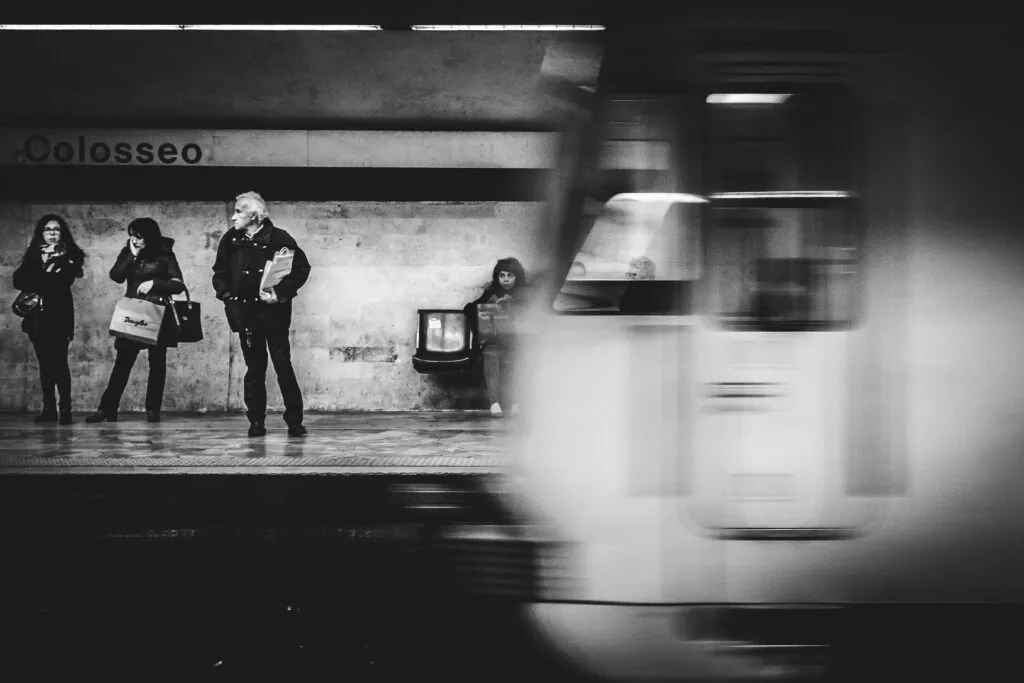
The Rome subway map shows three lines plus the B1 branch. Its colors match the official ATAC map:
The main transfer points are easy to identify on the map. Lines A and B cross at Termini, the central train station and the only interchange between those two routes. Line C has connected with Line B at Colosseo since December 2025, while the interchange between Lines A and C is at San Giovanni.
Rome’s major sights each sit near a specific metro station, listed below by line and stop. Millions of visitors a year use these connections, much like attractions served by the Barcelona Metro:

Rome’s airports do not have a direct Metro connection. From Fiumicino Airport (Leonardo da Vinci), the Leonardo Express runs nonstop to Roma Termini in 32 minutes. The fare is 14.00 € (≈ $15.97; July 2026), with trains every 15 minutes. Departures run from Termini roughly between 5:35 a.m. and 10:35 p.m. and from Fiumicino between about 6:23 a.m. and 11:23 p.m. At Termini, passengers can transfer to Metro Lines A and B.
The regional FL1 train is cheaper but slower. It does not serve Termini; instead, it links the airport for about 8.00 € (≈ $9.12; July 2026) with the Line B connections at Piramide/Ostiense and Tiburtina. The smaller Ciampino Airport has no rail station at the terminal. ATAC buses connect it with Line B at Laurentina and Line A at Cinecittà/Subaugusta, while shuttle buses run to Roma Termini.
| Sight | Line | Station | Note |
|---|---|---|---|
| Colosseum | B and C | Colosseo | Direct stop for the Colosseum |
| Roman Forum | B and C | Colosseo | Same station as the Colosseum |
| Vatican | A | Ottaviano-San Pietro | Metro stop named in the source |
| St. Peter's Basilica | A | Ottaviano-San Pietro | Metro stop named in the source |
| Spanish Steps | A | Spagna | Direct Line A stop |
| Prati and St. Peter's Square area | A | Lepanto | Line A access for the area |
| Roma Termini central station | A and B | Termini | Transfer between Lines A and B |
All fares belong to the integrated Metrebus system and are valid on the Metro, buses, trams and urban rail services. The standard BIT (Biglietto Integrato a Tempo) ticket costs 1.50 € (≈ $1.71) and is valid for 100 minutes. The table lists the main Rome Metro tickets. USD conversions use the ECB reference rate of 1 € = $1.1405 from July 14, 2026.
| Ticket | Price | Buy ticket |
|---|---|---|
| BIT single ticket (100 minutes) | 1.50 € (≈ $1.71) | Available on site |
| MULTIBIT (10 rides) | 15.00 € (≈ $17.11) | Available on site |
| ROMA 24H day pass | 8.50 € (≈ $9.69) | View ticket (Android) / View ticket (iOS) |
| ROMA 48H two-day pass | 15.00 € (≈ $17.11) | View ticket (Android) / View ticket (iOS) |
| ROMA 72H three-day pass | 22.00 € (≈ $25.09) | View ticket (Android) / View ticket (iOS) |
| CIS weekly pass (7 days) | 29.00 € (≈ $33.07) | View ticket (Android) / View ticket (iOS) |
| Annual pass (Metrebus Roma) | 250.00 € (≈ $285.13) | View ticket (Android) / View ticket (iOS) |
Prices checked in July 2026 via ATAC Tickets and Passes. Official app: ATAC Roma for Android and ATAC Roma for iOS.
Which ticket offers the best value? For most visitors the ROMA 24H day pass (8.50 €, ≈ $9.69) offers the best value: it beats single tickets from the sixth ride of the day. The MULTIBIT (15.00 €, ≈ $17.11) for ten rides works out to exactly 1.50 € per ride, so it adds convenience but no bulk discount. For a full week of several daily trips, the CIS weekly pass (29.00 €, ≈ $33.07, or about 4.14 € ≈ $4.72 per day) costs the least per day. Monthly and annual passes are also available.
Tickets are sold at machines in Metro stations, at Tabacchi tobacco shops and newsstands, and through the official ATAC app. A ticket is validated automatically at the Metro turnstile. The gate will open only after a valid ticket has been presented.
The Rome Metro operates from 5:30 a.m. to 11:30 p.m. Sunday through Thursday. On Friday and Saturday nights, the final trains leave the terminal stations at 1:30 a.m. ATAC does not publish fixed headways. Travelers should check the real-time displays in stations or the official ATAC app for waiting times. Current schedules by line are available from Roma Mobilità.
Night service: After the Metro closes, replacement night buses follow the main rail corridors: nMA for Line A between Anagnina and Battistini, nMB between Rebibbia and Laurentina, nMB1 between Termini and Viale Ionio, and nMC between Piazza Venezia and Pantano/Monte Compatri. Under the “Piano Roma Notte” program, the city doubled these services beginning July 11, 2026. Buses now run every 8 to 10 minutes throughout the night from Thursday through Saturday.
Rome’s Metro continues to grow, although construction advances slowly. The latest milestone came on December 16, 2025, when Line C opened the Colosseo/Fori Imperiali and Porta Metronia stations, bringing the line into the historic center for the first time. The new section from San Giovanni is about 4 kilometers long. Work on the next section toward the Vatican, Tratta T2, began on February 25, 2026. Stations such as Piazza Venezia are tentatively planned for later in the decade.
More nearby networks are covered in our guide to the Milan Metro and on the overview of all cities.
Fun Fact: Line C operates without drivers. Automated trains navigate the tunnels independently, while platform screen doors separate passengers from the tracks and open only after a train has stopped in the exact position. Rome’s newest route is therefore also its most modern, even as ancient remains only a few kilometers away continue to slow further tunneling.
A BIT single ticket costs 1.50 € (≈ $1.71) and is valid for 100 minutes. The ROMA 24H pass costs 8.50 € (≈ $9.69), the 48-hour pass 15.00 € (≈ $17.11), the 72-hour pass 22.00 € (≈ $25.09), and the CIS weekly pass 29.00 € (≈ $33.07; July 2026).
Tickets are sold at station machines, at Tabacchi shops and through the official ATAC app. On the Metro, present the ticket at the turnstile to validate it and open the gate.
Yes. The Rome Metro consists of three lines: A, B with its B1 branch, and C. It is operated by ATAC and supplemented by an extensive bus and tram network and regional rail services.
The Metro runs from 5:30 a.m. to 11:30 p.m. Sunday through Thursday and until 1:30 a.m. on Friday and Saturday. Night buses nMA, nMB, nMB1 and nMC then serve the same main corridors.
Yes. Metrebus tickets are valid on the Metro, buses, trams and urban rail services. The BIT is valid for 100 minutes after validation and includes one Metro or rail journey plus any number of bus or tram rides within that period.
There is no direct Metro link. From Fiumicino, take the Leonardo Express for 14.00 € (≈ $15.97) to Termini in 32 minutes and transfer to Metro Line A or B. From Ciampino, buses connect with Lines A and B.
You might also be interested in these metro maps – for comparison or for your next trip: