Amsterdam Metro Map 2026 – Timetable, tickets & prices
Last updated: September 30, 2026

Last updated: September 30, 2026
Yes, the Dutch are true masters of logistics. How else would they have managed to build half a state by reclaiming land below sea level? The Dutch also live the planning order in the metro system of its capital Amsterdam.
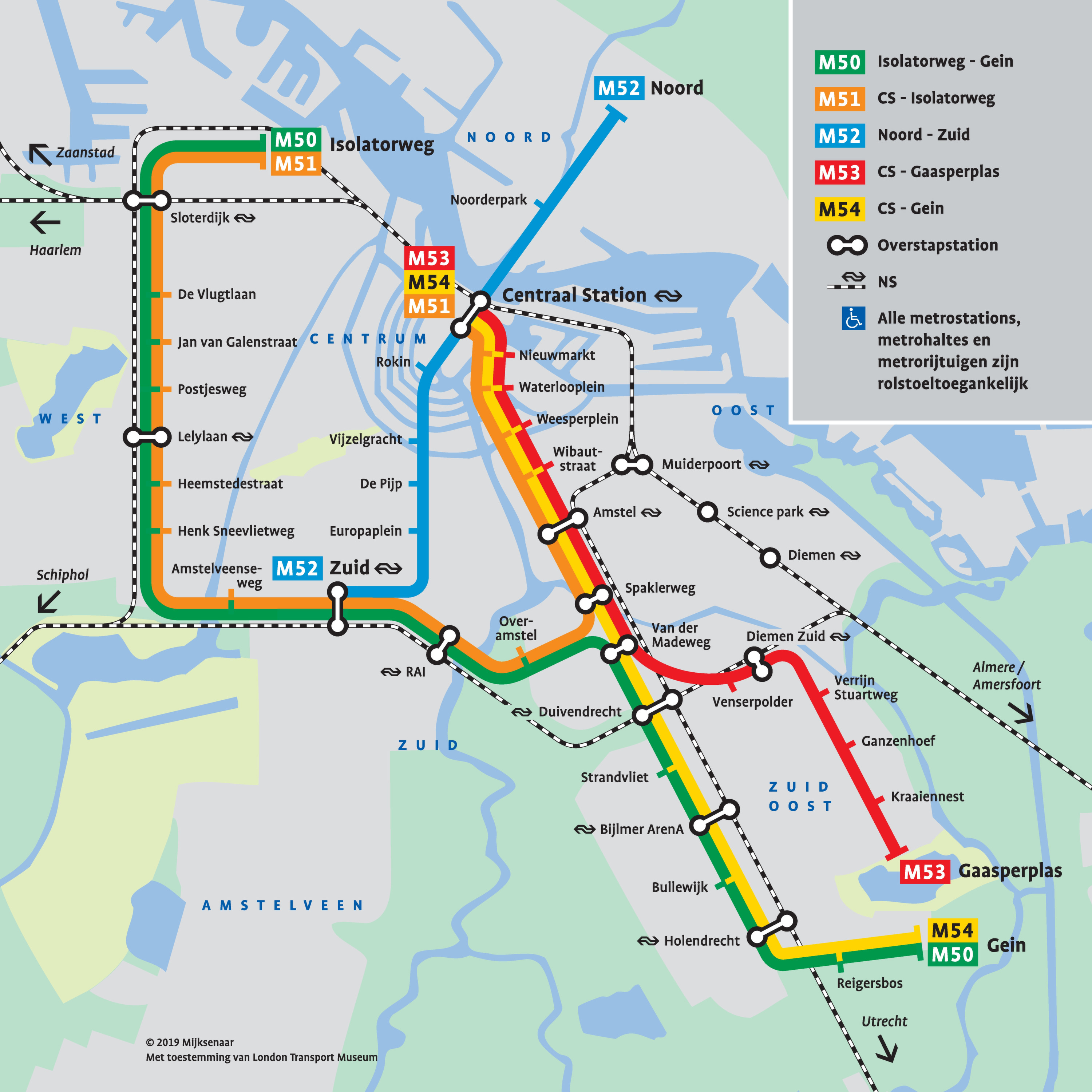
The Amsterdam Metro, operated by the municipal transport company GVB, opened in 1977 and is therefore the youngest subway system in the Benelux countries. The underground system planned on the drawing board currently extends across the capital with five lines and 39 stations and recorded around 111 million journeys in 2025. For a long time, a special feature of the Amsterdam metro was that it was not a pure metro system but a mixed system of four metro lines and one light rail line (Sneltram); since 2019, the former light rail line M51 has run as a full metro line between Isolatorweg and Centraal Station. Nevertheless, the five lines on the Amsterdam Metro map are easy to recognize thanks to their clear colour coding. Another special feature of the Amsterdam subway is its 39 stations, most of which are above ground.
With around 24 million visitors in 2024, 10 million of them staying overnight, the Dutch capital remained a very popular destination. This shows that Amsterdam remains a popular travel destination, which of course also has an impact on public transport. Due to tourism as well as the influx of commuters and students, the Amsterdam metro has developed into the backbone of public transportation in the canal metropolis.
A ride on the subway is especially worthwhile for vacationers, as the city is served very systematically by one north-south line, one ring line, two east lines and one west-southeast line. This makes the metro the ideal means of transportation for sightseeing, especially as you can reach the Rijksmuseum Amsterdam from Vijzelgracht and the Paleis op de Dam from Rokin; trams serve the Anne Frank House and the Van Gogh Museum.
Since all stations are displayed with names before they are reached, travelers on the Amsterdam subway do not have to remember any cryptic number or color codes. Getting to and from Schiphol Airport, on the other hand, is a little more complicated, especially as it is not yet directly connected to the subway network. To get into the city and connect to the subway, take the train from the airport station towards Centraal Station. Alternatively, take the Amsterdam Airport Express (bus 397).
The municipal transport company GVB uses one standardized ticket system for all of its own services. Metro tickets can also be used on GVB trams and city buses, and vice versa. A single ticket is valid for one hour from the first check-in. Single tickets and day tickets (1 to 7 days) are available at GVB service desks and, with the exception of the child day ticket, at GVB ticket machines. At GVB service desks you can pay with cash or card; depending on the machine, cash or card may be accepted.
While many subway systems in Germany manage without turnstiles at the entrances to subway stations, in Amsterdam you have to check in first. All you have to do is take the ticket and hold it up to one of the readers directly in front of the entrance to the metro platforms. After arriving at the destination station, it’s time to check out, as this is the only way to open the metro gates.
| Ticket | Prices | Buy tickets |
|---|---|---|
| 1 ride ticket (1h) | From €3.40 | available on-site |
| Daily ticket (24h) | From €10.00 | available on-site |
| Child day ticket (24h) | From €5.00 | available on-site |
| Daily ticket (3 Days) | From €21.50 | available on-site |
| Daily ticket (7 Days) | From €43.00 | available on-site |
| Amsterdam Travel ticket | From €20.00 | available on-site |
| "I amsterdam City Card" | From €67.00 | available on-site |
Although day tickets are ideal for exploring Amsterdam, the GVB also offers other special tickets for tourists. For example, the Amsterdam Travel Ticket is valid for 1 to 3 days. It is valid on all GVB metros, trams, buses and night buses as well as on the train and the Airport Express (bus 397) between Schiphol Airport and Amsterdam. Culture-hungry travelers are in an even better position with the “I amsterdam City Card“. In addition to free use of GVB services for 24 to 120 hours, it offers access to more than 70 museums and attractions in the city.
Amsterdam’s metro lines are almost similarly timed on nearly all routes, which makes getting around the city much easier for out-of-towners. The metro runs daily from around 6:00 AM to 12:30 AM. As the ring line, the M50 connects Isolatorweg and Gein without crossing the city center.
On weekdays, lines M50, M51, M53 and M54 run about every 10 minutes from 7:00 AM to 6:30 PM, every 12 minutes until 8:00 PM and every 15 minutes after that. The M52 runs more often: every 5 minutes from 7:00 AM to 9:00 AM and from 4:00 PM to 6:30 PM, every 6 minutes in between and every 7.5 minutes in the evening.
Timetables for the Amsterdam metro lines:
On Saturdays, the 10-minute interval applies from 9:00 AM to 6:30 PM, on Sundays from 11:00 AM to 6:30 PM; before and after that, the subway trains run every 12 to 15 minutes.
Because the metro in Amsterdam stands still at night, travelers have to rely on alternative means of transport. In addition to the numerous cabs on site, night bus lines are available to bring night owls home. GVB night buses N85 and N87 run every night, usually hourly and more often on weekend nights; other lines such as N81 to N84 only run on Thursday, Friday and Saturday nights.
The M52, which opened in July 2018 after around 16 years of construction, is Amsterdam’s newest metro line, but it is to be extended again in the future. The plan is to extend the M52 via Schiphol Airport to Hoofddorp; the project still lacks around €1.8 billion, and no opening date has been set. The parties involved expect the direct connection of the airport to the Amsterdam Metro Map to make arrival and departure more comfortable and, above all, faster for travelers and commuters.
Fun Fact:
If you get bored waiting for the metro in Amsterdam, take a good look around the metro stations. After all, there are treasures worth seeing waiting for curious eyes in some places. At Rokin station (M52), archaeological finds recovered during excavations in Amsterdam are on display.
Yes. The Amsterdam Metro has five lines, M50 to M54, and 39 stations. The M51 runs between Isolatorweg and Centraal Station.
On weekdays, M50, M51, M53 and M54 run about every 10 minutes from 7:00 AM to 6:30 PM; the M52 runs every 5 minutes at peak times. The metro runs daily from around 6:00 AM to 12:30 AM. After that, night buses N85 and N87 run every night, with additional lines from Thursday to Saturday.
Schiphol has no direct metro connection. From the station beneath the terminal, an NS train reaches Amsterdam Centraal in about 17 minutes; you can change to the metro there. Bus 397 leaves Schiphol Plaza, stop B17, every 10 minutes for Museumplein, Rijksmuseum and Leidseplein; a single bus ticket costs from 6.50 euros.
A GVB one-hour ticket costs 3.40 euros, a day ticket costs 10.00 euros and a child day ticket costs 5.00 euros. The one-hour ticket is valid on GVB metro lines, trams and city buses, but not on NS trains or night buses.
With OVpay, check in using a contactless debit or credit card, smartphone or smartwatch, and check out with the same payment method at your destination. You pay by distance: in 2026, a journey costs a base fare of 1.16 euros plus 0.217 euros per kilometer.
You might also be interested in these metro maps – for comparison or for your next trip: